Psychology of Belief

I’ve been discussing the relative merits of a scientific world view versus faith, with Lesley over on her blog. To clarify my view, basically how I get to my world view, I’ve added a couple of posts on this blog:

Contingency of Knowledge – How I get started, about what I can know.

Human Fallibility – Why we have to be careful about what we conclude.

Lesley has responded today with this post on Human Fallibility.

The distinction I would make, between our two positions, is as follows.

What Lesley is describing are the effects of actually believing, some of which are good, but others bad. The problem is that choosing to believe on faith leaves people open to persuasion or even indoctrination, and the way that goes, good or bad, seems to be the luck of the draw. If it goes the wrong way then faith can be used to justify awful behaviours.

The other side of the distinction between religion and a scientific approach is that the critical thinking that is promoted on the science side encourages self-analysis to an extent that faith doesn’t – some Christians being exceptions rather than the rule.

As a result of this, another bad effect of faith is that it provides justification for avoiding the effort to think too much. This can be carried over to other areas of human interaction, where it’s easy to let a view on marriage, sex, law, education, or politics, be so guided by one’s religion that it’s natural to just decide on the basis of what your own religion or you local or personal spiritual leader says. But this is often disguised by the fact that some critical thinking does go on, but only within the framework of the faith – the faith trumps reason.

Further, though each religion may recognise the existence of other religions it tends not to scrutinise them too publicly, too critically, particularly in a multi-cultural society like ours, because, I think, that there is genuine apprehension about exposing it’s own inconsistencies. This leads to an odd form of cultural relativism within religions that is somewhat like the left wing secular cultural relativism – where for the latter, you say anything goes, and for the former, you keep quiet about uncomfortable differences because of the uncomfortable similarities. We end up with daft compromises, like Rowan Williams on Sharia, in order to maintains one’s own privilege.

Here is a guide that demonstrates potential problems with thinking processes, with particular reference to belief in God. It’s a little bit geeky, but if you can get through it, it should shed light on what I think is wrong with religious thinking.

Psychology of Belief, Part 1: Informational Influence

Psychology of Belief, Part 2: Insufficient Justification

Psychology of Belief, Part 3: Confirmation Bias

Psychology of Belief, Part 4: Misinformation Effect

Psychology of Belief, Part 5: Compliance Techniques

Psychology of Belief, Part 6: Hallucinations

And, here’s another quick guide.

Top 25 Creationist Fallacies

Like all theories based on psychological research there are often controversies and new research results, but generally these modes of influence on thinking are well recognised, and identifiable in much religious discourse. Some of the above are also associated with logical fallacies in reasoning.

Of course this requirement for critical thinking applies to our side of the debate too. We too are human and not immune to error, and have to listen to criticism fairly.

Human Fallibility

[This is part of a set: Thinking]

From my previous post, on the contingency of knowledge, I’ve arrived at the point where our working model is that we think with our minds and we have senses to sense the natural world.

But on closer examination, by our minds, these senses appear to be fallible, so we concoct methods for gaining confidence in particular sense experiences. On even closer examination we discover that our reasoning and other cognitive faculties can also be fallible, so we take steps to account for that observation too. So all we can do is construct experience and look for multiple ways of confirming what we experience to gain confidence in it, to give credibility to it, to compensate for the fallibilities. When we do this rigorously we call this science. Science gives us the best and most reliable explanation of our cognitive and sensory experiences, accounting for and accommodating for our fallibilities the best it can.

Note that this is an entirely inductive experience, from the particular to the general. It is true that induction lies on top of no firm and absolute foundation. An inductive argument indicates some degree of support for the conclusion but does not ensure its truth. So, just to make it clear, none of this is offered as a proof! Of anything.

For any of the detail along the way we might use deductive reasoning, which is often thought to be more thorough than induction, more concrete. This does not mean that deduction is always the better choice. Deduction is fine if you construct a valid argument; and if you have true premises then you have yourself a ‘sound’ argument, the most sure argument there is. But it’s an illusion to think you can have a sound deductive argument at the limits of philosophy, in metaphysics – you can never be sure your premises are true! Why? Because all we have are our thoughts and our senses – we have no prior premises and arguments upon which to build our starting premises. So, if someone tells you they have a proof that, say, God exists, it’s baloney, because it always relies on presupposition, and the presupposition can’t be guaranteed to be true. If someone wants to offer you ‘evidence’ for God, that’s a different matter and should be treated seriously.

We are fallible human beings. The very best we can do is accumulate data, examples, lots of them, and compare them and subject them to any tests we can. We create hypotheses, of which Richard Feynman said they could just as well be guesses. Any old random guess won’t usually do – we could be here forever checking every possible hypothesis – something some theists think atheist are claiming (and what Pirsig mistakenly thought was a problem, in ZAMM – more of that in another post). Of course we base hypotheses on prior experience that appears to work. This is induction and science in action.

Science concludes (this means best explanation so far, not we’re absolutely certain) that according to our senses and reasoning there is a physical world out there. It gets a bit quirky sometimes – e.g. quantum physics – but so far nothing has been found to refute this tentative conclusion. I mean, really, nothing! You have to consider what it would mean to refute this. You would have to find something that isn’t physical. This is a tall order. Before sub-atomic particles were figured out the world was still physical. Discovering the sub-atomic particles didn’t introduce some magic into the universe – it was simply that we discovered something we didn’t know was there before, but is still considered part of the physical universe.

This is what will happen with any ‘paranormal’ effect or ‘energy’ that might exist. If it exists, then when it is found, that is when there is evidence of it, then it too will become a part of our physical description of the universe. The reason the paranormal is ridiculed so much isn’t because we know it to be false absolutely, it’s that fantastic claims have been made, but no evidence has been found to support them.

Astrology? No evidence. And further more, many of these ‘crank’ pseudo-sciences, are actually shown not to fit with scientific ideas that have much more support. The moon clearly has an immediate impact on our lives, with the tides; and has influenced us over a long evolutionary period. The other planets contribute to the stability of the solar system, and provide attractors for debris that might otherwise come our way. A supernova going off too close would have a significant impact too. Some cosmic events could wipe out life on our planet. But the suggestion that the particular arrangement of planets and stars at the time of our birth has some impact on the formation of our individual character? No only is it a dumb idea, but we now know of many more personal localised biological, psychological and sociological influences that are involved in the formation of our character. Astrology is a good representation of how bad ‘mystical’ nonsense can be – it doesn’t even rate as pseudo-science.

Evidence is the route to discovery and the support and maintenance of ideas and theories and facts. No evidence? Then it might as well not exist.

Not, you note, that it doesn’t exist! Science does not have to assert that anything in particular does not exist. It only says to what extent there is evidence to support an idea or the existence of something.

In everyday life, if we can’t see it, taste it, feel it, etc., then we might as well act as if it doesn’t exist, even if it does, for how can we tell the difference. We can happily go about our daily lives as if the speed of light does not have a limit, because in our daily lives we never reach that limit, and where it does impact on our lives, we are usually ignorant of it. Many cities around the world are built as if earthquakes don’t exist, because in those regions they rarely experience any of significance – and yet on a larger scale, for thos eliving in safe zones, we not only know they exist but we consciously participate in relief for those that suffer from them.

The extent to which reality affects us has some influence over how much we live as if some aspect of relaity exists or not. So, what about God?

We can ignore God as an entity because whether he exists or not makes no apparent difference. And even based on reason alone, so many varieties of teleological entities can be dreamed up, the limited theisms of the religious don’t really cover the bases they are trying to protect. And as for actual effects, … prayer does nothing to the event being prayed for, and has only psychological effects on believers. This means that despite the fact that theists can’t prove God exists and atheists can’t disprove it, it’s irrelevant, because there is no evidence, and that’s sufficient. We can act as if God does not exist because there is no evidence that such an entity does exist.

Many theists realise this and no longer require the existence of God as an entity ‘out there’ – See Rob Bell (h/t Lesley’s Blog). But that doesn’t mean theists have dealt with the problem of human fallibility in relation to faith. I’ll get to that in another post.

Of course, those people that believe God exists do themselves exist, and they do have an impact on the reality of the rest of us, which is a bit of a nuisance at times.

Contingency of Knowledge

[This is part of a set: Thinking]

I’m an atheist who is an atheist as a consequence of where science leads me – my atheism is a working conclusion rather than a presupposition, and certainly not a faith. I’m occasionally asked how I get to that point, so this is where it starts.

I like to take the track credited to Descartes and his Cogito[1] – I think therefore I am; or, if I’m thinking I can only conclude that something is doing the thinking, and that something I’ll call ‘me’. I’m not claiming this as a proof that I exist, but I am saying that it is the only evidence available to me that I exist. Feel free to criticise this; but it would be helpful if you could provide an alternative that is as all invasive as the experience that I am having of thinking.

I’m not sure what it would mean, what the consequences would be, if I were to say I am thinking but it’s not me, it’s something else thinking these thoughts, or, that my thoughts are an illusion (but what is it that is having the illusion of thinking), or that there is no thinking going on full stop.

So, based on this thinking experience, I accept the experience that is ‘thinking’, i.e. I think. I’ve had some people tell me this is my presupposition, but I don’t think it is, I think it’s a direct experience that I can’t refute.

Next I notice some senses, some apparent external inputs from some apparent external world – I see objects and people, I hear them, they appear to respond when I talk to them. Is this a phantom world created by my mind? Is there only thinking? This solipsism is a distinct possibility, I can’t deny it. Trouble is I can’t for the life of me tell the difference between the solipsism of imagined senses and real actual senses. Since that’s the case I’ll continue from here by choosing the arbitrary path – that my senses are real inputs from the external world, external to my thoughts. It’s important to realise that this is an arbitrary choice because I can’t tell the difference, I can’t refute solipsism.

Form there, through these senses, imaginary or real, I accept the discovery of other people who appear, according to my senses, to have the same experiences – at least that’s what they tell me. Not being able to refute any of this my basic working model, my working philosophy, is that we all exist and interact as our senses show us and our cognition (mind) understands us. This experienced world is the one we know as the physical world, or natural world, that applies to all of us.

At this point we can’t say to what extent our mind and senses report on the real, actual, universal, ultimate reality (or whatever you want to call it) that’s out there. We can’t even be sure there is such a thing. So note again the contingency of our position: we only think that we have a mind, and with this thinking mind we think that we have senses, but can’t be certain, and if we do have senses we think that they show us something of reality, but we’re not sure, and we don’t even know if this reality exists. But despite how contingent, how flaky and inadequate this position is that we’re in, it’s all we’ve got!

Next, I want to cover how humans deal with thinking about stuff in the light of these limitations: Human Fallibility.

[1] Cogito – Note I don’t consider too many of the options that Descartes does, because I can’t figure out what to do with them. And since nobody else takes us any further than this I am left to take from it what I’ve stated above.

Secret Agents

In many of the arguments about God and mind-body dualism there is the underlying notion of agency, or of an agent – an entity that has some autonomous control of its actions, some intent (i.e intentionality). If we can challenge the notion of agency then we can take a different view of the universe.

Dualists have an appreciation of the mind as something distinct from the physical brain. This dualism may be adapted to create the similar notion of the soul, as used by religions. The mind or the soul is the agency that to some extent or another exists or emerges out of the human brain and body; and familiarity prevents us accepting that we are totally physical entities.

This notion of mind, soul, or even self, conscious self, identity, seems to be a natural instinct that on the face of it appears difficult for the physicalist to explain. What seems clear to a physicalist, particularly one that also accepts Darwinian evolution as a satisfactorily explained process, is that this notion of agency has been projected, extended, by human creative imagination, to hypothesise the existence of gods. But from the physicalist evolutionary point of view there seems little doubt that this God is made in man’s image, not man in his. God is a construct of the human imagination.

If we imagine and follow the developmental and evolutionary path, from physical inanimate objects, to the first replicators, through simple life forms, lesser animals, mammals, primates, and on to man, it is clear that there is no evidence of any mechanism, or any intervention, that suddenly switches on or enables agency. Agency, like free-will, and consciousness, are illusory, so the physicalist hypothesis goes. They are simply hypothetical models of complex systems in action. The fact that we, in the complex biological process of responding to our environment and our current inner physical (chemical and electrical brain system) state, respond as if we are agents, as if we have free-will and consciousness, is merely an efficient mechanism that helps us to operate.

Watch the video clips of the ‘insects’ created by Robert Full’s and other teams. I challenge you not take an inner or explicit gasp as you inevitably look on these machines as being alive in some crude sense – that is your agency recognition system kicking in and recognising agency where there is none. We recognise agency in ourselves, in other animals, in some robots, in cartoon characters, in toys. We are built to perform this recognition of agency.

Did I say “We are built to perform this recognition.”? See? “We are built…” We are not built, in the active sense that someone built us. That’s precisely the point. We can’t help but think in this way. Richard Dawkins did the same throughout his book The Selfish Gene – his actual words, the title, imparted apparent agency upon genes, when of course this is precisely what he didn’t intend. We use phrases implying agency all the time, even when that’s exactly what we are arguing against. The phrase “We evolved (intransitive) to do …” itself could be interpreted as “We actively, through our own will, evolved (caused) ourselves to do …”, or as “We were evolved (transitive) by the agency of Evolution itself to do …” Our language is so evolved to inherently assume agency we have to resort to quite contrived language to describe the physicalist view without agency. So, when talking about something I do, to make it clear there is no intention and free-will in my action I have to resort to words like, “This complex responding organism (me) responded in such a way…”

Agency is a vehicle that gets us through the journey of life efficiently and quickly. But we need to get out of this vehicle now and then and ruminate in the grass, stroll through the woods, take in the view. Once we park agency on the road side we can proceed to walk carefully through life examining in more detail the arguments that tell us that agency is all there is, and just suspend that notion. Simply review the arguments as if there is only physical stuff; put agency to one side.

Some theists will happily tell you how necessary God is to explain the physical universe – he’s the first cause, he’s infinite, etc. But let a physicalist propose that the universe might be infinite, or that there might be multiple inanimate universes, with no agency, and the theists will ask how this is possible. They will raise paradoxes that physicalism appears unable to explain. But there really is no difference between any hypothesised cause of the universe, whether it be theistic or physicalist – except for the presence or absence of agency. Both theists and physicalists have to struggle with the fact that they don’t know what lies beyond the known; we don’t know if it’s infinity all the way or not; it’s hard enough to be sure that the concept of infinity has any significance, any reality. So, the only difference between any proposed God creator and an equivalent non-theistic beginning is the presence of God as the agent.

But if there is no concrete evidence for agency’s instantiation, no evidence of it springing into existence, then there is really no argument for it existing outside the universe, as God. And since we are the only agents we do have evidence for, if we figure we are complex stuff but not agents, then there is no known concrete evidence of agency anywhere.

Now, having said all that I’m still happy to use terms like agency, free will, consciousness, mind, etc., as creative notions, as convenient models, for complex physical systems and processes, like ourselves. I’m happy to say “evolution built us this way” without any teleology implied. It’s how I’ve evolved to think, so I can’t help it.

Wager On An Atheist’s God

Getting bored with arguing with theists, I thought it might be easier if I just give up and join the club. I’ve been trying to find a God hypothesis that comes close to working for me. There are none out there that completely satisfy my needs.

Though I’m not prone to believing God stuff without evidence, from my point of view it is legitimate to concoct hypotheses and check them against what my reason and senses tell me. Here’s one.

There is a God. He created the universe as we have come to know it through our senses, reason and science. He wanted nothing more than to create a universe to see what would happen. He is not omniscient, so he was curious. Being alone, but otherwise a good scientist, he is very hands-off and observational.

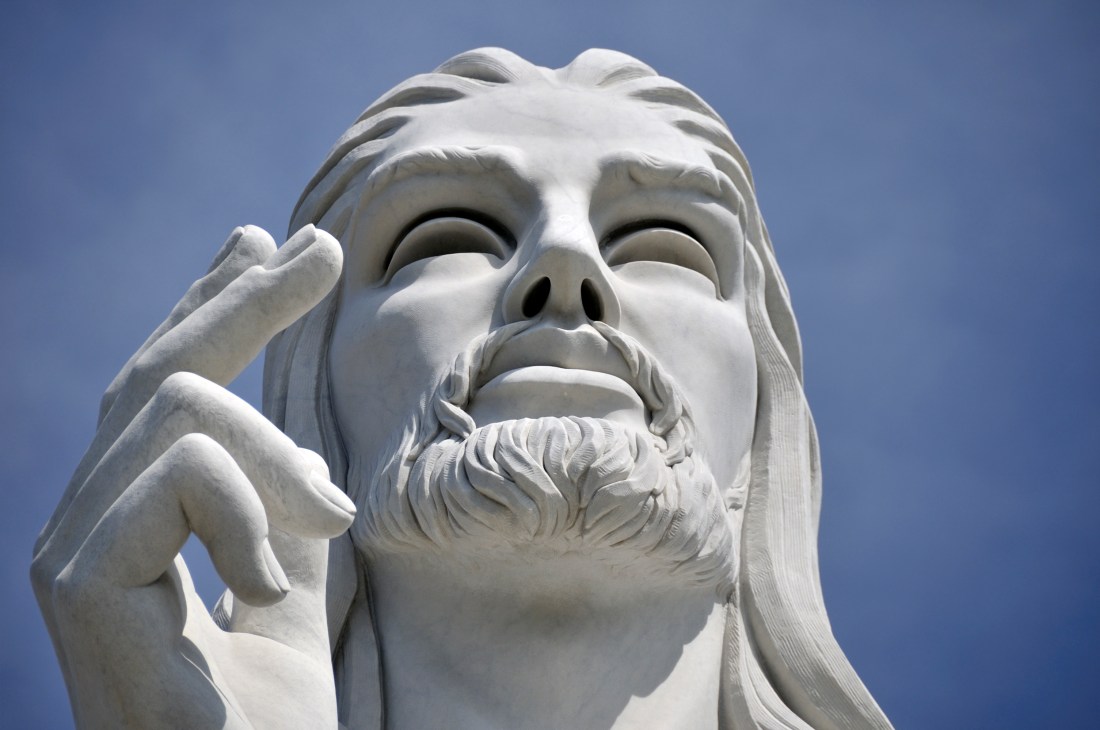
Jesus Statue
“Look, I know you don’t exist, right, … but if you did …”

Continue reading “Wager On An Atheist’s God”

God On My Mind – BBC

This new programme from the BBC pulls together some strings from evolutionary biology and neuroscience to attempt to explain religious and other beliefs.

I think these programmes will only be available to UK listeners, but if I can find a transcript I’ll put up a link.

From the programme information…

Part 1: Evolution:

We are programmed by our genes to believe in supernatural powers and to obey moral codes. Is this because it gave our ancestors an evolutionary advantage? Iranians, Scandinavians, Papuans, chimpanzees, twins and wedding rings offer some startling answers.

Part 2: Neurology

Almost half the population claim to have felt the presence of a power beyond themselves. But what happens in the brain during religious experiences? If magnetism can produce visions, then what price mysticism and meditation? What’s the difference between sainthood and schizophrenia? And why are many believers convinced that God speaks to them in their dreams?

Political Islam

There may be plenty of British Muslims that are perfectly peaceful, want nothing more than to be allowed to follow Islam on a personal basis.

But that isn’t where the trouble for democracy lies. This Telegraph article, and this Channel 4 Dispatches programme, show the real intent of many ‘politicised’ Muslims. But it’s not as if being ‘politicised’ is restricted to a few fundementalists. Islam is both a religious and a political movement, and it’s long term intentions are made clear over and over again. And the concept of infiltrating organisations that have views or policies that are incompatible with Islam (i.e. with Sharia) with the intent of taking control and applying Sharia wherever they can, is perfectly compatible with the long term aims of Islam.

Pay attention!

Thin Blue Line

Are you worried you know nothing at all about our environmental problems? Do terms like Greenhouse Gas, Climate Change and the like have you concerned, but you simply don’t understand how basic atmospheres work and how important they are to life? Then check this programme out while you can.

Thin Blue Line, Brian Cox, BBC iPlayer

This is probably one of the best popular explanation of why we need an atmosphere that’s appropriate for life, and how fragile atmospheres can be. There’s no doom mongering, just pure unadulterated enthusiasm for how our planet’s atmosphere works. In the context of other planets and moons you get a real feel for how special our planet is, and why we should consider, at the very least, what we are doing to it.

They’re Up The wall

The BBC news report on Women of the Wall shows the hypocracy of the religious mind, and the lack of a sense of humour that makes them fail to spot irony.

“…rabbi Ovadia Yosef denounced women’s prayer groups that wear the tallit at the Western Wall as acting to promote a feminist cause and not out of piety.” – A well-put pious argument rabbi, and not at all promoting male domination of the relgion, eh?

And, don’t the women get it? They’re claiming unfair treatment on religious matters in a society dominated by dogmatic relgious males? Why bother. Pick a relgion where women are already treated as equals – granted you’re going to have to skip all the mainstream religions. Sod it, become atheists.

Some Notes on Theism

I’m prompted to write this post as a general account of my opinions about the existence of God in response to an exchange with Aaron on Sam’s blog: Comments. In particular I wanted to respond to this comment by Aaron: “At the very core, Christianity is nothing more than following Christ. The word itself means simply one who follows Christ’s teachings. All of the sacraments, all of the ritual, all of the dogma is man-made artifice that is at times either helpful or harmful to a given individual or even to the world at large.”

There’s nothing new in what follows; it’s just a summary of my views on the subject of theism in the above context.

I don’t find anything wrong with following the teaching of any particularly wise person, but is it really likely that all the professed teachings of Jesus were all his own work? Even if it could be shown that many of the teachings of Jesus were attributable to his followers and biographers that wouldn’t necessarily diminish the wisdom inherent in the teachings.

But anything in addition to this is where my problem with Christianity, and theism in general begins.

First, to make Jesus anything more than simply a mortal teacher requires the presupposition of God. This presupposition is at the heart of all the main monotheistic religions. Without an initial God everything else fails, theistically. Theists sometimes argue that atheists aren’t in a position to comment on some aspects of theology that they haven’t studied, but without the presupposition of God the theology is worthless.

I find no rational reason to presuppose God. I have not seen one single argument supporting theism that doesn’t presuppose this, for any of the God religions. And this brings me to the degree of my ‘agnosticism’ or ‘atheism’ as discussed with Aaron. The metaphysical idea that a God is one possible cause of everything is fine, but that’s all it is, an idea, a concept, with no more weight than any other metaphysical idea. I could equally presuppose two Gods, and infinite number of Gods, or no Gods, a single once-only universe from nothing, a cyclical single universe, multiple parallel universes, metaphysical ideas that have mathematical support and those that don’t, and even pure fantasy universes – metaphysically, anything goes. So, in response to Aaron, I am ‘agnostic’ to the extent that the God hypothesis is one of many, and I am ‘atheistic’ to the extent that I don’t find the God hypothesis a particularly convincing one. I’m so unconvinced I’m prepared to accept the label ‘atheist’.

Without presupposing God it becomes necessary to say why one would think there is a God.

All the so called proofs of the existence of God, the ontological, teleological, cosmological, and other ‘logical’ arguments are all based on some unsupportable premise, that is usually based on some human intuitive requirement that there should be some cause, that it should be intelligent, and that it should be loving. God is made in the image of the best of what we would like to be, not we in his image.

Terms such as ‘infinite’ and ‘perfect’ are often used in relation to God. These are mere concepts that are useful in describing something beyond what we can see, measure or reach. There is no reality to them, as far as we know. There’s no good reason that they are attributes of or have anything to do with God.

Discussions about the ‘probability’ of any of these possible ideas, and in this context that there might or might not be a God, are metaphysical speculations and have no mathematical basis to take them any further. In order to calculate probabilites about God’s existence we need information we just don’t have.

Some theists don’t require proof or evidence or probabilistic likelihood, since they find some ideas ‘obvious’, when considering these issues. For example, it’s ‘obvious’ there must be a ‘loving’, ‘intelligent’, ‘omnipotent’, …, creator. To such a theist I’d ask the following. How would you know that? How many universes have you witnessed being created to come to that ‘obvious’ conclusion, deductively or inductively? What experiences do you have, on the scale of universes, that make you think this or any universe requires a creator at all? And as for ‘His’ attributes, how would you know what they were? Revelation? Well, revelation presupposes there’s a God to do the revealing, as opposed to there having been a number of fallible humans through the ages that have misunderstood, willfully lied, or been deluded about revelatory events. There’s that presupposition again?

Another approach theists sometimes take is with respect to what might be called ‘ways of knowing’. When all the rational arguments have been put forward – basically saying there’s no evidence or proof that God exists and so we should act as if he doesn’t – theists have been known to question the appropriateness of these arguments, by questioning the ways in which we can know things. All I want to say for now on this is that the best and most useful ways of knowing consist of supporting our personal experiences with rational critical and sceptical thought and, when appropriate and possible, employing what is commonly know as the scientific method. I accept that when we follow this path the best we can hope for is the accumulation of common experiences that give us some grasp of how things work, and to a limited extent why they work; but I also accept that in no way does that lead us to any ultimate and absolute truth about anything; it only provides us with a degree of confidence. What about meditation and other ‘spiritual’ ways of knowing? As far as I can see, moving to what is essentially a different mind-state is no different than chewing on magic mushrooms – anything goes; and there’s no reason to suppose anything valuable or real is being revealed.

Yet another idea that theism embraces whole heartily, and which is also a necessity for some non-theists, is the requirement for purpose or meaning. I think this idea is often behind the ‘obvious’ discussed above. But there is no requirement that the universe, or any part of it (i.e. us), should have any purpose or meaning. This need that some people have for there to be purpose and meaning in the universe at all is a quirk of human nature, akin to the need to bite ones nails or pick ones nose or scratch an itch. Can I prove this? No, but the parallels are sufficient to explain it without conjuring up an agent such as God.

Now, I can accept a ‘concept’, call it God if you wish, as an aspiration, a goal to which we would like to aim; but it’s entirely a human construct – it certainly isn’t theistic in the usual sense, and not even deistic. In that respect it’s a form of Humanism. I think that this is what some versions of Christianity have come to be, though I can’t understand why there remains the insistence on the truth of, say, the resurrection, or even the continued association with Christ.

Much of this aspiration for the unreachable perfection is fine. But because we can’t actually reach it we have to settle for less. And that ‘less’ that each person settles for is subjective. I don’t have a problem with different individuals or groups of people deciding that they think they should live by certain rules, constructing their own morality – I’ve seen no evidence or good argument for objective morality. And I think it makes sense that as a society (and collections of societies) that we should agree that compromises have to be made – we can’t all have our own particular moral codes enforced just as we choose. The problem with religion in this respect is that it has aimed for the heady heights of the infinite and the perfect, and has decided there is a real God, and has then interpreted its own subjective moral codes as being determined by this fictitious character. All theistic religions, and sects within religions, and individuals within sects, all have their own take on what God is, to what extent he interacts with us, to what extent he commands us, or requires us to worship him, etc. Religion is probably the most variable and subjective of human enterprises, in terms of what is believed, and yet often its adherents claim to have access to absolute and invariant truth. This is pure nonsense.

Take any individual, whether it be Jesus, his apostles, Mohammed, the Pope, or anyone claiming to be divine or to have been in touch with some divine being, or to have received a message, a revelation; take any of them; any claim they have made can be accounted for by down to earth explanations. But, you might say, at least some of the claims could be true. Well, how would you know? How, in fact, do you distinguish between a truthful claim about the divine and any of the many consequences of simple human frailty: mistakes, dreams, delusions, lies, intuitions, group-think, etc. There is no known way of making such a distinction, and since ultimately all supposed sources of divine information result from such claims, one way or another, they must all be seriously suspect, at the very least. Add to the shear variety the fact that no matter which religion you follow, and no matter how dedicated you are and to what extent you submit yourself and obey the commands and pray, there’s not a damn bit of difference made in this world. From the most pious to the most ‘sinful’ – not a jot of difference that anyone has demonstrated.

All that pretty much takes care of my view about God. I think it’s a strong case. I’d be happy to expand on any individual points, or to consider any angles I haven’t already. I’d even believe in God if I thought there was sufficient reason.

The ABC Of Putting Your Foot In It

Lot’s of coverage of ate ABC’s comments this week. I think Julian Baggini got it wrong on this one. Funny comment though, “People often say how intelligent Williams is, but I think they confuse intelligence with being thoughtful, well-intentioned and in possession of a fine beard.” You can imagine Blackadder delivering such a cutting line, which is coincidental since Sky News attributed the ABC’s comments to Rowan Atkinson (ht:The News Quiz).

Most of the other contributors on the Baggini blog topic made the case well enough.

God Releases Linux (Unsubstantiated)

I could quite easily fit my understanding of science into any religious view – God can do anything, so he made the world this way, and even made atheists to challenge my faith. Once I believe in magic I can invent anything. It’s all down to the premises; so that a valid argument can be claimed to be a sound argument, or I can simply claim that it’s beyond reason and the premises stand alone unchallengable.

I could quite justifiably, by the absolutist religious view, believe that in fact there is a God. But my God isn’t omnipotent, though he is omnibenevolent … this world is his software development project.

Linux Earth 1.0 – Code Name ‘Genesis’ – He spontaneously came into existence about 20 billion years ago, came up with a plan for our universe, and currently we are its latest enhancement.

Linux Earth 1.1 – Code Name ‘Jesus’ – He’s really sorry about the crappy mess he’s left us in, and has wanted to atone – that’s why he created a representation of himself as Jesus. That got a little weird, so he added a patch:

Linux Earth 1.1.1 – Code Name ‘Crucifixion Patch’ – He hadn’t anticipated our design flaws, so we screwed that up for him. An online compaign was started by fans of the 1.1 version that there was a resurrection bug.

Linux Earth 1.2 – Code Name ‘Islam’ – He tried again with Mohammed, but that was a real viral cock-up.

Linux Earth 2.0 – Code Name ‘Enlightenment’ – Eventually he settled on the Enlightenment. It was always going to be difficult – unlike his future creation Microsoft he decided to avoid any pretence at compatibility with previous versions – it was his Linux, and it had its own flaws, but did have certain benefits in that it wasn’t proprietary, it was open source! Anyone could contribute and everyone could benefit. As with all good projects the Enlightenment is an ongoing development, new anti-religious security patches are being contributed by many sources. He hopes to eventually convert all customers. And there’s an incentive for existing and upgrading customers alike – a free pass to heaven, where you’ll be met by Steve Jobs with some great gifts.

Unauthorised code branches: ‘Gold Plated Linux’ by rogue programmer Joseph Smith; ‘Scientology’ or ‘Gullible Celebrity Pseudoscienctology’, by RLH.

I suppose if I believed the above I could be aspect blind, in that I don’t see how my premises upon which it all stands can be at fault. But I’d KNOW I’m not wrong, wouldn’t I? Any objections?

Aspect Blindness and Personality

I wanted to note these points here following the reading posts by Ibrahim and Sam on the following blogs:

Sam:
http://elizaphanian.blogspot.com/2008/01/muscles-metaphors-mysteries-on-grokking.html
http://celticchimp.blogspot.com/2008/01/wittgenstein-and-aspect-blindness.html

Ibrahim:
http://stephenlaw.blogspot.com/2008/01/latest-response-to-ibrahim-lawson.html

The charge that atheists suffer from Aspect Blindness regarding religion can be just as easily, if not more so, directed at the religious.

I think part the absolute commitment to the religious view is part of one’s personal makeup, but put more generally it is a consequence of certain personalities.

I have had experience of religion. I was raised a Christian, I had doubts in my teens but wasn’t fully aware of the strength of the atheistic alternative (I was agnostic), and eventually came to realise the flaws in the religious view. But, I’ve been around enough religious people to recognise several types. Some are religious by default, as JustBrowsing describes. Some really are strong unquestioning believers that simply reject any alternative, with some element of fear, either of the spiritual consequences, or simply of the unknown. Many are what I’d class as ‘troubled’, in that they desperately want to find something spiritual as a source of comfort and guidance because they have some sort of difficulty with the basic physical world and what they see as all its nastiness – such as crime and ‘evil’, or natural disasters, things that from my point of view I can classify simply and naturalistically as “some people aren’t nice to each other” and “shit happens”. I’m not troubled by the world and its problems and the fact that I can’t fix them all. I’m not saying I’m heartless or fearless – I feel deeply disturbed to witness human and animal suffering, and I’d be as scared as the next person if I were mugged; but I can put these things into context so that I’m not fretting every minute of the day. I don’t become depressed with the state of the world or my personal life. I do have a driving need to learn new stuff, but I’m not disturbed by the lack of answers.

In some cases the religious view is one of ‘blind faith’, the outright unquestioned denial of the possibility of an atheistic view. But in many case I’d describe faith more as ‘tunnel vision’ or ‘aspect blindness’, rather than simply ‘blind’, as a consequence of personality, where critical reasoning is accepted and used, but sufficiently distorted and abused to affirm the religious view.

Maybe I have personality issues that drive me towards a critical questioning and a general scepticism that results in my atheism, and maybe it’s difficult for me recognise it in myself. I’m open to analysis, by professionals or amateurs.

It might be said that I’m this way because I haven’t had a religious experience, and that if I had I’d know. I can’t refute this categorically, but by the same token how am I supposed to know? And how would anyone else know what I have and haven’t experienced? Maybe I have similar ‘spiritual’ experiences, but just as people have different thresholds of pain I have a low threshold of the ‘spiritual’ experience. Maybe that’s all it boils down to, different strengths of ‘zap’ in the brain, and that the brains of those that perceive a stronger ‘zap’ interpret it all anthropomorphically as some superior presence. How would you tell the difference between that and a real religious God invoked revalatory event?