16,000 Out of Ten Billion Processors Prefer Cats

Wired reports on cat recognition. Two wins here: cats are the best; and evolution beats ID.

Google’s mysterious X lab built a neural network of 16,000 computer processors with one billion connections and let it browse YouTube, it did what many web users might do — it began to look for cats.

The “brain” simulation was exposed to 10 million randomly selected YouTube video thumbnails over the course of three days and, after being presented with a list of 20,000 different items, it began to recognize pictures of cats using a “deep learning” algorithm.

Take that ID suckers! If a few thousand processors can do this, then a few billion years for evolution to result in systems that recognise and operate in their environment (i.e. life) is a snip. The BBC reports:

The work of the team stands at odds with many image-recognition techniques, which depend on telling a computer to look for specific features of a target object before any are presented to it.

Damn! I’ve been using the Godly method of divinely commanding my software to work, when all the time I should have used evolutionary techniques. Note to self on next sales pitch:

Here’s a computer. Here’s some random code I threw together. Give it a try, and let me know how it goes. It should figure itself out eventually. Disclaimer: being evolutionary, when it does eventually work there’s no telling what it will work at.

On second thoughts, that does sound a little like how I work.

Supernatural v Natural

The notion that the Supernatural itself ‘exists’ is unsupported – equally unsupported no matter what the Supernatural metaphysics may be: gods, ghosts, fairies, wizards, …. But let’s go with the fantasy.

The question of the interaction between the Supernatural and the Natural raises its head occasionally, and it has been doing the rounds again, and specifically the question of whether the Supernatural is beyond the reach of science. So, supposing for now that there is a Supernatural, what can we know about it?

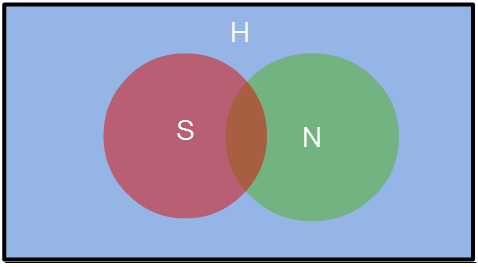
If the supernatural (S) is distinct from the natural (N), and they do not overlap at all, then what are all the religious claims based on? By this definition of non-interaction Natural human religious entities (theists) cannot experience the Supernatural; and since there are no interactions from S to N we don’t get any miracles to reveal the Supernatural either.

The only way the Natural human religious entities could experience the Supernatural is if there is some interaction between S and N.

So, one interaction might be that the human Natural entities have some Supernatural component that interacts with (witnesses) the Supernatural (e.g. the soul).

Another interaction is one whereby the Supernatural entities (e.g. God) have the capacity to act on the natural world. This is presumed to be the case, since He is supposed to have created the Natural in the first place.

But all interactions we know of in the Natural world are two-way. Cause and effect are mutually connected. So, for the soul to witness Supernatural experiences and transmit them to the conscious mind it must alter the conscious mind. It is the conscious mind of the theist that is making the claim of having an experience.

Both types of interaction are open to investigation by science.

Theists having religious experiences, being ‘in-touch’ with the divine, must be able to be tested. And the results of those tests must rule out (to some reasonable degree) any alternative natural cause for those experiences. All known religious experiences can be explained in terms of known psychological effects that are, at the very least, as feasible as a Supernatural explanation. Given how many alternative Supernatural or otherwise mystical explanations are offered by a multitude of cranks and variations on the religious you’d think the religious, wanting to be certain they are right, would be very concerned by these competing claims – but that’s where faith is required: belief’s cocoon of denial.

Theists claiming Supernatural effects on the Natural also clearly have some explaining to do. All modern claims are testable, and many have been tested and found wanting: faith healing, intercessionary prayer. Nothing. And any historical claims to miracles are sufficiently suspect by virtue of the period of ignorance in which they were made. Any theist who gives credibility to the resurrection must give equal credibility to fairies, imps, goblins, demi-gods, dog-head people, sea monsters (the least incredible), vampires, … Theists have no more grounds for believing in miracles than they do in any other crazy story. But, then again, faith (in one’s own beliefs) comes to the rescue of the reality deniers: no number of suspect mystical entities is sufficient to cause one to suspect one’s own.

So, either S and N interact, and those interactions are testable. Or they don’t, and all theism is just made up crap by Natural entities that have no access to the Supernatural in either direction. I mean to say, if the Supernatural is inaccessible to science, then it’s damned well inaccessible to a few fruit cakes who like to recite chants to their Supernatural Superheroes. So, theists, take your pick. Heads I win, Tails you lose.


Just to throw a spanner into the works, have a closer look at the Venn diagrams above. What’s all that empty space around the Supernatural and the Natural? Should the diagram be more like this?

Well, why should it? If theists can lay claim to the Supernatural without evidence, then I think I’ll go for the Hypernatural (H). You know, home of Hypernatural Thingymabob, that all encompassing thing that created all Supernatural creators of universes, the Thing that created God and gave Him the power to create the Natural.

How far does this stuff go on? Does the Hypernatural interact with the Natural, or just the Supernatural? Is there a Superhypernatural?

Is this getting silly? It already got silly, a few thousand years ago. And as we become more rational and sceptical, and are able to see the Emperor’s clothes for what they are, the whole religious show becomes an obvious invention of imaginative minds.

It’s one thing to hypothesise about the metaphysics of the origins of the universe, or maybe to make guesses about what is required to form an intelligent entity, and whether some such thing caused specific universes to come and go. But that’s all it is, guess work.

Far easier to let everything lie under one roof. It’s Natural all the way. Even the stuff that seems mysterious now will either one day be explained by Natural means, or will remain mysterious – but only in the sense of remaining unknown. Whatever the origins of our universe and any other, when or if they become known to us, they will be investigated, theorised about, and will take their place in our expanding field of Natural knowledge.

The strong nuclear force is something we discovered, or invented, or modelled, however you want to put it. It is now used to explain the interaction between particles in the nucleus of atoms. It was not once Supernatural and then suddenly Natural. Rather, it was once an unknown Natural phenomenon and is now a known Natural phenomenon.

The Primacy of Thought

A few recent blog posts have raised the issue of the primacy of thought, particularly these two:

John Loftus at Debunking Christianity quotes James East in this post.

Mike D at The A-Unicornist on this post.

The problem for me with theism, and some philosophy, is the primacy given to the mind and a failure to appreciate how humans, and all animals, are inherently constrained by our senses: Thought v Experience.

The trouble with ‘thinking’ is that by the time we humans started to do it reasonably well a lot of evolutionary water had passed under the bridge, but we had no clue about our sensory non-thinking heritage, so our point of view was skewed. It’s as if we came into the world as a fully formed thinking entities or souls, that just happened to reside in a corporeal body. The mental awakening of an individual human as they grow from childhood to adulthood is also a metaphor for the awakening of the species. So, quite naturally I think, we discover we can think and presume this is our greatest capacity, and not knowing its limitations we come to think the mind has some powerful ability to discover knowledge all on its own. Our very familiar relationship with our own minds, our subjective experience, is so overwhelming that it clouds our view so that we see it as the be-all and end-all of knowledge acquisition. This is the source of our conviction to the primacy of thought.

Here’s James East expressing this very experience (as quoted by John Loftus. My emphasis):

I was a Christian for nearly 20 years – starting as a young teenager, after being raised in a “very Christian” family. By the time I was able to think for myself, I basically believed everything already, so it was only natural to accept the salvation that was on offer when it finally clicked.

And here’s Articulet’s reply (my emphasis again):

Yes – boy can I relate! And don’t feel ashamed for falling for Christianity – probably most of your favorite people have – and most of the smartest people you know. But these are the memes that have survived through time.

In the extreme we have characters like Alvin Plantinga who suppose, for no good reason I can see beyond the persistence of ‘memes’, that we have mental capacities that are reliable routes to truth, when really we have no idea what ‘truth’ is.

Science has a limited practical interpretation of ‘truth’, which basically is the degree of correspondence between our various methods of discovery – so even in that sense ‘truth’ is not the all-or-nothing truth of logic. Epistemology is a mess because it is supposed that there is some real achievable certain ‘truth’ to be found, some absolute certainty out there waiting for us to discover, perhaps in the mind of God, that imaginary essence of truth itself, by virtue, maybe, of our sensus divinitatis.

I remain surprised that some otherwise bright people cannot grasp the link between our acknowledged fictions, and cannot recognise religious thinking for what it is: imagination allowed to run free and unconstrained by the senses.

Our thinking ability is more limited than we tend to think. Some of our recent ancestors will have had an even more limited capacity to think (and we see that in many of our existent cousins); and distant ancestors would have had no nervous system at all. But all of them, right back to the simplest celled organisms, have had a sensory interface with the world, even if it’s a simple chemical boundary. We are still, biologically and evolutionarily, sensory beings. Our evolutionary upgrade, a thinking brain, is an enhancement I’m sure; but a recent one that we are still learning to use. But it is useless in its own right, when acting alone. Try growing a brain in a child deprived entirely of senses and see what happens. Empiricism rules: we are sensory beings with an added capacity to analyse what we sense, to recognise patterns, to plan, to predict, to test again.

Common sense experience alone should be sufficient to tell us our senses and our reasoning are flawed. Our naturally developed faculty, our human knowledge acquisition system, our empirical nature, is only improved by the rigour of science. Even where science is still justifiably criticised as flawed, it’s still the best we can do. Science is, after all, practised by a flawed empirical system – the human being. All claims to ‘other ways of knowing’ have no foundation beyond wishful thinking. There’s only this one way of knowing, succinctly described as empiricism, but more rigorously practised as science. We can do it poorly or we can do it well, but that’s all we can do. We have no other faculties available to us that we know of.

We all acknowledge the human faculties of intuition and insight, but those that would put such faculties above science still don’t really get where these faculties fit in. Science uses them – that is scientists use them. They are part of the whole human knowledge acquisition system. But these faculties are also known to be suspect. The point being that science, the rigour of science, is the application of methodologies that weed out the useless intuitions and explore and expand on the good ones. In contrast to this approach the religious in particular, and some philosophers, are content to accept their intuitions without question, or at best only with questioning that also lies within the framework of their dogmas and schemas. They insist on this primacy of thought.

I feel that the failure to recognise this is why many theists and philosophers have been historically, and still are, so committed to the mind and the imagined capabilities attributed to it: reliable logical reasoning, freedom from bias and emotional drives to believe what we want to believe, a capacity to transcend the skull through thought alone, the ability to communicate with an imagined super being, the reliance on notions like faith. Until they grasp this view of what we are, our empirical nature, they will remain stuck thinking they have some pure, and possibly divine, route to knowledge through the mind alone.

Of course we could deny this empirical nature of ours, but to start down that road we would have to deny first the evolutionary theory that tells us this is how we got here from pre-thinking ancestors, and how this is the type of being we are. And once on that path, eventually, any significant contribution of the senses can be ditched. If the mind is really the route to knowledge, then the end of the line is solipsism. I can’t refute the solipsism hypothesis, but I’m content with not needing to.

Zeno’s Paradoxes of Motion

Zeno’s Paradoxes crop up occasionally. There are several paradoxes labelled as Zeno’s. Two of these are: Achilles and the Tortoise, and, the dichotomy paradox (or the race course paradox)

These are all basically the same sort of problem, about breaking down motion into an infinite series of ever smaller steps.

The runner of a race goes like this:

A runner starts running the length of a race track. At the half-way point he has covered half the distance, with half remaining. When he gets to half the remaining distance he still has the other half of that second distance remaining. At each ever shorter half-way point he has covered half the distance remaining, but always has half the distance to complete. This continues, with next half-distance remaining, indefinitely. He never completes the race. But, we know runners do finish races. This is supposed to be a paradox – two ‘truths’ that are incompatible:

  • The runner never completes the race ‘theoretically’, because he forever only completes ever smaller half distances.
  • The runner does complete the race, because we see him complete it.

The problem is with the first ‘theoretical’ presentation.

What’s actually happening, with the runner of a race, is we tend to assume him to be traveling at a constant speed S, and yet the never ending half distances make it appear that he never completes the race. Paradoxical? Only if you think of a normal runner at constant speed, while thinking of this runner with each half length taking the same time.

Constant Speed

Supposing that we look at his position, x, at times, t, and X is the length of the track:

x0, x1, x2, x3, …, xn, x(n+1), …
t0, t1, t2, t3, …, tn, t(n+1), …

The difference between each is:
dxn = x(n+1) – xn: dx0 = x1 – x0, dx1 = x2 – x1, …
dtn = t(n+1) – tn: dt0 = t1 – t0, dt1 = t2 – t1, …

The paradox tells you that dx is being halved each time, but may neglect to tell you that if the runner is moving at constant speed then dt is also being halved each time:

dx1 = dx0/2, dx2 = dx1/2, …
dt1 = dt0/2, dt2 = dt1/2, …

The time intervals are halving too.

So, the speed is still constant: dxn/dtn = S, period to period.

Constant Time Intervals – Reducing Speed

The other view of the paradox, the one presented when looking at the detail, thinking only about the distances, leaves you with this impression:

dx1 = dx0/2, dx2 = dx1/2, …, dx(n+1) = dxn/2
dt1 = T, dt2 = T, … where T is constant. If the paradox is expressed with the intention of declaring a never ending race then this will be stated explicitly.

So, s the speed is halving each step:

sn = dxn/T = dx(n-1)/2T = s(n-1)/2

which would take infinite time to complete.

So, what you think you’ve got is a half-life-like expression: where the distance is asymptotic to the end point and never actually reaching it, in principle:

Stopping Time, or Never Ending?

Once the constant speed distance intervals become smaller than a part of the runner’s foot, and the time intervals become smaller than we can detect, he seems to become stationary. You’ve stopped time – it’s as if the runner can never complete the race. But of course you are supposedly looking at the runner in real time (in your mind’s eye), while being able to see these ever smaller distances and times, as if you see him stop. But in reality, at constant speed, these smaller intervals flash by in real small times and we do see the runner complete the race.

With the constant time intervals the runner actually runs slower and slower in real-time. Again he appears to become stationary because each interval (let’s say T = 1s) his distances are really getting smaller and smaller each second. Asymptotically, in principle, he never reaches the end – or, more specifically, the total time (the sum of all the T’s), extends indefinitely with the number of intervals. He would have to run so slow as he approaches the end that he would again appear to freeze.

Finite sum of a convergent infinite series

Another way of looking at the (correct) constant speed scenario is by summing intervals.

Assume the total distance is 100m, and the time taken to travel the distance is 100s. The speed S is:

S = 100m/100s = 1m/s (Ok, so he’s 10 times slower than Carl Lewis on his first 10s 100m)

Normalised to unitless 1 (i.e. 100m = 1 and 100s = 1) this becomes:

S = 1/1 = 1

The paradox states each distance interval is halved, and in total you have a finite sum from an infinite series:

1 = 1/2 + 1/4 + 1/8 + …

The same must apply for the time intervals:

1 = 1/2 + 1/4 + 1/8 + …

So, again, the speed is 1/1 = 1.

If Ttot is the time to complete the race: Ttot = S/X

Then half the distance at constant speed: Th = Ttot/2

The series view is then:

Ttot = Th + Th/2 + Th/3 + …
Ttot = Th + Th(1/2 + 1/3 + …) = 2Th

Infinite sum of a divergent infinite series

For the constant time interval we have a divergent series:

So, the times at each x are:
x0, x1, x2, …
0, T, 2T, …

or

Ttot = T + 2T + 3T + … -> infinity

For a more detailed look at the maths of all this try these pages from S. Marc Cohen at Washington.

Conclusion

What we are led to believe is that we have a paradox concerning a single type of motion, with contradictory results. But it is simply two definitions of the motion of travel, neither of which is explicit in the statement of the paradox, and neither of which is problematic in isolation.

Some formulations may state explicitly that the time intervals are constant – in which case there is only one single description of motion, and you just have to avoid the trap of having the motion of a constant speed runner in the back of your mind to avoid coming over all paradoxical.

So, it’s not a real paradox:

“a statement or proposition that seems self-contradictory or absurd but in reality expresses a possible truth.”

The ‘paradox’ contains two actual truths masquerading as a self-contradictory single truth, or a single truth that you have mistaken for two. You have been conned.

Getting Real

Constant speed
We could object that it takes time to accelerate at the start of a race (even at 10m/s), but the example here just simplifies the case of a variable speed natural runner. You could change the definition of the race, so he accelerates to 10m/2 before x0, and decelerates after passing X.

Constant Time Periods
The constant time interval is even more unrealistic. There is a difficulty with infinitesimal distances, even in the case of the constant time intervals. The atom on the tip of the runner’s nose is sufficiently large to jiggle back and forth across the finish line as the runner is halving his speed on approach to the finish. And good luck with dealing with this as you approach the Planck length.

Half Life:
In practice the half life of a piece of caesium isn’t infinite. A mole of caesium contains 6.022 × 10^23 atoms – which is a finite number, so it would eventually decay to zero.

But, it is a thought experiment after all, and philosophers, even back in Zeno’s time, weren’t too hot on thinking through thought experiments. Don’t get me started on ‘the heap‘.

It’s True! – Harry Redknapp

I posted on the nonsense that is the It’s True! claim, which theists are apt to use directly themselves, or which is the basis of the supposed truth of their religious books – that the books contain words proclaiming the truth of the books. LOL!

Well, of course religion isn’t the only source of this stunning[ly useless] argument. It turns out that it’s a favourite defence of the guilty in a court of law, and no doubt some innocent people too, when they become desperate.

Harry Redknapp used this very move in court yesterday. The story so far, from the Guardian piece

Redknapp and the former Portsmouth owner Milan Mandaric, who both deny two counts of cheating the public revenue, have told the court that the $145,000 paid in May 2002 and a further payment of $150,000 in May 2004, were paid by Mandaric as “seed money” for investments to be made on Redknapp’s behalf.

Here, from the BBC

Under cross examination on Thursday, Mr Redknapp said he lied to reporter Rob Beasley about the source of payments to the account because he did not want negative stories ahead of a cup final.

The Tottenham boss said: “I have to tell police the truth, not Mr Beasley – he’s a News of the World reporter.”

So, he lied to the reporter, but he didn’t lie to the police and he didn’t lie in court, honest. It’s true!

Remember, Hitler put his signature to the Munich Agreement, of which Chamerlain said on arriving home to England, “This morning I had another talk with the German Chancellor, Herr Hitler, and here is the paper which bears his name upon it as well as mine…“. Churchill didn’t buy it, “We have suffered a total and unmitigated defeat… you will find that in a period of time which may be measured by years, but may be measured by months, Czechoslovakia will be engulfed in the Nazi régime.

Of course, Hitler subsequently, metaphorically, wiped his own arse with his copy, and flushed.

All gullible people please take serious note! Liars will not only lie, they tell you they are telling the truth when they are not! It’s part of what they do. It’s what it is to be a liar! When someone says, “It’s true!“, without further justification, then you not only don’t have to believe them, I really recommend you ignore their proclamations and seek evidence of the truth.

Which of Harry’s truths is a lie? Because they are inconsistent. He claims he lied to the press. But if he admits to lying there, can he be trusted now?

Well, perhaps this is convincing, from the Metro newspaper…

Harry Redknapp - Not a liar
It’s true!

The Spurs football manager was even reduced to shouting from the witness box at prosecutor John Black QC.

“You think I put my hand on the Bible and told lies?” he exclaimed. “That’s an insult, Mr Black, that’s an insult.”

No Harry, it’s his job. The whole point of this hand on the Bible bollocks (funny how religion is in on the lies again) is that it doesn’t work, except when told to the gullible. If you are innocent of the charges Harry, the Bible won’t help, and if you’re guilty, the hand on the Bible isn’t working.

“Everything I have told you is the truth, the whole truth, and nothing but the truth, so help me God…”

“I am not a liar.”

Well, that’s that then. Case dismissed? FFS!


Post Script…

Harry is currently manager of Tottenham Hotspur Football Club, who denied my beloved Manchester City a place in the Champions League three years ago, though we turned the tables last year. They are now one of the serious contenders to our title hopes this year.

But, Harry is a great football manager, and Spurs are a great club that I actually like. I have no idea whether he’s guilty or not – that isn’t the subject of this post. So this post is in no way biased. Honest! It’s True, I tell you, it’s true!

It’s True!

Great Jesus & Mo cartoon again.

The best bit, and the most crucial bit that applies to all religious books is number 1:

1. This is true

This is the one and only necessary assumption in any religion to make it worthy of the name. It must declare its own truth. Of course (snigger 🙂 (more smugness to come) we all know this is pure bollocks don’t we.

I get regular visits from Jehovah’s Witnesses. They are really nice people (at least to ones who visit me are). I think they like me and return often for the following reasons:

(a) I don’t slam the door in their faces;
(b) they haven’t converted me yet, so I suspect, like a lottery rollover, my cache goes up with each rejection;
(c) the religious are masochists (why else invent sin and then admit to bing up to the neck in it).

Anyway, I keep two things handy for when they call.

The first is a copy of Darwin’s On the Origin of Species. They always quote from it incorrectly and it’s an easy book to show them they’ve been misled. They do go through some other topics, such as DNA, irreducible complexity, but I usually wing it once we get past Darwin, because it would take too long to go through any book to convince them (“Let’s start with basic chemistry…”). I know, it’s wrong of me, but I argue from authority of knowing just a bit more about this stuff than they do. As much as I can make points against Behe’s arguments generally, if they brought him along as a guest doorstepper I might be screwed on the biology, because I’m not a biologist.

But I digress, again. The second, and most important thing I keep nearby is a piece of paper, oh and a pen – so that’s three things I keep near by, but you know what I mean.

And on that piece of paper I write words to this effect:

This paper contains the word of God as revealed to Ron Murphy. If you’re here while he’s writing this you too must bear witness to this miracle. Now, as your God I command you to ignore the Bible, Koran, gold tablets and any other bollocks you may have come across telling absolute crap about me. I can swear by the way. I am God after all. Though the atheists got it wrong, they got it wrong for the right reasons – they don’t believe any old crap in a document claiming to be the revealed truth. What sort of fucking argument is that?! Anyway, on this occasion it happens to be the truth. However, I’ll forgive you not believing it if you throw it in the bin. On one condition: you throw your crappy book in the bin too and start thinking for yourself.

No, I don’t really write all that, I just feel as though I want to. A sentence or two is usually enough to make the point.

But, miracle of miracles, their faith survives even this cutting blow. What the fuck can I do?

I thought perhaps I should show them the fabulous Morwenna Banks, from that brilliant series Absolutely.

This for me says everything about religious imaginative invention. It encapsulates millenia of theology as Little Girl rationalises uncertainties and contradictions in what pops into her head.

And her punch line:

It’s true! I know because I do!

And Little Girl here provides us with the best accommodationism I’ve ever come across: Genesis plus Evolution! It’s true!


And this is what you get when It’s true! is put into practice. Enjoy!

The Rescue of Philosophy of/in Science

[This is part of a set: Thinking]

I obviously don’t mix in the right internet circles. For some time I’ve been seriously disappointed by what I’ve seen of modern philosophy. It’s so exasperating, and I’ve come across so many examples, that I’ve not had chance to blog about them – while I’m contemplating one, up pops another to get my goat, and in the end they pass me by.

I’ve managed to make some points, here: Plantinga, Law, Coyne: Theology, Philosophy, Science, here: Philosopher Stephen Law Doesn’t Get Science, here: Thought v Experience.

But there are plenty more examples out there, of how philosophy isn’t keeping up with science in the interesting stuff of metaphysics. It’s too much to expect of any fallible human, which accounts for all humans, that those of us who are philosophers should be perfect thinkers, just because thinking is their speciality. So we do have to cut them some slack.

Well, it’s not all bad. This piece, What Happened Before the Big Bang? The New Philosophy of Cosmology, tells us how philosophers are doing their bit. It starts with this, which carries the sentiments of may scientists:

Last May, Stephen Hawking gave a talk at Google’s Zeitgeist Conference in which he declared philosophy to be dead. In his book The Grand Design, Hawking went even further. “How can we understand the world in which we find ourselves? How does the universe behave? What is the nature of reality? Where did all this come from? Traditionally these were questions for philosophy, but philosophy is dead,” Hawking wrote. “Philosophy has not kept up with modern developments in science, particularly physics.” [my emphasis]

Ross Andersen tells us about groups of philosophers in the US and UK who are staking a claim for philosophy, which is good news. There’s a real place for philosophy in both pushing the boundaries of thought, in going where science is yet unable to, and for scrutinizing science itself, and scientists that do science, to make sure their critical thinking skills are on the ball.

Ross talks to Tim Maudlin, at NYU, who puts Hawkins in his place.

Tim doesn’t reveal anything here that I’ve not already heard from scientists. Some scientists are pretty good at the philosophy associated with their subject. Lawrence Krauss, Peter Atkins, Sean Carroll, Neil deGrasse Tyson, …, there are a ton of popular scientists who tell it like it is, or how it seems it might be, without wondering off into the realms of fancy that many philosophers tend to do.

But the project seems like a good idea, so I’ll have to dig deeper and keep an eye on them.

Here’s one bit where, for me, Tim gets it dead right:

Now, one can first be a little puzzled by what you mean by “how likely” or “probable” something like that is. You can ask how likely it is that I’ll roll double sixes when I throw dice, but we understand the way you get a handle on the use of probabilities in that instance. It’s not as clear how you even make judgments like that about the likelihood of the various constants of nature (an so on) that are usually referred to in the fine tuning argument.

This is a point I’ve tried to make to a few fine tuning enthusiasts. We don’t have the first clue as to what’s required in the universe manufacturing process. We don’t know a damn about the probabilities involved.

And this:

Now let me say one more thing about fine tuning. I talk to physicists a lot, and none of the physicists I talk to want to rely on the fine tuning argument to argue for a cosmology that has lots of bubble universes, or lots of worlds. What they want to argue is that this arises naturally from an analysis of the fundamental physics, that the fundamental physics, quite apart from any cosmological considerations, will give you a mechanism by which these worlds will be produced, and a mechanism by which different worlds will have different constants, or different laws, and so on. If that’s true, then if there are enough of these worlds, it will be likely that some of them have the right combination of constants to permit life. But their arguments tend not to be “we have to believe in these many worlds to solve the fine tuning problem,” they tend to be “these many worlds are generated by physics we have other reasons for believing in.”

“I talk to physicists a lot” – Wow! This is what we want to hear. That can’t be said of many philosophers, and even less for many theologians.

Tim finish with this:

I will make one comment about these kinds of arguments which seems to me to somehow have eluded everyone. When people make these probabilistic equations, like the Drake Equation, which you’re familiar with — they introduce variables for the frequency of earth-like planets, for the evolution of life on those planets, and so on. The question remains as to how often, after life evolves, you’ll have intelligent life capable of making technology. What people haven’t seemed to notice is that on earth, of all the billions of species that have evolved, only one has developed intelligence to the level of producing technology. Which means that kind of intelligence is really not very useful. It’s not actually, in the general case, of much evolutionary value. We tend to think, because we love to think of ourselves, human beings, as the top of the evolutionary ladder, that the intelligence we have, that makes us human beings, is the thing that all of evolution is striving toward. But what we know is that that’s not true. Obviously it doesn’t matter that much if you’re a beetle, that you be really smart. If it were, evolution would have produced much more intelligent beetles. We have no empirical data to suggest that there’s a high probability that evolution on another planet would lead to technological intelligence. There is just too much we don’t know.

Yes! A philosopher gets the insignificance of human intelligence on both evolutionary and cosmological scales! This is so promising.

Still, I can’t let him get off with a free pass. There’s the minor quibble that maybe, once intelligence emerges, that either there’s only really room for one intelligent species, because they wipe out the others (along with all the non-intelligent species they wipe out too); or, that there’s just one remaining intelligent species on this planet is down to just plain evolutionary bad luck – the others happened not to be fit for survival at the time they arose.

There’s the distinct possibility that, given enough evolutionary time, other species could evolve to become intelligent examples. Given that we are here, that doesn’t seem likely at the moment. But an asteroid, or human action, could cause the extinction of human and much mammalian life on this planet. Then, left to its own devices, who’s to say earth wouldn’t see the rise of intelligence again, from a completely different branch of the tree of life. We can speculate, philosophically, but we don’t have the data to be sure of or to rule out these very plausible outcomes.

As I said, I minor quibble. I’m looking forward to finding out more about these philosophers.

Ideas, Concepts, Thoughts – Physical Instantiation In Brains

[This is part of a set: Thinking][This is part of a set: Consciousness]

Abstract ideas, concepts, thoughts, occur in human brains. But how are they instantiated in those brains? Physically.

There are patterns of matter and energy in the universe, sometimes called ‘fractures in the continuum’, or ‘lack of conformity’. In informational terms there are distinctions – distinct data patterns. These are synonymous to all intents and purposes, though some philosophers may object to this – but then I think if they object to this they’ve got bigger problems with solipsism anyway. Certainly from an inductive point of view this acknowledgement of the correspondence between reality and the patterns or distinctions in it is sufficient.

On this basis, everything is essentially data – including human brains. The change in human brains that occurs when thoughts flit through them or when they remember something is merely brain matter changing state, changing pattern. Conversely, everything is also material – including data, by virtue of the fact that it consists of the organisation of matter into distinct patterns, whether that’s a configuration of electrons in the capacitive element of a logic transistor, or the configuration of synapses in a human brain.

Even when we think in our minds of abstract data existing in some Platonic plane, that very idea itself has an existence in the formation of matter in the brain. The odd thing to grasp with this is that we have this abstract notion that there is nothing abstract, it’s all real, except the abstraction itself, which doesn’t have some separate reality independent of physical reality.

I think it important to note that all ideas, such as ‘idea’, ‘concept’, ‘abstract’, along with religious ideas like ‘soul’, ‘God’, are all inventions of the human mind – as is ‘mind’ of course, so I should really say, inventions of the human brain. No science has ever discovered the existence of a material object, or any trace of energy, or anything else, that is a ‘soul’, or an ‘idea’, or a ‘concept’, other than their physical instantiation as patterns in matter/energy.

So that when philosophers talk about these as if they have some existence, it’s pure invention with no verification through evidence. What we do find are patterns in matter which are used to represent these, which then invokes something in the brain.

Representation = Physical Implementation.

So, the word ‘concept’ itself invokes the concept of ‘concept’ in my brain as I read it. But given that this is happening in a material brain then there is little more to expect other than the word on the screen has triggered a corresponding pattern in the brain: word on screen, light to eye, retina activity, complex neuronal activity, triggered concept recognition.

This is why I think that even when talking about human ‘knowledge’ in the brain we are better sticking to terms like data, or information. This view also unifies the idea of knowledge as data within human brains, and outside them, on paper, in books and databases, and even unifies the idea with the material world.

Data = Physical Distinction

I accept that as a matter of convenience we will want to differentiate between the places where this data/matter resides. So, on some occasions we’ll talk about ‘the body of human knowledge’ when we mean the accumulation of all of what has at sometimes been in some human brains and has been translated into common media, such as books. On other occasions we’ll talk of how a person ‘knows some proposition to be true’, when we are talking about their commitment to the correspondence of the proposition to some relating thing or event in the world outside the human head. But when looking at this in the whole, and at the same time looking for how all this ‘knowledge’ exists in some detailed but unified way, it’s easier to talk about information, data, matter.

Let’s compare software. A piece of software is only ever an abstraction in a human mind. There is nothing you can touch that is a Microsoft Word program. When you buy it on disk you are actually taking with you a disk with some pattern on it. Look at the pattern on the disk and you see pits in a CD. You do not see nebulous software. When you install it onto a PC there is real physical energy transfer, from the CD reader, through the system, into magnetic patterns on the hard drive. Other than wear and tear and any decay, loss of fidelity on the disk through laser action is entirely incidental – the disk pattern largely remains. Software has not been transferred. It has been copied – re-represented. When it’s loaded into PC memory and run, it’s just bit states in the memory. Programs are data; data is information; information is distinction in physical state.

Abstractions, ideas, concepts, are our software. They don’t exist in any physical sense other than they are patterns. They are patterns in the brain, no matter how permanent, like long term memory, or how transient, like short term memory, or even non-memorised flashes across areas of the working brain.

Take a concept, any concept. Can you hold one? Or are they fleeting brain content? If I have the concept of a car, and I draw that car on paper, and show that paper to someone, and they recognise the pattern as representing a car, their brain will likely construct, immediately, a concept of a car. At no time did that concept exist on the paper. Only a representation of it existed. If the other person did not share the concept of car, had they never seen one (our classical ‘jungle native’, ignorant of all technology), then, they would only see lines on the paper – and might even mistake the paper for some kind of leaf or some object they are familiar with. The lines in which we see a car would not invoke the concept of a car in anyone ignorant of the human technology.

An example used by Sam Harris is language. When I hear English spoken it triggers patterns in my brain. My brain recognises the words and converts them into brain patterns that emerge into consciousness as concepts. This is to a great extent unconscious, thanks to my having learned English from childhood. I have limited experience of other languages. If I listen to a French speaker speaking quickly I may pick up only a portion of the content, and may miss some key words so that I get the story completely wrong. I know some French but I’m not fluent. My brain is not attuned to the sound patterns of quickly spoken French. If I listen to Korean it will be pure noise. I don’t know that I know any Korean. Just as someone who has no experience or knowledge of cars would not recognise a line drawing of a car, so my brain does not pick anything useful out of Korean. It’s noise.

Information theory relies on distinction for any information at all. In our physical universe distinction amounts to different states of matter/energy; and dynamic states at that. The whole point of the heat death of the universe is the complete and utter loss of distinction. Our very existence relies on distinction in states of matter. Our brains undergo dynamic changes to the matter of which it is constituted to form distinct states.

Is it surprising that thoughts, concepts, ideas, only came into being along with our evolved brains, and even more so when our brains acquired language? But, you might ask, what about the thoughts of God? Well, so far, all the evidence points to God coming into existence, as a concept, along with the development of human brains. I don’t know of any encoded record of God being present along with any fossils. Our first notions of gods appear with the early artifacts of creatures that were already human.

Epistemology is a problem for philosophy. Knowledge doesn’t have a satisfactory water tight definition that gets us anywhere. Far simpler to accept the information theory use of knowledge which is more about the correspondence between what we have in our heads and the material experience it represents. The problem is that we are inundated with continuous experiences from our first conception, though cognitive experiences await some rudimentary brain development in the fetus. By the time we’re old enough to think consciously about ideas like ‘concept’, ‘knowledge’ and other ‘abstract’ ideas, our brains are already full of them. This leaves us with the impression that they have some sort of abstract life of their own, but they don’t. They exist as brain states, and changing states: behaviour.

I find it odd that anti-physicalists want to use the insubstantial ephemeral nature of ‘ideas’, ‘concepts’, as evidence of a real and active ‘mind’ that is distinct from the brain. To my physical brain, my mind, the very nebulous nature of ‘concepts’ and ‘ideas’ is evidence of their non-existence in any independent reality, and better as evidence of their existence only in the brain.

Re-running The Universe: Determinism, Indeterminism, Quantum Stuff

[This is part of a set: Thinking]

The philosophical persuasiveness or either determinism or indeterminism has been made foggy by the success of quantum physics, in particular the apparent indeterminate nature of the world, that is the result of quantum physics.

One question that arises is the extent to which we can be sure, or not, that the universe is deterministic. Does ontological determinism hold?

[This follows from another post which assumed determinism for the points made. It ignored quantum stuff.]

From the point of view of a scientist there is the laudable position that we go wherever the evidence leads – and I agree with that. It appears that all the science is telling us that we live in a quantum indeterministic world, but with determinism at the macro level that allows us to make limited predictions.

So, if anyone wants to argue on the basis of evidence, then that’s it. The world is a deterministic+indeterministic mix. But it is indeterminate anyway, epistemologically, to those entities within it.

At our macro level we can still argue that there is a determinism that appears as a result of any quantum event, once it has occurred. Once a particle has had a causal effect on another, to a measurable degree, then the outcome is, within limits, deterministic.

One question that often arises is this. If we ran the universe again, would all the same events occur? The quantum non-determinist would say that, no, it would not, because quantum events are by nature indeterminate and would result in a different outcome.

But, given that we can’t re-run the universe this is a speculative position. Here I give several alternatives that I see. What follows assumes there is some sort of existence of something outside our universe – that our universe is contained in some way, so that the starting conditions can be set up the same way, down to whatever detail one might like to speculate about.

Determinism seems to require causality, otherwise what does it mean for one state to be determined by prior states. On the other hand, if there is a genuine time symmetry, then effects would cause causes, when considering time reversal. A one-way time dimension can also be causal the one way (which is what we perceive), and yet even in this universe Galilean physics is time reversible. Anyway, putting time issues to one side for now, here we go:

1) Indeterminate Universe. In this case there might or might not be causal relationships. It might be the case that there is no causality, just correlation – weak observed correlation. How does a completely indeterminate universe allow for predictability? Maybe it doesn’t. Maybe what we perceive as repeatable predictable outcomes – say from y = mx + c – are just coincidental correlations. If the universe is so indeterminate in actuality, in practice it’s difficult for us to figure that out, to ‘determine’ its indeterminism, as it were. This is somewhat like the reality-solipsism dilemma – we can’t tell the difference. The point though, in the context of this post, is that to re-run this universe with the same starting conditions will result in a different universe each time.

2) Deterministic Universe. In such a universe every event is determined causally by prior events. This is a point of view that might have been held prior to our discovery of the quantum indeterministic nature of the universe. In such a universe it would re-run exactly as it did on a previous run. On the face of it, at the macro level, it seems a reasonable working hypothesis. We observe what we think are deterministic connections on many levels of science, and other than quantum indeterminacy, we’ve observed no evidence against determinism.

3) Quantum Indeterminate Universe. In such a universe, even with identical starting conditions, the re-run would produce a different universe, because of the truly indeterministic nature of quantum events. This seems to be how some scientists view the consequences of quantum physics in our particular universe. But this seems to require some knowledge of facts outside our scope. Consider, if the quantum indeterminacy is, at some other level, actually determinate, but our understanding of physics is mistaken, then how would we tell the difference? Only a re-run of this universe would reveal the true quantum indeterminacy because a different universe would appear on each run.

4) Quantum Determinate Universe. In this universe even the quantum events are determined – though I refuse to speculate on how that might occur. Note though, that to the entities contained within each ‘run’ of that universe the quantum events would still be non-deterministic, because those entities are contained within the re-running universe and are bound by the evolving quantum events that are taking place. So, on each re-run, the inhabitants of the universe are convinced that their universe is non-determinate because of the observed quantum events, and yet on each re-run the very same quantum events are occurring, deterministically, and each re-run produces an identical universe.

Now, (4) is purely speculative of course. But then so are all of these options, because we don’t have a view of our universe from the outside and over re-runs of it. So, I don’t see any justification for being dogmatically committed to any of these views.

Perhaps the important point is that we do not know what our science is telling us about the deep status of our universe. It is all metaphysical speculation. And, I repeat an earlier point, to us it’s all indeterminate anyway. We cannot tell the difference between a determinate and an indeterminate universe if we ar a part of it.

Ontological Determinism, Epistemological Indeterminism, Laplace’s Demon

[This is part of a set: Thinking]

What follows is putting aside any quantum stuff for the purposes of this point about the difference between ontological determinism and epistemological indeterminism. Adding ontological indeterminism, through quantum indeterminacy or some other means, doesn’t really alter the points made. It also ignores relativistic effects.

This is purely about classical determinism and how, if that were the case in our universe, we still have problems of indeterminism. It’s also about the implications for our view of free-will.

But it begins with a response to some fears of determinism.

In Sean Carroll’s post on Determinism (in the context of Free will) a comment by Katherine included two quotes. One was from Stephen Hawking:

The ideas about scientific theories outlined above assume we are rational beings who are free to observe the universe as we want and to draw logical deductions from what we see. In such a scheme it is reasonable to suppose that we might progress ever closer toward the laws that govern the universe. Yet if there really is a complete unified theory, it would also presumably determine our actions. And so the theory itself would determine the outcome of our search for it! And why should it determine that we come to the right conclusions from the evidence? Might it not equally well determine that we draw the wrong conclusion? Or no conclusion at all?

Well, “Yes” to the last two questions, and “It needn’t” to the first of the last three.

Katherine also quotes Conway and Kochen in a similar mood:

It is hard to take science seriously in a universe that in fact controls all the choices experimenters think they make. Nature could be in an insidious conspiracy to ‘confirm’ laws by denying us the freedom to make the tests that would refute them. Physical induction, the primary tool of science, disappears if we are denied access to random samples.

Well, so what. To paraphrase Lawrence Krauss, science tells us how the universe is, not how we want it to be. If we learn from science that the universe is deterministic, and it happens to be that way, then yes, that determinism determined that that is what we would find. And if we conclude it isn’t deterministic and yet it actually is, then determinism has determined that we make that mistake. We’re stuck with that. Does that make you, the budding Nobel Physicist just embarking on your studies give up and throw in the towel? Well, that was determined too. It’s no good denying determinism because we don’t like it. We should only deny it if we figure out that it isn’t the case (and accept we may have been determined to make that mistake).

If the universe is totally deterministic then that is what it is. If we do eventually observe that this is the case, then this is what we observe, no matter how much it messes with our minds (which too would be determined, obviously). It could be that the determined universe does determine evolution and that our current interpretation of evolution is describing how we see it so far. Natural selection would then simply be the determined outcome of prior states and processes.

A different deterministic universe might have determined no evolution and no entities with self-awareness that could observe the universe the way we do. It’s laws may have had room for evolution, but it simply might not have occurred given the a different starting state.

The Conway and Kochen paper was intent on saving free-will, which seems to be necessary for some people. But why the desire to save free-will? Now, I don’t think we have free-will, that is real free-will beloved of dualists and theists. I do actually think, for now, that we are effectively mechanistic systems. What I’m not clear about is the extent to which determinism holds (given that there are possibilities that allow for quantum mechanics being deterministic – the jury is still out). But I don’t think that has any consequences for any physicalist version of free-will that matters.

So, whether we like it or not, no matter what the implications are for free-will, what if the universe is actually deterministic?

Thinking for the moment about entities within the universe, I don’t see how determinism precludes there being such entities that observe and alter the universe (i.e. ones that do science). It just means that the altered states are just more bits of the determined outcome.

There’s a significant difference between a deterministic system and the capacity for some entity to determine (calculate) its states – the capacity to actually do the math to predict some total state in the future. That a system is deterministic does not require that the system, or any bit in it (e.g. us) actually has to do any predicting of any sort. It just plays out, as determined by its laws (as those laws are, not necessarily as we currently understand them).

Determinism rarely requires that perfect prediction be practically possible – only prediction in theory. – Wiki on Determinism.

To actually determine any one complete state from the starting state you must be an outside observer. The problem for an observer inside the system being observed is that they are part of the system. The observer needs the capacity (e.g. memory + processing system) in order to contain every little detail of the system. But then that capacity (memory + processing system) is also part of the observed system, and so you need more capacity to store data about the state of that sub-system, … This is part of the point of Laplace’s demon, that requires ‘arbitrary’ capacity to do the maths. Perhaps it should be phrased as ‘adequate’ capacity, and it should be made clear that the demon can’t be part of the system.

So, even if the universe is ontologically deterministic, it must be epistemologically indeterminate to internal entities.

Whether it is epistemologically deterministic to external entities is another matter – e.g. Leplace’s demon, God or some other deity, or some other non-intelligent entity like a universe-computer.

But I don’t see reason to suppose that a deterministic universe requires either an observer, or a creator. We have a dataset of 1, as Neil deGrasse Tyson is fond of pointing out. We haven’t the slightest clue as to what’s required in the business of universe creation (active agent) or coming into being (passive mechanistic systems).

The only practical matter for now, to us, is that the universe is practicably indeterminate, because we’re in it. Quantum effects only add to that indeterminacy. In this sense, whether ontological determinism actually holds or not isn’t important.

But as a convenient model determinism is helpful because it should make us think twice about attributing mysterious explanations (like dualist free-will, or the soul) to indeterminate events, or attributing agency where we have no reason to. If we can overcome the fear of determinism and its threat to our hubris of being human and special and immune to the discoveries of science, and just be prepared to face up to what science exposes of the universe to us, or about us, then maybe we can move on from some of the ancient myths that still hold us back.


See also: Re-running The Universe: Determinism, Indeterminism, Quantum Stuff

McGrath on Science and Religion

The Alister McGrath piece was brought to my attention by the Jerry Coyne blog post. As usual with pieces like McGrath’s there’s so much to go at that a simple comment on another blog that’s critical of it isn’t enough. Nearly every paragraph is hopelessly vague, when not outright wrong. The religious bullshit language isn’t as heavy from McGrath as from some other theologians, but it’s bad enough.

On with my rant then…

“Why talk of Christmas when any idea of God is misguided?” – Christmas and God are only related by the name given to a festival by one particular religion. As an atheist I’m quite comfortable with Christmas – even with the mythical stories about Jesus, just as I am with the ones about Santa. Christmas fairy tales.

“Science, we are confidently told, has buried God. But has it?” – If there was no God to bury, then this misses the point. What it specifically hasn’t buried is belief in God. Quite different issues. What it has buried is the intellectual case for belief in God (in terms of most religions, though it does not refute the many god hypotheses).

McGrath turns to what he thinks are questions for religion rather than science…

“Where did everything come from?” – Still a science question.

“What’s it all about?” – A very vague question that summarises our inquisitiveness and our desire to find our place in the universe. Still basically a science question, though put within some human emotional context.

“What’s the point of life?” – Whatever we make it, apparently. Other than that there’s no indication from anything we know that there need be any ‘cosmic’ point.

“Its [science’s] interim reports are always important and interesting, but they are also provisional.” – Yes. But then all our reports are provisional. Simply inventing religious stories and sticking to them (as much as that is the case, since even religions change) doesn’t give them any more lasting credability or make them any less provisional; and since religious stories are pure invention they don’t even warrant the adjective ‘provisional’.

“Some atheist scientists ridicule Christians for believing in a God whose existence cannot be proved. Yet science regularly posits the existence of things whose existence cannot be proved to make sense of our observations.” – Well, not really. They ridicule them because their God cannot be evidenced. There are no observations. The objection to ‘proofs’ of God are only raised in response to claims for proof, not because there was ever any credibility to the proofs of God’s existence.

“Thus we infer the existence of dark matter from observations that would otherwise be puzzling. We can’t see it, and we can’t prove it’s there. Yet this doesn’t stop most leading astronomers from accepting its existence.” – Again, the mistaken presumption that (logical) ‘proof’ is significant.

“We can’t see it; we can’t touch it; we can’t smell it; and we can’t hear it. Yet many scientists argue that it’s the only meaningful explanation of observed gravitational effects. Where the naive demand proof, the wise realise that this is limited to logic and mathematics.” – So, with no proof on hand, and no evidence, what has religion got going for it? Why believe?

“Christians have always held that their faith makes sense of the enigmas and riddles of our experience. It’s not about running away from reality, or refusing to think about things (to mention two shallow popular stereotypes of faith).” – Oh yes it is (about refusing to think). The point here is that many different ‘theories’ or explanations can fit the same data. The problem with religion is that it is pure fantasy invented precisely to explain as much as possible, but without any requirement that it account for anomolies. Declare that prayer works, but ignore cases that don’t fit this hypothesis and proclaim the success of prayer when any instance happens to fit.

“For Christians, faith is not a blind leap into the dark, but a joyful discovery of a bigger and clearer picture of things, of which we are part.” – And how exactly does that discovery proceed? What methodologies does it use, other than the employment of ‘feel good’ imaginative assertions.

“You judge the power of a torch, she remarked, by its ability to illuminate the world’s shadows.” – Well, taking the metaphor literally, you can do that by measuring the incident and reflective light, measuring the frequency distribution of the light source (sodium street light, for example, doesn’t illuminate too well). And, you’re illuminating what’s in shadow (that which was not illuminated), not the shadow itself. This metaphor is a prime example of the vague and incoherent nature of religious language. Most religious language puts into shadow that which would otherwise be illuminated. The shadow of mystery is highly prized ignorance, in religion.

“If Christ is indeed the ‘light of the world'” – But he isn’t. There’s no reason to think he fits this metaphor. As a humanist he perhaps contributed to some enlightenment. If indeed any of his words were in fact his – which isn’t at all clear. His actual words, instead, remain in the shadow of history and evolving religious doctrine. Religious invention is bright in its imaginitave power, but casts a shadow over historical truth.

“So how does the Christian faith light up the shadowlands of life? … This does not detract from the wonder of the universe; if anything, it adds to its beauty and grandeur.” – Yes, as any fantasy story does. That’s the point of imaginative fiction, novels, the movies. They extend our imaginative experience beyond our real experience. But it’s still finction.

“…science takes things apart to see how they work. But religion puts them back together again to see what they mean.” – Science is also used to put them back together again, which then allows all humans, not just the religious, to impart meaning in the human context. Religion is really superfluous here; or, at best, just one more fantasy interpretation of our experienced life.

“If science is about explanation, religion is thus about meaning.” – Again, religion is not the only way of imparting human contextual meaning; and for many of us it’s not only far from the best, it’s one of the worst.

“…religion [helps us] to see, however dimly, the ‘big picture’ of which they are part.” – But only in the way that Star Wars helps us to see another possible big picture of human potential. Fantasy.

“God, according to the Christian tradition, is the heart’s true desire, the goal of our longings, and the fulfiller of our deepest aspirations.” – My emphasis. It’s odd, that for one who is supposed to be ineffable, most religious people are quite content to tell us what God is. This statement is just plain old religious language abuse.

“Some see life as a random and meaningless process of meandering, in which we search endlessly for a purpose that eludes us, if it exists at all.” – Who do? Christians? It was, after all, part of the paragraph telling us what Christians think. But I guess he really intended this second statement to mean atheists? I’m not sure who it really applies to, if anyone. As an atheist I’m not assuming there is a purpose, so I’m not particularly looking for one, endlessly or otherwise. I might choose (in as much as I can) to give my life a purpose, or maybe many purposes that come and go as the feelin suits me. At one point I had the purpose of raising a family: job done. At another time I had the purpose of achieving specific educational goals: job done. I have other purposes now. Should some natural disaster strike my neighborhood, no doubt I’ll have a temporary change of purpose which might be, basically, staying alive. Of course the religious don’t like to be too specific, because that allows them to be pinned down. Far batter the vague wishy-washy ‘purpose’, as in ‘the meaning of life and everything’.

“The Christian vision, enacted and proclaimed in the Christmas story, is that of a God whose tender affection for humanity led him to enter our history as one of us.” – The Christian fantasy; until supportive evidence is available.

Deleted Comment On Robert Lanza Nonsense

Posted the following on Psychology Today’s Robert Lanza article. The comment seems to have been accepted, in that another comment appeared that said something critical too, and acknowledged my comment. Both comments have been deleted. A favourable comment has been left on.

I commented on another Robert Lanza post earlier in the week (see my post). That vanished too, although at first I wondered if I’d actually posted the comment, or if, you know, the captcha bit had screwed up or something. I’m used to seeing unfavourable comments being deleted from the blogs of crazies. Does Psychology Today have any credibility? Who’s doing the deleting? I wouldn’t want to think it was Robert Lanza himself – unless of course it is.

I’ve not been following Psychology Today for long. My current impression of it is it’s a woo site geared very specifically to looking credible so that it can sell its crazier stuff to unsuspecting readers. Anyone else got any views on Psychology Today?

Anyway, this is what I wrote…


What incoherent nonsense. And such a misleading title. No evidence is offered.

“A string of new scientific experiments helps answer this ancient spiritual question.”…”As I sit here in my office surrounded by piles of scientific books, I can’t find a single reference to the soul”

Which experiments? Not any that are explained in science books, apparently. Certainly not any that are mentioned in this article (two-slit experiment).

“Recently, biocentrism and other scientific theories have also started to challenge the old physical-chemical paradigm…”

Which other scientific theories?

“This [two-slit experiment] and other experiments [which other, I ask again?] tell us that unobserved particles exist only as ‘waves of probability’…” – Okay, some experiments tell us this much. But that’s not really telling us the soul exists. Failed.

“They’re statistical predictions – nothing but a likely outcome. Until observed, they have no real existence; only when the mind sets the scaffolding in place, can they be thought of as having duration or a position in space.”

Depends what you mean by ‘observe’. It doesn’t require human consciousness, just any interaction. Human consciousness observes, after all, only after intermediate events have occurred: light emitted from observed object, reaction on the retina, transmission of chemical-electrical impulses along neurons,…

“Experiments make it increasingly clear that even mere knowledge in the experimenter’s mind is sufficient to convert possibility to reality.”

Which experiments?

“…showed that quantum weirdness also occurs in the human-scale world. They studied huge compounds composed of up to 430 atoms, and confirmed that this strange quantum behavior extends into the larger world we live in.”

Yes. But nothing to do with consciousness.

“Importantly, this has a direct bearing on the question of whether humans and other living creatures have souls.”

Really? well then it also has a bearing on whether a rock has a soul, because the quantum nature of matter applies to all matter, not just conscious humans.

Consider this. If consciousness is related to quantum nature of matter, then my consciousness has bits of consciousness of every living creature in the past that has shared the atoms that make up my conscious brain. And when I die and I’m buried, I will decay and contribute my atoms to bacteria, and then to plants, and then to insects, to mammals, to other humans, throughout the food chain – from my death to the end of human civilization. If I’m cremated and I go up in smoke the feedback of my consciousness will be breathed in pretty quickly and shared among many plants and animals and no doubt some humans.

If you want to detach the soul from this material quantum connection and insist it is something separate from matter, something spiritual, then all this quantum nonsense is totally irrelevant.

Get a grip man. Get a life. It would be generous to call this pseudo-science. But there’s no science whatsoever that applies to biocentrism. What there is is the massaging of current science that is still on the edge of human understanding to cherry pick the bits that are little understood but that sound spooky enough.

Where’s the science? Where’s the evidence?

Thought v Experience

[This is part of a set: Thinking]

So, where are we, and how did we get this far. This is a short history as I see it, laid out in the order of discovery rather than the chronology of events.

The Dawn (The Preparation)…

Man acquires self awareness and reasoning capacity through evolution. Maybe other members of the 2.4 million year old Homo genus had it too. Details unimportant.

Man’s Journey…

1) Man sees himself think for the first time. At this point he figures: I think therefore I am – thinking starts to dominate. Even though we did have to wait for Descartes to spell that out. Man isn’t aware of The Dawn at this time, and remains ignorant for most of his existence so far. But he soon begins to ponder origins, truth, reality.

2) Millennia of philosophical and theological musings emphasise the primacy of this purist thinking over the rough and gruesome experienced life, to the point that some speculate on the possibility of solipsism and many variations on the theme of idealism, pure spiritual existence. Philosophical logical thought develops and searches for absolute truths. Plato proposes his forms, as perfections distinct from the messiness of bodily earthly life. The simple, the pure, the perfect, become the object of our investigations, whether divine or natural. The divine thoughts invent many origin myths over time – all in the heads of the believers. These myths are expanded upon to produce complete narratives up to some important point, and ideas are refined into a monotheism, the variations of which dominate thinking. A simple but effective story that not only explains origins but is also recruited to the unexplainable of one’s personal life and times.

3) Natural philosophy bumbles along trying to figure out what’s happening in the practical world. Some progress and much nonsense. The difference here is that nonsense becomes evident as such when it turns out not to work. The still primary thinking process doesn’t suffer this setback, since, if you can think it, it must be true, or at least possible. Some start to question the balance of pure reason against a material empiricism, but without any clear headway on the empirical front we find thinking still dominates.

4) Big jump forward. Evolution discovered. It appears we evolved, not only from creatures that have less thinking capacity and self awareness than ourselves, but also from life forms that didn’t have any nervous system as we know it at all. We came from truly experience-only, non-thinking beginnings, which existed long before The Dawn. Experience is our primary means of discovery and had precedence after all – though this was hidden from our enquiring minds. And the supposed superior thinking, it turns out, is an add-on, an upgrade – a new and valuable tool when it appeared, but not the primary route to knowledge acquisition. It’s early use, as fine as that appeared to be, to the brains doing the thinking, was no better than the wobbly child on a bike for the first time, making some progress, but with little control.

5) The Enlightenment starts to show the benefits of empiricism. But there is over confidence. Dogmatic science emerges. Science has a short affair with modernist dogmatism in the 20th century, where it is believed by some that science is infallible. But this is because they too misunderstand what science is and how it is limited in the hands of humans – they are still not thinking straight. Despite the principles that are being developed many scientists and science proponents fall into the same pattern of behaviour that has plagued religion – the truth of authority, the certainty of knowledge. Our child has become a teenager, a boy racer, overconfident for lack of drastic failure, impervious to the effect on others.

6) Roll on the later 20th and the 21st centuries. The science wars break out and expose the fallibility of science, as a very human enterprise. We’re seeing more and more how flawed our individual thinking and experiential capabilities are. But they are all we have. Further revolutions in communication spread dissension against the dogmatic authority of science; with no small help from the feminist backlash to the male domination (and not just in science).

7) Science grows up, recognises its fallibility and the fallibility of it’s methods and the fallibility of its scientists. There’s a real democracy of science: open to all comers, no matter what gender, race, culture, religion; but at the same time the science itself is a democracy of data, not of people – the data speaks, not the people (in theory). Despite all the problems, this is the best route to take to knowledge. It’s not perfect. It will make mistakes. Some philosophers are listening to science, and some scientists are taking on philosophy. Science has to think about how it does science. Sadly, not everyone sees it this way. There are still philosophers in their ivory towers ridiculing science because of its flaws; and theists are still locked into ways of thinking that are being dictated by myths from the pre-scientific times. They mistake ‘ways of thinking’ for ‘ways of knowing’. They don’t see the failures of their own ‘ways of thinking’ (e.g. that faith is a good idea). They are not different ‘ways of knowing’ – since humans have only one way of knowing: experiencing the world and thinking about the experiences. Many point to the emotions, and feelings. But these are no more than internal experiences, to be experienced and reasoned about – they form part of the same one ‘way of knowing’.

Arrival?…

So, here we are. This scientific view might not seem as perfect and as pure an outcome as it was anticipated ‘pure thought’ would produce – but the primacy of pure thought was always an illusion anyway. We only thought our thinking was our primary means of discovery. It was not, is not. It is an add-on, an upgrade that we can use to make sense of our senses. But without our senses it’s just a mental machine running on nothing but internal feedback from its own noise, destined to wonder everywhere and anywhere and to take sense and nonsense as indistinguishable justified beliefs.

In fact we can say more than that. Thinking is sensing. The neurons of the senses and the brain are pretty much the same thing. They are ion driven pulse carriers, with internal chemical systems and chemical interfaces to other cells. Brain cells ‘sense’ and ‘activate’ each other much as sense neurons sense and motor neurons activate. It’s a far more complex and incestuous relationship within the brain, but we have no evidence that our experience of thinking consists of anything other than this neuron interaction. We feel thinking is something special, and even feel we have the experience of a free thinking mind in some other realm, the mind realm. But if we consider how inefficient it would be for a thinking system to have to sense its own thinking process in great detail – an infinite regress avoidance system, a filter of internal unnecessary experience – then it seems quite reasonable that a thinking brain cannot detect the actual mechanism by which it thinks. The result is we feel we have minds free of this physical home.

But as far as we can tell we are entirely evolved empirical systems, in which thinking is just one more complex physical component process.

So, is this it? Is this the end of the line. Has science reached its pinnacle?

No, only the start…

Understanding and prediction of nature are still some of the main businesses of science and philosophy – to know how things are and to predict how things will behave. This includes all the mysteries of human nature – though the prospect of demystifying some of this seems to frighten some people – they cry ‘Scientism!’

It’s hard to say where this will lead. We have no more reliable a conception of what science, human knowledge acquisition, will be like a millennium from now, than did those living a millennium ago have of what today’s science would become.

Perhaps we need another mental add-on or upgrade. What’s the next model up from our current emotional but rational feeling mind? What extra mental tricks will we be able to perform? Given our current pace of technological change it looks most likely that it will be an artificial upgrade rather than a biological evolutionary one.

Given our remaining commitment to the primacy of thinking it seems to me like we’ll need an upgrade to progress through this bottleneck of a brain that still sees thought as the primary means of acquiring knowledge. Science seems the best, the only route to success in moving forward. The track record for religion is stagnation in past millennia; and philosophy is hard to shift out of an obsession with long discredited or unevidenced ideas.

A View of Science: Lawrence Krauss on Cosmic Connections

[This is part of a set: Thinking]

This is based on the following talk: Lawrence Krauss on Cosmic Connections – A Vimeo video

Over at Stephen Law’s blog I’ve been responding to criticisms of Peter Atkins by Stephen Law, Mary Midgeley, and comments on Stephen’s blog.

In his talk Krauss makes two important points that distinguish science from theology, and some philosophy (the ‘only thinking allowed’ type of philosophy, as opposed by Atkins).

The first is on the nature of the scientific method, in principle. I’m not talking about some of the details: come up with the hypothesis, design experiments to falsify it, run experiments, evaluate results, test a theories predictions, etc. I’m talking about the contingency built into science as a principle.

…The big question is, how did the water get here [on Earth]? And the answer is we don’t know – sort of. Which is, by the way, the best answer in science. ‘Cause the other thing people don’t realise about science which differentiates it from religion, is that the most exciting thing about being a scientist is not knowing. Well, there’s two things. Being wrong is up there too. Because that means there’s a lot left to learn. We have some ideas [about how water came to be on Earth]…

… As wonderful as that is, it’s wrong. It’s amazing when something works out perfectly and you find out it’s wrong. I’ve had that experience many times, ’cause I’ve been wrong many times. It just looks elegant and beautiful, and it’s wrong. And that’s the other gift that science has for us. I hope all of you have that experience, at least once in your life: that something you deeply and profoundly believe in because it’s beautiful and elegant and wonderful turns out to be wrong. Because then you can open your mind.

Now, sure enough, this isn’t always how science goes. There will, inevitably, be scientists who are a little too strident in pushing their particular ideas. Not that this matters much within their specific field, because their peers will see through any bluff and thunder and criticise the protagonists without mercy.

Obstinacy in holding to the status quo can sometimes stall progress; but then being open to every new idea leads to chaos and can in its own way prevent progress. It may be that sometimes the balance isn’t right – but scientists, the ones doing the science, are only human.

But there is a problem with the wider perception of science, particular when journalists fail to explain the contingent nature of what seems like an absolute assertion, or when an anti-science theist gets hold of an misrepresents the whole of science using one over egged pudding.

What should we expect from our scientists? Perfection? But the whole point about the benefits of science is, as Krauss frames it, it’s endeavour to look for answers, to make mistakes, to look for better answers, to dare to be wrong. And this in the hands of imperfect fallible human beings – yes, again, scientists are human beings.

The other point that came out of this talk by Krauss is on the benefit of science. Science is often compared unfavourably to other human activities, which we could simply call the arts. Krauss puts things in perspective.

I do theoretical physics, and it’s kind of esoteric. And people say why the hell do you do it. What’s it good for. Which amazes me when they say that because I rarely get asked what’s a Picasso painting good for, or what’s a Mozart concerto good for. But somehow science has to do something, and somehow make a better toaster, or something like that. But the biggest and most important thing about science is not that it does anything, but that it enhances our lives with beautiful ideas that change the way we think about ourselves. ‘Cause that’s what all good art and music and literature is all about; it’s changing our perspective of our place in the universe. And that’s what science does.

Well, I’d add to that. Science is just as enlightening to our lives as the arts, if not more so, since there is much art and beauty in science. But not only that, science also does stuff! It does build better toasters. Science has both beauty and practicality.

The beauty available to the arts is available to everyone, as is the added beauty of science, for those prepared to look for it. This is from Richard Feynman on this very point (no apologies for referring to this yet again). Richard Feynman – Ode on a Flower.

Biocentrism – How life and consciousness are the keys to the universe?

[Part of a set on Consciousness]

Psychology Today continues to publish junk mixed in with some science. Biocentrism gets its turn. Robert Lanza peddles it in this article: Why Do You Exist? Don’t look to the sky and gods for answers. It lies deeper. (Not sure about deeper; more Deepak).

A few hundred years ago when they were trying to make gold from other elements many people would have wondered at the mystery of God’s creation and said it wouldn’t be possible, or even that we shouldn’t try to understand God’s creation.

But now we know you can make gold from other elements, if you have the right technology for constructing elements of gold from sub-atomic elements, because we now know how gold is composed of them.

It seems with the brain’s workings we are still in the dark.

There are two issues: ontological and epistemological.

Epistemologically it’s true we still don’t know enough about the brain to figure out how consciousness emerges within a brain to be able to say how that happens, or how to build an ‘artificial’ container of consciousness, AI.

But, ontologically, we have found nothing in addition to the basic physics that goes to construct atoms, molecules, proteins, cells, neurons, brains. Mind-body dualists have nothing to show for the mind or the soul as ontological entities. It appears to be physics all the way; but that we don’t yet understand how that works doesn’t count as evidence against that view.

Articles like this are two-a-penny. If you re-read you find that some basic statements of fact take up most of the article, while the final few paragraphs really just re-state the fact that we don’t know enough about the brain to understand consciousness. Of course it helps to wrap it all up in a bit of mystery – I gather some people like that.

“That’s why in real experiments, the properties of matter – and space and time themselves — depend on the observer. Your consciousness isn’t just part of the equation — the equation is you.”

But we are just properties of matter – space and time themselves. Or rather, there’s no evidence to the contrary. Your consciousness is part of the equation, as are you. Observers (you and me) are part of the system. As is any spider. As is a telescope. It’s all matter interacting – just that some matter interacts in a more complex chaotic way than others, depending on its formation. And some of that matter exists in a state of self-examination. And some of that matter imagines all sorts of mysteries to explain itself.

“The answer to life and the universe can’t be found by looking through a telescope or examining the finches of the Galapagos. It lies much deeper. Our consciousness is why they exist.”

I think we’ve found out far more about life by doing just those things than by all the mysticisms we have tried for millennia. On what scientific grounds can it be said that “our consciousness is why they exist”? Is the author descending into philosophical solipsism rather then science? (Well, yes – see later) All our senses and reasoning tell us that stuff exists, and that the tricky bit is that we don’t know how reliable our consciousness is, even with all of science at our disposal, at discerning the bedrock of reality – or even if there is such a thing.

Our biggest problems are epistemological, and that’s the route of our difficulty of establishing the ontological. The signs of the ontology of stuff are strong (a point Samuel Johnson made with “I refute it thus.”) – so strong we are convinced that we, our bodies, are actually here as containers of consciousness. As much as we might feel or want consciousness to be something special, something extra, there’s no evidence that it is.

“The answer to life and the universe…” – What pretentious nonsense. What’s the question? What does it mean, really, to suppose the you can form a specific question about life and the universe? There are many questions we may form about life, and about the universe, and about life in the universe – but the general ‘question’ of ‘life and the universe’ is incoherent. That someone’s consciousness can suppose it is coherent, and then go on to such incoherent drivel as this: “It unifies the thinking and extended worlds into a coherent experience and animates the music that creates our emotions and purposes — the good and the bad, wars and love.”

What unifies the thinking? Consciousness? Well it would wouldn’t it?

It unifies the thinking and *extended worlds*? What does this mean? To unify extended worlds, or to unify consciousness with extended worlds? What extended worlds?

And animates the music that creates our emotions? I thought biological processes animated our emotions.

…and purposes? OK, our consciousness, our self reflection, on our cultural life histories and on our memories and our emotional drives, animates, creates, our purposes in life – we construct purpose for ourselves.

“It doesn’t load the dice for you to play the game of life.” – What?

“But as Will Durant pointed out…” – Very good. Basically, we need to get on with life while we’re trying to figure it out. Bear in mind that many people, if not most, just get on with life without too much of this reflection of where we come from, what we are made of, how we tick.

“In whatever form it takes, life sings because it has a song. The meaning is in the lyrics.” – I suppose it helps to maintain the mysticism if you end on a bit of poetic prose. But really, what has this contributed to our greater understanding other than to cloud it in more mystery?

But, back to the top of the page:

“Biocentrism – How life and consciousness are the keys to the universe.”

OK, I could see how solipsism could be used to suppose everything we think is real is instead constructed by a mind. But then we wouldn’t be able to tell if there was one mind, or many. Is it my mind, my consciousness that’s constructing you, or are you constructing me? Is there just me, or just you? Or, are we really multiple consciousnesses? How does all that work?

But, how *life* and consciousness… this seems to presuppose life in order to create a universe that then creates life? What’s this all about.

Not surprisingly not everyone is impressed by biocentrism.

“Lanza believes experiments already in progress or recently completed could validate his idea”

Specifics would be helpful.

Don’t get me wrong, Robert Lanza may be a great cell biologist – that’s for his peers to evaluate. But he joins a bunch of other scientists who have gone off on flights of fancy supposing that they have the answer to life the universe and everything (which we all know is 42 – job done, he’s wasting his time).

Be warned, his book, Biocentrism, has this from Deepak Chopra on the cover: “Original and exciting”.

I will read the book. But I’ll wait for a cheap second hand copy. It’s always a problem trying to weigh up the pros and cons of buying these books. If you’re going to criticise the ideas it’s at least fair to give them a full read. On the other hand finding that it’s junk after you’ve increased the royalties and contributed to the promotion of pretentious tosh is a bit irksome.

The Depth of Empiricism

[This is part of a set: Thinking]

In the previous post on empiricism I looked at how philosopher Stephen Law missed a few tricks when he debated chemist Peter Atkins.

In this post I pick up on Jerry Coyne’s post making similar points: Can philosophy or religion alone establish facts?

I think the problem for philosophers is two-fold.

One is their commitment to their profession.

I see this as similar to the position of some priests who in many respects seem to accept all the intellectual criticisms of religion and faith, but can’t quite bring themselves to go the whole hog – there’s too much to give up, too much cognitive dissonance to contend with. So they fall back on faith – the only excuse left to maintain belief.

In the case of philosophers it seems to be their indebtedness to the history of the subject. This too is similar to theology – where the ideas of the ancients seem to retain some philosophical sacredness. Philosophers seem to need their ancients more than any other discipline with the exception of history. That “there’s nothing new in history” might well be applied to how some philosophers see their field.

And this brings me to the other problem. It doesn’t matter how much philosophy they claim to do, how much critical thinking they perform, how much evidence they consider, they still seem to retain a conviction to the primacy of thought and reason. It doesn’t matter how much pure reason is criticised, they still indulge in it.

I wonder if this stems from Descartes Cogito. This is a pretty good starting point, and one I use myself, in particular here. But many philosophers, even non-dualists, seem to be stuck with the idea that because we start out by discovering that we think, that this is our natural and primary mode of understanding. I don’t think they get how deep empiricism goes, how much we are empirical creatures before thinking entities.

Okay, so that’s where we start, with thinking about stuff. But before long, when we follow the trail and side-step Solipsism, we are left with a few clues to the fact that we are not primarily thinking entities.

Evolution is the big clue. You have to throw out evolution to avoid inferring the following from it.

We are evolved from creatures that didn’t have brains. Our ancestors were various in nature, ranging from the simple single cellular, through multiple cellular, to entities with multiple organs. Back then we were primarily experiential sensory creatures – and by sensory I mean in the simplest sense: physical and chemical interactions at our surfaces. And where there were neuronal nervous systems they might not be central nervous systems but distributed neural nets. An advantage of electrical communication over purely physical and chemical is the speed and the targeted nature of the connections. As early as neurons might have evolved they weren’t forming what we would call brains – though, given a physicalist perspective, that begs the question of what a brain is anyway. Nevertheless, through physical contact, chemical interaction, neuron transmission, our ancestors were empirical creatures.

This is what we still are, of course. I guess our sensing using light and sound removes us as whole entities from direct contact with much of our environment. Our actual contact with the wider environment, through touch, is often more difficult, and often undesirable: there are many things for which it’s safe to look at but not to touch; and if you can touch you may well be too close. Vision and hearing give us some protection against dangers, but they also isolate us from our environment to some extent.

This gives us the illusion that we stand alone in the world, so that we acquire (once we have thinking brains) the feeling that we are subjective individuals independent of the rest of the world.

We seem to be enclosed minds, when really we are empirical creatures that have brains connected to the outside world by remote sensing.

On top of that, this brain that we each have awakens and becomes aware of itself. This happens to each of us as individuals as we develop from an infant into a fully interactive child, teen, adult. And collectively it has come about culturally, historically, as our collective recorded awareness of our consciousness has dawned on us as a species (and maybe our ancestor species had some of this awareness too).

The dawn of recorded history and the emergent self-awareness of the infant are mutual metaphors, both beginning, or at least becoming sufficiently complex, with the acquisition of written language for the species and language generally for the infant.

The problem has been that our philosophical view has been dominated by this awakening of the mind, as if it is the primary source of knowledge, when in fact it’s our experiential empirical nature that has primacy. Our mind is merely looking at, analysing, speculating, on what we experience – and mostly with very poor access to most of our experiences.

Not only are we not directly aware of most of what our bodies or even our brains are experiencing, but we don’t have access directly to our deep past experiences – those that we have accumulated in our DNA.

I think most people accept now that we are the combination of nature and nurture – to the extent that this dichotomy is considered a very simplistic notion. We are each of us a developing complex system of our inherited biology responding to its environment, and in turn altering that environment through the decision processes that go on in our biological brains, which in turn effects how our biology responds further. We might be inclined, biologically, to be a couch potato or an athlete, but we can generally still become either, and even both – who hasn’t seen a once keen athlete turn to flab after they retire.

Though not specifically part of evolution, abiogenesis seems the only real source of what we call life. And, though there is no direct evidence to support abiogenesis, there is no good alternative hypothesis on the table. It seems that we come from inanimate matter, and we are inanimate matter – just inanimate matter that has become pretty dynamic.

So, there is nothing to suggest there is anything else going on in our heads. There is no evidence for any other source of thinking than it being matter in action. We are ultimately empirical beings, even in our reasoning in our heads. The processes going on in there are real material experiences in their own right; but it is we who categories experiences into externally sensed, or internally reasoned, as if the reason was pure and unsullied by real nasty experience.

In this respect there isn’t a significant difference between the peripheral neurons and the neurons in our brains. Neurons are communication mechanisms, whether in our arms or in our heads. While peripheral neurons connect other tissue to the brain, brain neuron connections are mostly with other brain neurons. So in a very real sense the brain neurons are sensing each other: they are empirical. We are empirical first and foremost. Thinking is an evolutionary add-on.

That some philosophers don’t get how deep empiricism goes is exemplified by the philosopher Steven Law in his discussion with Peter Atkins.

So, some philosophers seem to think that reasoning, while our primary tool of analysis, is actually our primary tool of discovery. They are mistaken. Unless one rejects evolution we can only conclude that we are experiential, empirical beings who acquired reasoning late in the day. It may be true that our reasoning provides us with far more than our sensory bumbling through life alone ever could. But it’s an even greater mistake to think that reasoning alone could do anything – especially since without sensory experience there would be no stimulus for neurons to evolve with which we could do any thinking. Some philosophers have it arse about face.


Update…

Jerry Coyne reviews a portrait of E O Wilson.

This bit strikes me as a good assessment of philosophy:

Generation after generation of students have suffered trying to “puzzle out” what great thinkers like Socrates, Plato, and Descartes had to say on the great questions of man’s nature, Wilson said, but this was of little use, because philosophy has been based on “failed models of the brain”.


This is part of a set of posts on Thinking.

Philosopher Stephen Law Doesn’t Get Science

[This is part of a set: Thinking]

As much as I like what Philosopher Stephen Law does to debunk theism I still don’t think he gets science and empiricism.

Here is his page where he links to a video set in which he debates with Peter Atkins: Peter Atkins vs myself on limits of science.

What I found astonishing is that in an earlier post Stephen said this, “Anyway, Atkins is not the sharpest philosophical pencil in the box, I think (though he’s obviously good at chemistry). Strong on assertion but remarkably weak on argument.”

On watching the video I found it to be that Stephen wasn’t being that sharp, with regard to science or philosophy.

Stephen’s statement that looking up Peter’s shirt to establish if Peter’s claim he has a cat up there is a simple observation and not empiricism makes me wonder what he thinks empricism is.
Continue reading “Philosopher Stephen Law Doesn’t Get Science”

Theologian Censors Debate?

Jerry Coyne debated theologian John Haught.

Both paties agreed to the debate being taped, but it seems Haught didn’t like the outcome and now doesn’t want it to be shown. Further more, some people have emailed Dr. Robert Rabel, head of the Gaines Center for the Humanities, because he had agreed to Haught’s turnaround, and Rabel didn’t like that. So he’s now threatening to take legal action against Coyne, accoding to Coyne.

Theologians can be really dumb sometimes.

Other coverage:

Butterflies and Wheels

The Mystery of Consciousness

Sam Harris has another post on consciousness: The Mystery of Consciousness II.

While we know many things about ourselves in anatomical, physiological, and evolutionary terms, we do not know why it is “like something” to be what we are.

Well, this is my stab at it.

Here’s an analogy. Take a long loose spring and connect it rigidly at both ends, and then impart a wave motion on the spring. What is the wave? In one sense it is only the motion of individual parts of the spring that together, because of the physical laws governing that motion, describe a wave in space. Though we can describe the wave – precisely, mathematically – we cannot capture that actual ‘wave’. We can record it on camera; we could copy it in another spring, or the same spring over time. But what we can’t do is capture the actual wave. Take away the spring, or simply stop its motion, and the wave magically vanishes.

This is how I see consciousness. Not, trivially, ‘brain waves’, though they are one aspect of consciousness – it’s output, maybe its ‘waste’, as heat is from an engine.

The one significant difference is that in consciousness the device (brain) in which this ‘wave’ is occurring is able to monitor itself – at least in terms of some vague abstracted representation of its inner operation. Just as the pressure in a balloon is the vague representation of the motion of the particles it contains, so consciousness is a representation of what’s going on in the brain.

The brain (like the entity it controls) is complex, so it’s no surprise that a representation of it would be complex too – at least one would expect complexity if that representation is to prove useful, but not so complex in use that it becomes so cumbersome it proves use-less.

An over-simplified analogy (for this would not(?) count as consciousness) would be if the spring was made of a network of microchips (retaining the connected elasticity of the spring) that could monitor accelerations and produce an overall vague representation of the action of the spring, as represented by some higher abstract level system (as an IQ figure summarises related but different task performances). What does it feel like to be a micro-chip spring? Would different waveforms emerge as different ‘thoughts’ or mental experiences?

In a sense the wave in the spring is an illusion – there is no ‘wave’ that is independent of the spring’s motion; it has no physical actuality itself, unlike the moving particles of the spring (avoiding any deeper physics and philosophy regarding the particles that make up the spring). Even if a micro-chip spring is monitoring its own (brain) wave activity, there is no actual wave.

Perhaps there is no real consciousness in actuality. As materialists we already accept there is nothing else but the ‘matter’ we are made of (whatever form it takes). Perhaps consciousness is only the residual analysis of the activity of (only part of) the brain, by (only a part of) the brain. So complex, yes, that it fools the entity that is ‘experiencing’ it into feeling it is something else, something additional.

This feeling of something additional seems crucial, and is possibly the cause of the feeling of consciousness, the feeling of what it is like to be something. Where does this feeling of something being additional come from? I think the clue is in the ‘only part’ aspects of what is being perceived and what is doing the perceiving. And I think it is related to the evolutionary process that got us to where we are today; and, significantly, to where we were, whenever we first realised we were conscious.

This ‘awakening’ is one that happens to us as individuals, during development, but it is so far back into our infancy, and maybe back to the early stages of brain emergence and development, in the womb, that at the time we don’t have the language, or the other experiences of self or others, that are required to register it – and certainly not enough to remember it in any senss that is meaningful to an adult. The awakening may happen gradually, or it may be a pretty sharp event, a spark – we simply don’t know.

And this awakening has a parallel in the wider sense of human culture. We have no cultural memory of when we humans (or our non-human ancestors), as individuals, and as communicated among ourselves culturally, became conscious and culturally self-aware.

So, what would it feel like to an entity (trying to avoid anthropomorphic sentiments) that had recently started to monitor its own behaviour, and then realised that, wow!, it can ‘see’ itself monitoring itself!? Wouldn’t it ‘feel’ just like this? Wouldn’t it feel like (given the unity of that feeling) that there is something that it is like to be that entity, to identify with it, to call itself, ‘I’?

Now, think of the micro-chip spring being able to have some autonomous control over its behaviour. Wouldn’t it have to develop strategies for controlling its wider entity that accounted for the fact that it didn’t have, couldn’t have, full and instantaneous control of every aspect of itself. At the limit this is a measurement problem: to monitor itself ‘completely’ it needs to monitor the monitoring system too, which would require more capacity to monitor, which in turn would require monitoring, and so on. Like all biological systems there’s a balance – and we seem to have reached ours, for now. We have limited ‘consciousness’: limited awareness and control of the wider entity that is represented by ‘I’.

A related question: What would it have felt like if our two brain hemisphere’s had been more independent, so that ‘I’ became ‘we-two’? What would that consciousness feel like? And what if we-two shared some of our self-awareness, say, but less of our motor capabilities? Or if our motor capabilities were unified, but our planning systems (our intent) were independent? Maybe evolution would have ditched these latter oddities and settled on a unified consciousness (how would a push-me-pull-you escape from threats?)

The split brain patients give us some clues, but if you ask them they don’t reveal two independent ‘consciousnesses’ – one half of the brain may be independent to some extent, but appears to be sub-consciously independent (i.e active, so not ‘un-conscious’ as in brain dead) – at least that’s how it appears from the outside. I wonder (haven’t quizzed those experienced in this area) if the other brain half is a locked in but otherwise self-aware identity.

As with the wave in the micro-chip spring I think that consciousness is an emergent phenomenon, and as such can be explained (eventually) by processes in the brain. The hard problem, what then remains of it, is like trying to capture the wave that the spring’s motion describes – or trying to attribute the higher level representation (in the micro-chip spring’s central control/nervous system) of the wave, as if the wave itself actually exists.

Finally I’d like to consider this higher level representation that I think we have, which we call consciousness. I don’t think its anything like as precise and as acute as we often like to think it is. When we talk of memories, when we recall them all the indications are that they consist of nothing more than states in the brain, probably distributed over parts of the brain. Any one memory (e.g. a face) seems to require memory ‘bits’ from many neurons, and many of those neurons may be used in forming other higher level conceptual memories too. We often get confused about memories – someone mentions the name of a person we met once, and we have a vague recollection of their face – but that recollection may be incomplete, or may even contain elements of one or more other people, so that when we meet the person again they are not quite as we remember them. We mis-remember incidents too.

We know to some extent that the act of recollection is itself somewhat an act of re-building, re-remembering, re-enforcing – and in the mush and complexity and chaotic activity of the brain we should know that our thoughts are bound to be pretty random in their content. The amazing thing is that they are precise and accurate enough (over time, shared and compared, recorded and repeatedly re-analysed) to build long standing concepts, ideas, philosophies, sciences, religions.

An additional thought that comes to me here is that this is why Plato conceived his Forms concept – the many actual and messy and very real shapes with, on the whole, three sort of sides, eventually distills out into the pure form of the triangle. It is the pure triangle and the mathematical model of it that is the approximation to messy reality of real near-triangles, rather than real triangles being approximations to pure forms, as if those pure forms exist in any objective reality. All the precise mathematical theory of our science, the assumed infinite precision of the pure maths, is never experienced in actuality. We can hold vague conceptual notions like ‘infinity’ in our heads, but do they represent anything real? We struggle too with zero, nothingness – just ask a physicist about the nothingness of space.

All this gives me the impression (and being a thought in my brain is also fairly vague at this moment, needing further development) that consciousness and its virtual particles, it’s thoughts, are just illusory phenomena. That they are patterns described by actual physical particles in the brain is where the real physical material objectivity lies. Consciousness, as we perceive it, is a representation of that activity, and nothing more.

Kant could critique ‘pure reason’ so easily because it is so insubstantial – there is nothing there in and of itself. All there is is experience. What we think we know about evolution tells us that our ancestors were experiential creatures – experience comes before and is prior to consciousness, and as such is more real in every sense: in the sense above, that consciousness is at most a pattern of behaviour, or a higher level model of that behaviour; and in the sense that evolutionarily our experiential heredity is far more engrained and powerful than our mental heredity. Mentally, on cosmic scales, we are novices. Our parochial view makes it look a big deal. When we consider our genius we have only ourselves to compare. No wonder our view is skewed.

The predominance we have given to reason, thoughts, consciousness, I feel has come about because when we first became aware, that consciousness is what we were most acutely aware of. Our thoughts about our physical experiences seem to show us that those physical experiences are fleeting passing phenomena: they change, moment to moment, and as we age. But our self-awareness unity seems to be the thing that persists, and as such adds to the illusion that it is a thing in itself, rather than a representation of the overall, average, statistically consistent patterns, in a material brain.