Misinformation Memes

There are plenty of antisemitic memes flying around, and some of them are debunked here: Antisemitic Memes: Lies About Israeli Jews. The morons that repeat these do not restrict themselves to lying about Jews.

The accounts that post these may be bots acting from inside or outside the West. These accounts may have few followers, so their direct reach isn;t that great, with perhaps one or two likes per post. However, they drop their memes as replies to popular accounts, and the images are copied and spread by the more gullible.

This page focuses on memes, images, that contain textual claims that can be checked.

Barring Muslims From Office
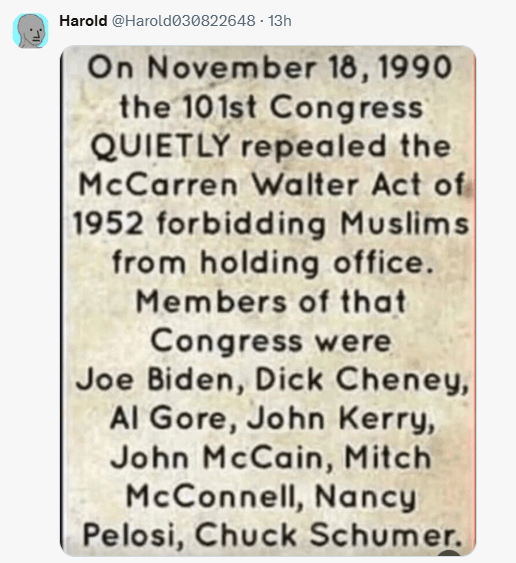
The claim is false. The McCarran–Walter Act did not forbid Muslims (or any religious group) from holding public office, and no such ban has ever existed in U.S. law. The U.S. Constitution explicitly prohibits religious tests for office, meaning people of any faith can serve. As a result, there was nothing in 1990 that could have been “quietly repealed” to allow Muslims into office. The list of politicians is also misleading—it implies involvement in a hidden policy change that simply did not happen.

The real context is that Congress passed the Immigration Act of 1990, which reformed immigration rules by removing outdated quota systems and some discriminatory exclusions tied to nationality and ideology. This was part of a broader modernization of U.S. immigration policy, not a change to eligibility for political office. The meme distorts this routine legislative update into a conspiracy narrative by inventing a restriction that never existed and then claiming it was secretly lifted.

The Epstein Files
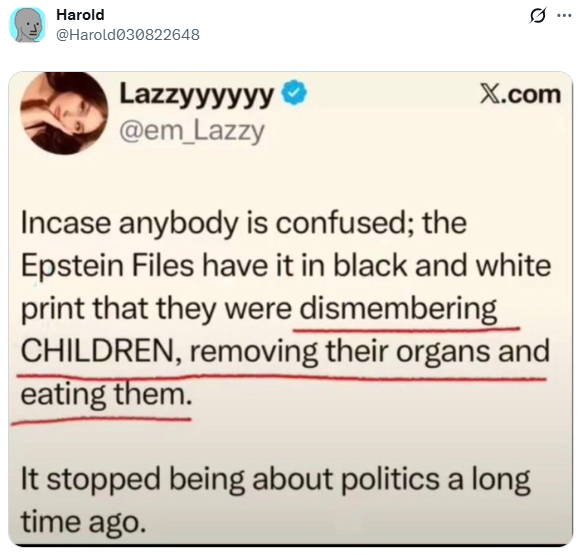
The claim is false. There are no “Epstein files” that state, in black and white, that children were dismembered, had their organs removed, or were eaten. Investigations, court documents, and reporting around Jeffrey Epstein and his associate Ghislaine Maxwell concern sexual abuse and trafficking of minors, which are serious crimes—but do not include evidence of organ harvesting or cannibalism. Claims like this are fabricated and resemble long-standing conspiracy tropes rather than anything found in verified records.

The real context is that the Epstein case exposed a network of abuse involving wealthy and well-connected individuals, leading to criminal convictions (including Maxwell) and civil cases. Large sets of documents—often referred to online as “Epstein files”—are mostly court filings, depositions, and contact records, many of which are incomplete, disputed, or lack proof of wrongdoing by those named. These documents have been repeatedly misrepresented online, with false or exaggerated claims layered on top to create sensational narratives that go far beyond what any verified evidence shows.

Despite this, there are countless memes that accuse people from different parts of the political spectrum and buisiness. If there’s a connected person you don’t like, create an Epsteing meme to libel them.

McGrath, Dennet, Dawkins – Memes

I read this debate between Dennet and McGrath: http://www.rsa.org.uk/acrobat/dennett_130306.pdf

I think McGrath is right to point out that the meme hypothesis is purely that – with no evidence. The hypothesis can be made to fit history, but is it falsifiable, and what supportive evidence is there?

McGrath points out Blackmore’s acceptence that atheism is a meme, just as theism is. Is atheism a meme? In some respects – when there is unquestioned belief in atheism. And I suppose the same hypothesis can be applied to any human idea – such as the appreciation of art, what art is, how it evolved, etc.

But scientific atheism accepts its own vulnerability, and does not claim infalability, and does not require faith. It is not a belief system in itself, but a consequence of what all humans do – attempt to understand and reason about the world around us. Atheism is a probabilistic conclusion, not a dogma, not a self sustaining belief. It may be that atheism as a world view is falsified in the future, by scientifically supported evidence of God. But how would theism be falsified? No matter what was discovered about the universe god could always be postulated to be beyond that.


McGrath points out some of the flaws in the meme hypothesis: “But my real question is this: how would Dr Blackmore and Professor Dennett be able to settle that point scientifically? If they are not able to do so, then we have a non-scientific debate about imaginary entities, hypothesised by analogy with the gene. And we all know how unreliable arguments based on analogy can be – witness the fruitless search for the luminiferous ether in the late nineteenth century, based on the supposed analogy between light and sound. It was analogically plausible – but non-existent. The analogy was invalid. Richard Dawkins tells us that memes are merely awaiting their Crick and Watson; I think they are merely waiting for their Michelson and Morley.”

I would agree with this, particularly about the inappropriateness of analogies sometimes. Dawkins Burka analogy in “The God Delusion” is suspect, for example.

McGrath makes another good point about the association of ‘evil’ with religion: “Now Professor Dennett might respond by saying that these are not typical of atheism. I believe he would be right to do so. But neither are the excesses of violence and intolerance that he does mention, typical of religion. I appreciate the need for a bit of rhetoric and exaggeration to spice up an argument, but one cannot represent the pathological elements of any movement, religious or antireligious, as if they were normal or typical. Few of us in this audience tonight are in favour of fanaticism; but it is clearly perfectly possible to be a fanatical atheist, as much as a fanatical religionist. It’s fanaticism that’s the problem, not religion or anti-religion.”

Agreed. I think the early use of the ‘evil’, as in ‘evil in the name of…’ and the other old chestnut ‘the problem of evil’ are fine as simplistic rebuttals of simplistic claims of theist about the inherent goodness of religion. Both theists and atheists would be better to leave these out of the main debate. Basically ‘evil’ can be performed by anyone, religious or not. And the problem of evil can be argued either way, as problematic for theism, or inconsequential as evidence against.

McGrath is right here: “In Oxford, we are facing a threat from one of the most fanatical groups in British society today: animal rights protestors. They are not religious. They are driven by an ideology – by a world view. Surely our common enemy is the fanatic, first and foremost. We need to reflect on how to control this phenomenon. But it is a clear factual error to assume that this is limited to, or necessarily characteristic of, religion.”

However, Dawkins point is that the dogmatic teaching of religion to children makes them amenable to irrational unquestioned ideas later. That would also be true if we taught dogmatic atheism to children too. I think Dawkins, (and Stephen Law in “The War for Childrens’ Minds”) are really promoting the teaching of reasoning to children, and the removal of teaching of dogmatic religion – and are not proposing the teaching of atheism. Read Stephen Law’s books on philosophy – they don’t promote atheism as such, but ask questions and invite the reader to think of their own answers.