
Novara Media is a left wing propaganda channel started by Arron Bastani. That’s Aaron Bastani, the author of the naive fantasy work, Fully Automated Luxury Communism.
In the accompanying short, their gaslighting ties their own arguments up in knots and completely destroys decades Muslim fantasies of a Muslim Palestinian state, though it does encourage the genocide of Jews.
The video makes the claim that Israel does not have a right to exist. They point out that the question of whether Israel has a right to exist is propaganda. So, I guess they think the Palestinian claim to a state is propaganda too, right?
They show Francesca Albanese saying, in response to the question of whether Israel has a right to exist, “Israel does exist,” as if that nullifies the quesiton.
They then flip to a show guest who tries to make more of this point than is rationally justifiable.
Let’s just pause for a second on “the right to exist” question, “Does Israel have a right to exist?” It’s a nonsense question. It’s an absurd question. It’s pure propaganda. It’s effectively ‘strat comms’ (strategic communications). The Israeli government came up with it. …”
This is a lie. Muslims came up with the proposal that Israel has NO right to exist, so the Israeli claim that Israel does have a right to exist, is simply rejecting the genocidal intent of Muslims.
What’s more, many of Israel’s enemies claim that Jews have no right to exist. This genocide of the Jews is of no concern to Novara Media and its guests.
No other country is ever told that it has a right to exist.
This is duplicitous claim. It is absurd to suggest any country is TOLD it has a right to exist out of the blue. What usually happens is a country CLAIMS the right to exist, and other countries choose to accept or reject that, and individuals choose to accept or reject that claim, and what usually follows is a set of events that determine the outcome of whether it does exist or not.
Israelis CLAIMED a right to exist in 1948, as Pakistanis did in 1947. Israel’s claim was based on the historic presence of persecuted Jews in their homeland. Pakistan’s claim was based on the conequst of India by Muslims that wasn’t going os well.
Both were supported by the powerful international community … though a number of Muslim states immediately rejected Israel’s claim and started a war to demonstrate their point of view – and such aggression is conveniently ignored by Novara Media and its guests. And of course Bangladesh later CLAIMED its right to exist independently of Pakistan. These states are not TOLD they have a right to exist, but they are told they have a right to defend themselves when they do exist. Israel exists and is attacked by Islamic terrorists, and has a right to defend itself. Muslim Palestine does not exist as a state.
So, this video is a gaslighting colouring of the narrative, Novara propaganda, when no other country is told as often as Israel is that it does NOT have the right to exist, which means, “from the river to the sea.” We all know that means wiping Israel and Jews off the map – we know because so many Muslims tell us so, and act on it when they can.
Does the UK have a right to exist? Does Ireland have a right to exist? Does NORTHERN Ireland have a right to exist?
Ah, his emphatic “NORTHERN Ireland” suggests he thinks not, but does he really think the Republic of Ireland has no right to exist? Does someone want to tell the IRA?
Did the former Yugoslavia have a right to exist?
This is a funny one for the commies that saw states like Yogoslavia break up after the fall of the USSR under the weight of its own oppresssion of its people.
Yugoslavia was a group of disparate peoples that had been dominated by larger powers, in the Ottoman Empire and the Austro-Hungarian Empire. The formation of Yugoslavia was again a CLAIMED identity, and later renamed as a state, by the various peoples, as the power of empires shifted. It became a state in 1918, The Kingdom of Serbs, Croats and Slovenes, but was rename Yugoslavia in 1929. While the common need for security was a driver for the existence of the larger state, the different peoples later had other ideas, and the inherent friction would lead to the breakup, and the CLAIM of the right to exist for the individual states.
So, again nobody TOLD Yugoslavia to exist, and the suggestion any external entity did or should tell Yugoslavia to exist is far more preposterous than the suggestion that the question of whether Israel has a right to exist is absurd.
I think that Francesca Albanese put it brilliantly about a year ago, when she said, look, the premise of the question is absurd. Does it have a right to exist? It exists.
No, Albanese’s is the absurd point. Whether a state has a right to exist, and its actual existence are two independent variables.
0 0 – Has no right to exist, and does not exist.
0 1 – Has no right to exist, but does exist.
1 0 – Has a right to exist, but does not exist.
1 1 – Has a right to exists, and does exist.
Whether Albanese thinks the question of a right to exist is absurd or not, the existence, or not, of a state IS NOT THE PREMISE OF THE QUESTION.
Albanese has deliberately confused a descriptive fact and a normative fact:
- Descriptive fact → Does a state exist?
- Normative claim → Does a state have a right to exist?
This is all rhetorical garbage, propaganda, stoked by a deep antisemitic hatred, with conditions that are never applied to non-Jewish states.
- A way of challenging legitimacy
- Or implying that a currently existing state should not exist / should be dismantled
You see now what they are doing?
Let’s look closer of at what it might mean for a state to have a right to exist. If a state did have a right to exist, then on what grounds might that right be based? Self-determination of the people to declare their state exists, recognition by others, the power to succeed, etc.? Israel would then have that right, and Palestine would not, because they are crap at it.
Or, conversly, if we were to acknowledge that the peoples of a region have a right to self-determination, recognition, power, could we not acknowledge it by assigning states the right to exist? Isn’t that basically what happens? A state takes for itself, through its government, on behalf of its people, the right to exist. We do acknowledge a state’s right to self-defence, which is itself an acceptance of a right to exist without being attacked. We say states are typically said to have sovereignty, recognition, legitimacy. Isn’t that just a variation on the framing of a ‘right to exist’?
So, you can start to see how this attempt to question the question of a state’s right to exist is nothing more than a ploy that is used ONLY against Israel.
And this is what the Novara propaganda is all about: not recognising Israel, delegitimising Israel, opposing the sovereigty of every Israeli Jewish, Christian, Muslim, Druze, Atheists, citizen. But only regarding Israel.
It (Israel) exists. It is a fact that it exists as a nation recognised by the UN.
Well, I’m glad we cleared that up. So no more of this bollocks trying to delegitimise Israel.
But, there is nothing in international law to say that a nation has a right to exist.
Then we are clear, Novara and its guests acknowledge that Muslim Palestine has no right to exist, and it does not exist. Got it. Thank you.
The propagandist goes on to say,
But what there is in international law is something to say that peoples have a right to exist.. All peoples have the right of self-determination.
But according to many on the left, not Israel. Terrorism Islamic states? No problem. Israel? No thank you.
As a matter of fact, Muslim Palestinians have been given that right to a state that exists, and have renounced it themselves many times, because rather than accept co-existence and the recognition of both Muslim Palestine and Israel, they have given up their right by turning to terrorism … because what they wanted was BOTH self-determination for them AND the freedom to determine that Israel does not exist, so denying the rights of the Israeli peoples to self-determination.
Do you accept that Nazis gave up their right to both their self-determination, and to their domination, persecution and murder of other peoples? Then why do you permit that for Muslim Palestinians?
Well, Jews and Muslims and Christian and Druze and other Israelis have a right to self-determination, and to a state, so suck it up and stop excusing Islamic insanity.
Now, if only you’d back up your “self-detrmination” ideal every time Muslims invade and terrorise the state of Israel, but you freaks are rarely anywhere to be seen when Muslims are killing people, in Israel or anywhere else.
So Israel’s right to exist, the fact of Israel’s existence doesn’t give it a right to run an apartheid state, and to perpetrate a genocide against the Palestinian people.
Erm, what was you saying about dodgy premises?
This is the atrocious state of far left politics in the West.
Israel is clearly NOT apartheid – Jews, Muslims, Arabs, Druze, Christians, all live free as Israeli citizens. There are countless videos of Israel Muslims pointing this out …. but here are external white knights TELLING Muslims of Israel they live in an apartheid state.
What about the West Bank and Gaza? The funny thing is, Israel was TOLD it had a right to that land by the power of the international community – i.e. the ‘power’ part of declaring a state.
Now, the West bank is contested territory that was taken from Israel by Jordan. The West Bank was never made an independent state by Jordan but was absorbed into Jordan. And, while Israel controls the region again, for security purposes because Muslim Palestinians launch terrorist attacks from the region, it is not part of an apartheid state.
No complaints from the left when Gaza was held by Egypt, and not created as a Muslim Palestinian state. Only when Israel beat the Egyptians in yet another war on Israel, did Israel occupy Gaza for security reasons, and later pulled out to leave Gazans to create their own state … but they chose terrorism.
If you want to look for apartheid states, you could look to the many Muslim states, all on land conquered by Muslims and turned into apartheid states under dhimmitude and slavery. But, the left are not interested – no Jews no News.
“Genocide” is another pernicious lie that they want to make true by repeating it. It’s almost as if they WANT Israel to commit genocide – many were calling it genocide the day after October 7, of all days, when Muslims explicitly stated their intent to commit genocide.
Throughout the war against Hamas (which admittedly IS much of Gaza, so thorough has been the UN sanctioned indoctrination of Gazan children), there have been claims of starvation, when the ONLY cause of starvation has been Hamas stealing trucks of supplies.
It’s astonishing how blind the left is to Gaza’s own videos, of the October 7 massacre, and the continuous fat arsed Gazans telling us they are starving, and their own videos of fake events.
Gazans are idiots of their own making, that not only make propaganda videos for release to the West, but film themselves making the propaganda and releasing those videos too. Pallywood make fictions that the left take to be documentaries.
The only reasonable conclusion is that the Western left are wilfully ignoring the evidence that genocidal Muslims are out to kill Jews, and the existence of Israel, in the Jewish homeland, upsets them to the point of wanting to kill them even more.
“Oh Muslim, there is a Jew behind me, come kill him.”
The Western left are totally blind to the depth of belief in the escatalogical requirement to kill Jews. When Muslims joined ISIS at its height, and on Octover 7, many Muslims were declaring ecstatically online that the end times were near. They are the ultimate “The End is Nigh” lunatics of our times.

Isn’t it crazy that it might have taken a genocide for liberals and centrists to realise that they have a problem with their support for Israel.
I reject yet another stupid premise of your rhetorical question. Your premise that there is a genocide BY Israel is false. So, no, I have zero problem supporting Israel in the world’s fight against global Islamic terrorism and extremism.
But, I do have a problem with the left’s continued apologetics for Islamic terrorism in THEIR support for the terrorist enclave of Gaza, when the evidence for Islamic terrorism extends way beyond Gaza, the West Bank and Palestine. Muslim Palestinians, Hamas, the Muslim Brotherhood, Hezbollah, have continued to wreck Lebanon, Egypt, Jordan, Syria – but of course the left blame Israel for attacking these threats.
It’s not as if the evidence isn’t clear around the world: EVERY DAY someone dies in the name of Islamic terrorism.
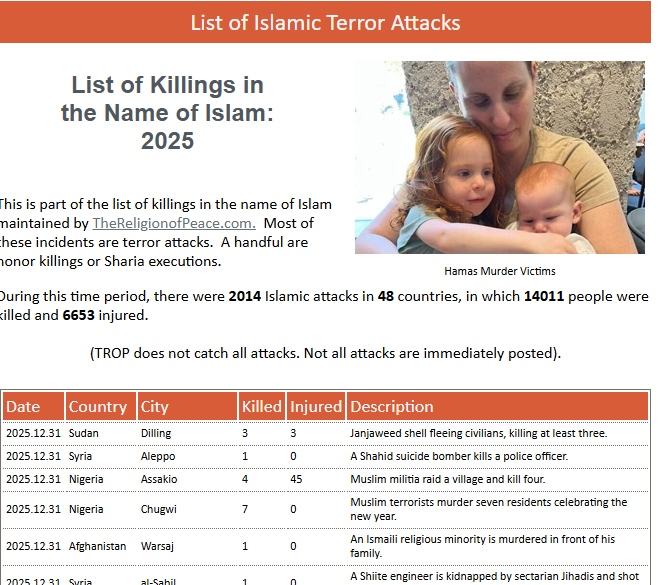
https://thereligionofpeace.com/attacks/attacks.aspx?Yr=2025
Propaganda
If you’re not convinced this is antisemitic propaganda, why is it the same message is appearing all over social media? Here’s another propagandist making the same stupid claim that also denies the terrorist Palestinians a state.
Does Israel have a right to exist? Does any nation state? What is a nation-state? Is the concept as old as civilization? Or is it the latest social engineering project of the ruling class?
No, Matthew, your crap is the latest social engineering attampt to jusify the genocide of Jews by the death cult Islamic terrorists of Gaza. Who is Matthew? From his bio:
Oscar nominated filmmaker. Writer. Former guest host for Larry King.
So, a filmmaker, a maker of fantasies. Like Palestine.
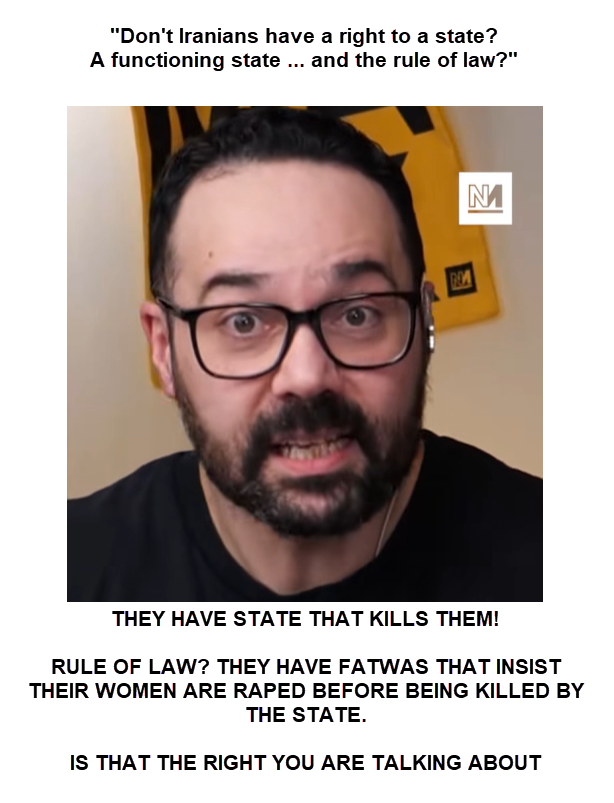
Let’s leave the last word on the right of a state to exist to Novara’s Aaron Bastani (from an insane rant of a video clip that deserves its own post).















 Ramblings