What’s Up Doc? Heaven, Apparently

In this piece, Heaven Is Real: A Doctor’s Experience With the Afterlife, Neurosurgeon Eban Alexander gives his account of a brain event that made him see the light. (h/t @SkepticViews)

This is the dumbest piece of God promotion I’ve seen for some time. I wouldn’t have this neuroscientist anywhere near my brain. He says how much he wants to believe, has a specific brain experience that matches reports of experiences by other people, and that’s it – job done, God exists.

1) Auditory hallucinations can be auto-generated in the brain without sound input through the ears, so it’s possible for someone with a brain to ‘hear voices’; and some people who ‘hear voices’ attribute them to God or Jesus. He should know this. Humans hallucinate.

2) The brain perceptions experienced (bright light, vast space, God, etc.), and the reality of the things supposedly conceived (heaven, God), are quite distinct. The experience of the perceptions is no guide to the reality of the thing perceived. That’s why we call them hallucinations. Near-death is a rare experience for a human brain (except for those with a one way ticket, but then they don’t come back to report), so it is difficult to say what we would expect to experience. Novel brain experiences are not a sufficient guide to reality.

3) People will have similar experiences because, duh, they have brains too. We should expect that experiences of near death will be similar, so the similarity of the reports should not be taken as mounting evidence for the thing claimed of the experience.

4) As others have pointed out in the article’s comment stream, similar experiences can be achieved by using drugs. And by stimulation of the brain in the lab or operating theatre. There is no reason to suppose that the perceptions contained during these experiences represent a reality, and plenty of evidence that they don’t.

5) On what grounds does Alexander suppose that his perceived experiences occurred in real-time while he was unconscious? He has no way of knowing, because he was unconscious! Only later, when his consciousness returns, is he able to report on his experiences. For all he knows his brain might be constructing a completely false memory, as if it had occurred, as part of the process of recovering consciousness. Perhaps this is what it’s like when a brain is ‘turned on’ again. Being a neuroscientist he should know of this and many other rational possibilities.

There’s a problem here that theologians, many philosophers, and it appears some scientists, have with the nature of the brain and its relation to our inner thoughts and experiences. Lurking behind views expressed by those like Alexander is a presupposition that the mind is distinct from the brain and that what we experience in the mind has some distinct reality. I call this the primacy of thought problem, where we suppose that the mind and our thoughts, through our Rationalism, is the primary source of knowledge. To some extent this is understandable, since as physical animals we have to wait until our brains achieve a certain degree of complexity and experience before they become self-aware enough to do any reasoned thinking. It’s then as if our ‘mind’ has been switched on, and then is perceived to exist as if it is something independent of the brain. Contributing to this feeling is the fact that our self-awareness, our introspection, can only go so deep. We cannot, for example, perceive the individual neurons firing away as we think. We only perceive the thoughts, not the cause of the thoughts. We have no physical sensation in the brain, like touch or pain, that tells us what is actually going on inside our heads as we think. So, we feel detached, as free-floating consciousness.

In the context of this post Alexander is in no position to say what caused his experience. All he ends up with is a perception of an experience – a brain experience.

What a dumb-ass. He was lost to religion before he started on his unconscious journey; he wanted it; he says as much. Confirmation bias?

Not just the medical impossibility that I had been conscious during my coma…

Is this guy really a neuroscientist? It’s difficult to say to what extent a brain is ‘inactive’ during a coma, or other states where external appearances imply unconsciousness. It’s not even fully understood to what extent there is a real barrier between consciousness and un-conscious activity.

What happened to me demands explanation.

There are plenty answers to choose from. You can go with the simple functioning of a brain under stress and bad health that is capable of inducing perceptual experiences that are not associated with any reality; or you can go for your God explanation, because you want to.

Today they are realities. Not only is the universe defined by unity, it is also-I now know-defined by love.

Of course this statement tells us more about Alexander’s understanding of ‘knowing’, his views on epistemology and what it is for an animal brain to ‘know’ something, his commitment to Rationalism, than it does about any actuality.

The universe as I experienced it in my coma is – I have come to see with both shock and joy – the same one that both Einstein and Jesus were speaking of in their (very) different ways.

It’s hard for this statement to be wrong, because of course it is a fatuous profundity – a deepity, as Dennett would say. Quite meaningless in that it could be taken to mean anything. A straight forward physical interpretations is that yes, the physical brain has physical behaviours that under some conditions give the impression of a spiritual experience while at the same time the very same brain is governed entirely by the natural laws of science as we discover them.

But that belief, that theory [of the brain], now lies broken at our feet.

No, just at his feet, as he perceives it to be broken; as perceived by his broken brain that has had a perceptual experience that has left him with the impression that the imagined content of that experience is real.

When the castle of an old scientific theory begins to show fault lines…

The fault lines are as imagined as the content of his dreams.

… no one wants to pay attention at first … The looks of polite disbelief, especially among my medical friends, soon made me realize what a task I would have getting people to understand the enormity of what I had seen …

Oh dear. The plight of the unbelieved prophet. Everyone else is blind. Why can’t they see?

One of the few places I didn’t have trouble getting my story across was a place I’d seen fairly little of before my experience: church.

No fucking kidding!

I’m still a doctor, and still a man of science every bit as much as I was before I had my experience.

Well, I’d say not. Unless we take this to mean that he was already lost to science in his desire to believe.

I only hope he doesn’t turn into one of these evangelical doctors that you get from time to time. My mother is a believer in God of sorts, but she decided that enough was enough when at her local GP practice (an evangelical husband and wife team) her doctor suggested at the end of a consultation that they should hold hands and pray together for her recovery and well being. Preying on the sick by praying for them. But you can see this coming with Alexander.


Update: Sam Harris has chipped in:  This Must Be Heaven covers more detail, including comment by Mark Cohen. As well as going to town on Alexander, he also dishes it out to Newsweek. Harris is as eloquent as usual, so it really is worth a read. Pleas do.

The Giant’s Balls-up

I have seen reports that the National Trust is lending support to Young Earth Creationist (YEC) views on the formation of the Giants Causeway (GC). Here, for example.

(h/t JC)

I have to say that I’m very disappointed in the way the audio transcript is unclear about the NT’s position and does give the impression that it lends credibility to the YEC view. And the NT response to media enquires is no better:

“We reflect, in a small part of the exhibition, that the Causeway played a role in the historic debate about the formation of the earth, and that some people hold views today which are different from mainstream science.”

That is not the case, based on the transcript. It would be a legitimate point to say that explicitly, that is, to say that YEC have used the GC and other geological formations to support their views, but that this conflicts directly with the science. But that is not what the transcript expresses:

Like many natural phenomena around the world, the Giant’s Causeway has raised questions and prompted debate about how it was formed.

This debate has ebbed and flowed since the discovery of the Causeway to science and, historically, the Causeway became part of a global debate about how the earth’s rocks were formed.

This debate continues today for some people, who have an understanding of the formation of the earth which is different from that of current mainstream science.

Young Earth Creationists believe that the earth was created some 6000 years ago. This is based on a specific interpretation of the Bible and in particular the account of creation in the book of Genesis.

Some people around the world, and specifically here in Northern Ireland, share this perspective.

Young Earth Creationists continue to debate questions about the age of the earth. As we have seen from the past, and understand today, perhaps the Giant’s Causeway will continue to prompt awe and wonder, and arouse debate and challenging questions for as long as visitors come to see it.

There is no such debate, only unsupported claims by YEC. They may think there is a debate, but the science demonstrates there is nothing to debate. And it would be a misrepresentation of science to liken these YEC claims to the legitimate debate within science about the precise age and cause of the formation.

How does it compare, for example, with the NT’s treatment of other myths? In how many audio visual presentations are local myths presented as serious matters of debate, rather than just myth? Is there serious debate on the matter of the Irish warrior Fionn mac Cumhaill (Finn McCool) building the causeway to walk to Scotland to fight his Scottish counterpart Benandonner? Both this and the YEC claims are on equal footing – i.e. myths.

The NT does indeed appear give the Fionn some weight, here: Giant’s Causeway; but in this case the it is presented tongue in cheek so clearly, as are many fabulous Irish myths, that there is no misunderstanding – and, no religious fundamentalism striving to make political points, something I’d have thought Ireland had seen enough of.

I’d be interested to know what will be done about this at the site. I think the NT has a duty to represent the history of its properties in the most accurate manner. Where ancient myth has played a significant role in a location’s history then it is right and proper to describe such a myth. Where a religious or political debate has used a location, then it is reasonable that this fact should be included in a presentation.

But there is a distinction between the fact of the religous or political debate, and the fact of the matter supposedly being debated. In this case, one fact is that YEC have used the causeway in the promotion of their claims. A quite different fact is the age and cause of the rock formation. The NT should not allow religous or political pressure groups to influence NT presentations as it is a very dangerous precedent. There’s already abundant bollocks believed in Ireland as it is. The NT doesn’t need to add to it.

Supernatural v Natural

The notion that the Supernatural itself ‘exists’ is unsupported – equally unsupported no matter what the Supernatural metaphysics may be: gods, ghosts, fairies, wizards, …. But let’s go with the fantasy.

The question of the interaction between the Supernatural and the Natural raises its head occasionally, and it has been doing the rounds again, and specifically the question of whether the Supernatural is beyond the reach of science. So, supposing for now that there is a Supernatural, what can we know about it?

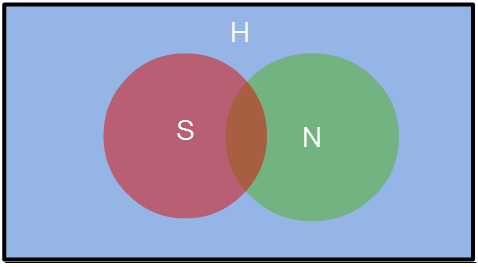
If the supernatural (S) is distinct from the natural (N), and they do not overlap at all, then what are all the religious claims based on? By this definition of non-interaction Natural human religious entities (theists) cannot experience the Supernatural; and since there are no interactions from S to N we don’t get any miracles to reveal the Supernatural either.

The only way the Natural human religious entities could experience the Supernatural is if there is some interaction between S and N.

So, one interaction might be that the human Natural entities have some Supernatural component that interacts with (witnesses) the Supernatural (e.g. the soul).

Another interaction is one whereby the Supernatural entities (e.g. God) have the capacity to act on the natural world. This is presumed to be the case, since He is supposed to have created the Natural in the first place.

But all interactions we know of in the Natural world are two-way. Cause and effect are mutually connected. So, for the soul to witness Supernatural experiences and transmit them to the conscious mind it must alter the conscious mind. It is the conscious mind of the theist that is making the claim of having an experience.

Both types of interaction are open to investigation by science.

Theists having religious experiences, being ‘in-touch’ with the divine, must be able to be tested. And the results of those tests must rule out (to some reasonable degree) any alternative natural cause for those experiences. All known religious experiences can be explained in terms of known psychological effects that are, at the very least, as feasible as a Supernatural explanation. Given how many alternative Supernatural or otherwise mystical explanations are offered by a multitude of cranks and variations on the religious you’d think the religious, wanting to be certain they are right, would be very concerned by these competing claims – but that’s where faith is required: belief’s cocoon of denial.

Theists claiming Supernatural effects on the Natural also clearly have some explaining to do. All modern claims are testable, and many have been tested and found wanting: faith healing, intercessionary prayer. Nothing. And any historical claims to miracles are sufficiently suspect by virtue of the period of ignorance in which they were made. Any theist who gives credibility to the resurrection must give equal credibility to fairies, imps, goblins, demi-gods, dog-head people, sea monsters (the least incredible), vampires, … Theists have no more grounds for believing in miracles than they do in any other crazy story. But, then again, faith (in one’s own beliefs) comes to the rescue of the reality deniers: no number of suspect mystical entities is sufficient to cause one to suspect one’s own.

So, either S and N interact, and those interactions are testable. Or they don’t, and all theism is just made up crap by Natural entities that have no access to the Supernatural in either direction. I mean to say, if the Supernatural is inaccessible to science, then it’s damned well inaccessible to a few fruit cakes who like to recite chants to their Supernatural Superheroes. So, theists, take your pick. Heads I win, Tails you lose.


Just to throw a spanner into the works, have a closer look at the Venn diagrams above. What’s all that empty space around the Supernatural and the Natural? Should the diagram be more like this?

Well, why should it? If theists can lay claim to the Supernatural without evidence, then I think I’ll go for the Hypernatural (H). You know, home of Hypernatural Thingymabob, that all encompassing thing that created all Supernatural creators of universes, the Thing that created God and gave Him the power to create the Natural.

How far does this stuff go on? Does the Hypernatural interact with the Natural, or just the Supernatural? Is there a Superhypernatural?

Is this getting silly? It already got silly, a few thousand years ago. And as we become more rational and sceptical, and are able to see the Emperor’s clothes for what they are, the whole religious show becomes an obvious invention of imaginative minds.

It’s one thing to hypothesise about the metaphysics of the origins of the universe, or maybe to make guesses about what is required to form an intelligent entity, and whether some such thing caused specific universes to come and go. But that’s all it is, guess work.

Far easier to let everything lie under one roof. It’s Natural all the way. Even the stuff that seems mysterious now will either one day be explained by Natural means, or will remain mysterious – but only in the sense of remaining unknown. Whatever the origins of our universe and any other, when or if they become known to us, they will be investigated, theorised about, and will take their place in our expanding field of Natural knowledge.

The strong nuclear force is something we discovered, or invented, or modelled, however you want to put it. It is now used to explain the interaction between particles in the nucleus of atoms. It was not once Supernatural and then suddenly Natural. Rather, it was once an unknown Natural phenomenon and is now a known Natural phenomenon.

The Primacy of Thought

A few recent blog posts have raised the issue of the primacy of thought, particularly these two:

John Loftus at Debunking Christianity quotes James East in this post.

Mike D at The A-Unicornist on this post.

The problem for me with theism, and some philosophy, is the primacy given to the mind and a failure to appreciate how humans, and all animals, are inherently constrained by our senses: Thought v Experience.

The trouble with ‘thinking’ is that by the time we humans started to do it reasonably well a lot of evolutionary water had passed under the bridge, but we had no clue about our sensory non-thinking heritage, so our point of view was skewed. It’s as if we came into the world as a fully formed thinking entities or souls, that just happened to reside in a corporeal body. The mental awakening of an individual human as they grow from childhood to adulthood is also a metaphor for the awakening of the species. So, quite naturally I think, we discover we can think and presume this is our greatest capacity, and not knowing its limitations we come to think the mind has some powerful ability to discover knowledge all on its own. Our very familiar relationship with our own minds, our subjective experience, is so overwhelming that it clouds our view so that we see it as the be-all and end-all of knowledge acquisition. This is the source of our conviction to the primacy of thought.

Here’s James East expressing this very experience (as quoted by John Loftus. My emphasis):

I was a Christian for nearly 20 years – starting as a young teenager, after being raised in a “very Christian” family. By the time I was able to think for myself, I basically believed everything already, so it was only natural to accept the salvation that was on offer when it finally clicked.

And here’s Articulet’s reply (my emphasis again):

Yes – boy can I relate! And don’t feel ashamed for falling for Christianity – probably most of your favorite people have – and most of the smartest people you know. But these are the memes that have survived through time.

In the extreme we have characters like Alvin Plantinga who suppose, for no good reason I can see beyond the persistence of ‘memes’, that we have mental capacities that are reliable routes to truth, when really we have no idea what ‘truth’ is.

Science has a limited practical interpretation of ‘truth’, which basically is the degree of correspondence between our various methods of discovery – so even in that sense ‘truth’ is not the all-or-nothing truth of logic. Epistemology is a mess because it is supposed that there is some real achievable certain ‘truth’ to be found, some absolute certainty out there waiting for us to discover, perhaps in the mind of God, that imaginary essence of truth itself, by virtue, maybe, of our sensus divinitatis.

I remain surprised that some otherwise bright people cannot grasp the link between our acknowledged fictions, and cannot recognise religious thinking for what it is: imagination allowed to run free and unconstrained by the senses.

Our thinking ability is more limited than we tend to think. Some of our recent ancestors will have had an even more limited capacity to think (and we see that in many of our existent cousins); and distant ancestors would have had no nervous system at all. But all of them, right back to the simplest celled organisms, have had a sensory interface with the world, even if it’s a simple chemical boundary. We are still, biologically and evolutionarily, sensory beings. Our evolutionary upgrade, a thinking brain, is an enhancement I’m sure; but a recent one that we are still learning to use. But it is useless in its own right, when acting alone. Try growing a brain in a child deprived entirely of senses and see what happens. Empiricism rules: we are sensory beings with an added capacity to analyse what we sense, to recognise patterns, to plan, to predict, to test again.

Common sense experience alone should be sufficient to tell us our senses and our reasoning are flawed. Our naturally developed faculty, our human knowledge acquisition system, our empirical nature, is only improved by the rigour of science. Even where science is still justifiably criticised as flawed, it’s still the best we can do. Science is, after all, practised by a flawed empirical system – the human being. All claims to ‘other ways of knowing’ have no foundation beyond wishful thinking. There’s only this one way of knowing, succinctly described as empiricism, but more rigorously practised as science. We can do it poorly or we can do it well, but that’s all we can do. We have no other faculties available to us that we know of.

We all acknowledge the human faculties of intuition and insight, but those that would put such faculties above science still don’t really get where these faculties fit in. Science uses them – that is scientists use them. They are part of the whole human knowledge acquisition system. But these faculties are also known to be suspect. The point being that science, the rigour of science, is the application of methodologies that weed out the useless intuitions and explore and expand on the good ones. In contrast to this approach the religious in particular, and some philosophers, are content to accept their intuitions without question, or at best only with questioning that also lies within the framework of their dogmas and schemas. They insist on this primacy of thought.

I feel that the failure to recognise this is why many theists and philosophers have been historically, and still are, so committed to the mind and the imagined capabilities attributed to it: reliable logical reasoning, freedom from bias and emotional drives to believe what we want to believe, a capacity to transcend the skull through thought alone, the ability to communicate with an imagined super being, the reliance on notions like faith. Until they grasp this view of what we are, our empirical nature, they will remain stuck thinking they have some pure, and possibly divine, route to knowledge through the mind alone.

Of course we could deny this empirical nature of ours, but to start down that road we would have to deny first the evolutionary theory that tells us this is how we got here from pre-thinking ancestors, and how this is the type of being we are. And once on that path, eventually, any significant contribution of the senses can be ditched. If the mind is really the route to knowledge, then the end of the line is solipsism. I can’t refute the solipsism hypothesis, but I’m content with not needing to.

It’s True! – Harry Redknapp

I posted on the nonsense that is the It’s True! claim, which theists are apt to use directly themselves, or which is the basis of the supposed truth of their religious books – that the books contain words proclaiming the truth of the books. LOL!

Well, of course religion isn’t the only source of this stunning[ly useless] argument. It turns out that it’s a favourite defence of the guilty in a court of law, and no doubt some innocent people too, when they become desperate.

Harry Redknapp used this very move in court yesterday. The story so far, from the Guardian piece

Redknapp and the former Portsmouth owner Milan Mandaric, who both deny two counts of cheating the public revenue, have told the court that the $145,000 paid in May 2002 and a further payment of $150,000 in May 2004, were paid by Mandaric as “seed money” for investments to be made on Redknapp’s behalf.

Here, from the BBC

Under cross examination on Thursday, Mr Redknapp said he lied to reporter Rob Beasley about the source of payments to the account because he did not want negative stories ahead of a cup final.

The Tottenham boss said: “I have to tell police the truth, not Mr Beasley – he’s a News of the World reporter.”

So, he lied to the reporter, but he didn’t lie to the police and he didn’t lie in court, honest. It’s true!

Remember, Hitler put his signature to the Munich Agreement, of which Chamerlain said on arriving home to England, “This morning I had another talk with the German Chancellor, Herr Hitler, and here is the paper which bears his name upon it as well as mine…“. Churchill didn’t buy it, “We have suffered a total and unmitigated defeat… you will find that in a period of time which may be measured by years, but may be measured by months, Czechoslovakia will be engulfed in the Nazi régime.

Of course, Hitler subsequently, metaphorically, wiped his own arse with his copy, and flushed.

All gullible people please take serious note! Liars will not only lie, they tell you they are telling the truth when they are not! It’s part of what they do. It’s what it is to be a liar! When someone says, “It’s true!“, without further justification, then you not only don’t have to believe them, I really recommend you ignore their proclamations and seek evidence of the truth.

Which of Harry’s truths is a lie? Because they are inconsistent. He claims he lied to the press. But if he admits to lying there, can he be trusted now?

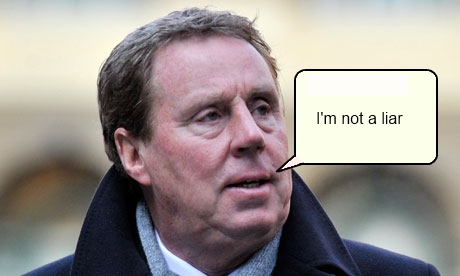
Well, perhaps this is convincing, from the Metro newspaper…

Harry Redknapp - Not a liar
It’s true!

The Spurs football manager was even reduced to shouting from the witness box at prosecutor John Black QC.

“You think I put my hand on the Bible and told lies?” he exclaimed. “That’s an insult, Mr Black, that’s an insult.”

No Harry, it’s his job. The whole point of this hand on the Bible bollocks (funny how religion is in on the lies again) is that it doesn’t work, except when told to the gullible. If you are innocent of the charges Harry, the Bible won’t help, and if you’re guilty, the hand on the Bible isn’t working.

“Everything I have told you is the truth, the whole truth, and nothing but the truth, so help me God…”

“I am not a liar.”

Well, that’s that then. Case dismissed? FFS!


Post Script…

Harry is currently manager of Tottenham Hotspur Football Club, who denied my beloved Manchester City a place in the Champions League three years ago, though we turned the tables last year. They are now one of the serious contenders to our title hopes this year.

But, Harry is a great football manager, and Spurs are a great club that I actually like. I have no idea whether he’s guilty or not – that isn’t the subject of this post. So this post is in no way biased. Honest! It’s True, I tell you, it’s true!

It’s True!

Great Jesus & Mo cartoon again.

The best bit, and the most crucial bit that applies to all religious books is number 1:

1. This is true

This is the one and only necessary assumption in any religion to make it worthy of the name. It must declare its own truth. Of course (snigger 🙂 (more smugness to come) we all know this is pure bollocks don’t we.

I get regular visits from Jehovah’s Witnesses. They are really nice people (at least to ones who visit me are). I think they like me and return often for the following reasons:

(a) I don’t slam the door in their faces;
(b) they haven’t converted me yet, so I suspect, like a lottery rollover, my cache goes up with each rejection;
(c) the religious are masochists (why else invent sin and then admit to bing up to the neck in it).

Anyway, I keep two things handy for when they call.

The first is a copy of Darwin’s On the Origin of Species. They always quote from it incorrectly and it’s an easy book to show them they’ve been misled. They do go through some other topics, such as DNA, irreducible complexity, but I usually wing it once we get past Darwin, because it would take too long to go through any book to convince them (“Let’s start with basic chemistry…”). I know, it’s wrong of me, but I argue from authority of knowing just a bit more about this stuff than they do. As much as I can make points against Behe’s arguments generally, if they brought him along as a guest doorstepper I might be screwed on the biology, because I’m not a biologist.

But I digress, again. The second, and most important thing I keep nearby is a piece of paper, oh and a pen – so that’s three things I keep near by, but you know what I mean.

And on that piece of paper I write words to this effect:

This paper contains the word of God as revealed to Ron Murphy. If you’re here while he’s writing this you too must bear witness to this miracle. Now, as your God I command you to ignore the Bible, Koran, gold tablets and any other bollocks you may have come across telling absolute crap about me. I can swear by the way. I am God after all. Though the atheists got it wrong, they got it wrong for the right reasons – they don’t believe any old crap in a document claiming to be the revealed truth. What sort of fucking argument is that?! Anyway, on this occasion it happens to be the truth. However, I’ll forgive you not believing it if you throw it in the bin. On one condition: you throw your crappy book in the bin too and start thinking for yourself.

No, I don’t really write all that, I just feel as though I want to. A sentence or two is usually enough to make the point.

But, miracle of miracles, their faith survives even this cutting blow. What the fuck can I do?

I thought perhaps I should show them the fabulous Morwenna Banks, from that brilliant series Absolutely.

This for me says everything about religious imaginative invention. It encapsulates millenia of theology as Little Girl rationalises uncertainties and contradictions in what pops into her head.

And her punch line:

It’s true! I know because I do!

And Little Girl here provides us with the best accommodationism I’ve ever come across: Genesis plus Evolution! It’s true!


And this is what you get when It’s true! is put into practice. Enjoy!

Jesus and the Batman Gospels

What is it with Christians and the gospels? Don’t they get that they are fiction wrapped around a myth? One argument often used to support the case for the gospels being a representation of historically truthful events is their claimed consistency. How could these independent writers all tell what is basically the same story? It must be based on truth, right? Well, no.

I visited the Museum of Comic and Cartoon Art yesterday, on Broadway, New York. That is, Suite 401, 549 Broadway, a nondescript entrance between two stores (as opposed to the more glamorous ‘appearing on Broadway’). This isn’t a big show; and to call it a museum is stretching it a bit. Still, comic life is an exaggeration of real life – as are the Christian gospels.

I found that one of the notes accompanying some of the Batman strips struck a chord with me, and prompted me to make this comparison. It’s a presentation of Batman in a way I’m familiar with hearing from Christians, regarding the Christian gospels. I thought it worth quoting here. When you read it, try replacing references to Batman with Jesus, and the various Batman artists with the Christian gospel authors.

Batman is the most protean of the great comic book characters: From Bob Kane’s original cartoon icon, to Dick Sprang’s broad-chested guardian of Gotham, comfortable as parade marshal; from Neal Adams’ cloaked figure in the shadows of the night, to Frank Miller’s aged and cranky crusader; each talented artist has brought a very personal vision to this hero.

And the impossible thing, they all feel right … definitive … even with all their inherent contradictions. Unlike lesser legends, which need to follow model sheets from generation to generation, Batman gives his chroniclers the power to transcend them, and in so many cases, do the most important work of their careers. No other hero would give us the ability to simultaneously showcase so many of the legendary talents of the comics field; and no other would be the character to greater acclaim than any other.

Walk along MoCCA’a walls, and stroll the streets of Gotham in daylight and darkness, enjoying the protection of the Caped Crusader and the Dark Knight … the one and only Batman.

– Paul Levitz is a comic book fan (The Comic Reader), writer (Legion of Super-Heroes), editor (Batman), Executive President & Publisher (DC Comics, 2002-2010), and historian (75 Years of DC Comics: The Art of Modern Myth Making)

Of course there have been other contributors to the Batman story; but then there are other Christian gospels too.

Many ‘sophisticated’ and ‘liberal’ theologians like to emphasise the ‘story’ of Jesus, as an allegory, a story that represents life to them, but not necessarily literal. That is until you witness them talk among themselves, or to more literal believers, when it’s pretty damned hard to interpret their stories as anything but literal. The blurring of the line between fact and fiction seems to be a convenience that allows them to switch modes, being sophisticated in the company of rational atheists, and yet literal to literalist believers.

The evolution of the Batman myth, as represented by the various artists that have imposed their belief in Batman on the story, echoes that of Jesus as presented in the gospels. There’s no more reason to suppose there’s any more truth in the gospels than there is in the Batman stories. The Batman stories have varied over time, but maintain a consistency; but that doesn’t make them any more true.

Okay, I’ll allow some particular truths to the Christian gospels: they may contain mentions of real place names, and real people. Gotham City isn’t real, after all. But let’s not pretend that having a story contain real locations means it’s not fiction. While in NYC I also saw Mission Impossible, with real locations.

McGrath on Science and Religion

The Alister McGrath piece was brought to my attention by the Jerry Coyne blog post. As usual with pieces like McGrath’s there’s so much to go at that a simple comment on another blog that’s critical of it isn’t enough. Nearly every paragraph is hopelessly vague, when not outright wrong. The religious bullshit language isn’t as heavy from McGrath as from some other theologians, but it’s bad enough.

On with my rant then…

“Why talk of Christmas when any idea of God is misguided?” – Christmas and God are only related by the name given to a festival by one particular religion. As an atheist I’m quite comfortable with Christmas – even with the mythical stories about Jesus, just as I am with the ones about Santa. Christmas fairy tales.

“Science, we are confidently told, has buried God. But has it?” – If there was no God to bury, then this misses the point. What it specifically hasn’t buried is belief in God. Quite different issues. What it has buried is the intellectual case for belief in God (in terms of most religions, though it does not refute the many god hypotheses).

McGrath turns to what he thinks are questions for religion rather than science…

“Where did everything come from?” – Still a science question.

“What’s it all about?” – A very vague question that summarises our inquisitiveness and our desire to find our place in the universe. Still basically a science question, though put within some human emotional context.

“What’s the point of life?” – Whatever we make it, apparently. Other than that there’s no indication from anything we know that there need be any ‘cosmic’ point.

“Its [science’s] interim reports are always important and interesting, but they are also provisional.” – Yes. But then all our reports are provisional. Simply inventing religious stories and sticking to them (as much as that is the case, since even religions change) doesn’t give them any more lasting credability or make them any less provisional; and since religious stories are pure invention they don’t even warrant the adjective ‘provisional’.

“Some atheist scientists ridicule Christians for believing in a God whose existence cannot be proved. Yet science regularly posits the existence of things whose existence cannot be proved to make sense of our observations.” – Well, not really. They ridicule them because their God cannot be evidenced. There are no observations. The objection to ‘proofs’ of God are only raised in response to claims for proof, not because there was ever any credibility to the proofs of God’s existence.

“Thus we infer the existence of dark matter from observations that would otherwise be puzzling. We can’t see it, and we can’t prove it’s there. Yet this doesn’t stop most leading astronomers from accepting its existence.” – Again, the mistaken presumption that (logical) ‘proof’ is significant.

“We can’t see it; we can’t touch it; we can’t smell it; and we can’t hear it. Yet many scientists argue that it’s the only meaningful explanation of observed gravitational effects. Where the naive demand proof, the wise realise that this is limited to logic and mathematics.” – So, with no proof on hand, and no evidence, what has religion got going for it? Why believe?

“Christians have always held that their faith makes sense of the enigmas and riddles of our experience. It’s not about running away from reality, or refusing to think about things (to mention two shallow popular stereotypes of faith).” – Oh yes it is (about refusing to think). The point here is that many different ‘theories’ or explanations can fit the same data. The problem with religion is that it is pure fantasy invented precisely to explain as much as possible, but without any requirement that it account for anomolies. Declare that prayer works, but ignore cases that don’t fit this hypothesis and proclaim the success of prayer when any instance happens to fit.

“For Christians, faith is not a blind leap into the dark, but a joyful discovery of a bigger and clearer picture of things, of which we are part.” – And how exactly does that discovery proceed? What methodologies does it use, other than the employment of ‘feel good’ imaginative assertions.

“You judge the power of a torch, she remarked, by its ability to illuminate the world’s shadows.” – Well, taking the metaphor literally, you can do that by measuring the incident and reflective light, measuring the frequency distribution of the light source (sodium street light, for example, doesn’t illuminate too well). And, you’re illuminating what’s in shadow (that which was not illuminated), not the shadow itself. This metaphor is a prime example of the vague and incoherent nature of religious language. Most religious language puts into shadow that which would otherwise be illuminated. The shadow of mystery is highly prized ignorance, in religion.

“If Christ is indeed the ‘light of the world'” – But he isn’t. There’s no reason to think he fits this metaphor. As a humanist he perhaps contributed to some enlightenment. If indeed any of his words were in fact his – which isn’t at all clear. His actual words, instead, remain in the shadow of history and evolving religious doctrine. Religious invention is bright in its imaginitave power, but casts a shadow over historical truth.

“So how does the Christian faith light up the shadowlands of life? … This does not detract from the wonder of the universe; if anything, it adds to its beauty and grandeur.” – Yes, as any fantasy story does. That’s the point of imaginative fiction, novels, the movies. They extend our imaginative experience beyond our real experience. But it’s still finction.

“…science takes things apart to see how they work. But religion puts them back together again to see what they mean.” – Science is also used to put them back together again, which then allows all humans, not just the religious, to impart meaning in the human context. Religion is really superfluous here; or, at best, just one more fantasy interpretation of our experienced life.

“If science is about explanation, religion is thus about meaning.” – Again, religion is not the only way of imparting human contextual meaning; and for many of us it’s not only far from the best, it’s one of the worst.

“…religion [helps us] to see, however dimly, the ‘big picture’ of which they are part.” – But only in the way that Star Wars helps us to see another possible big picture of human potential. Fantasy.

“God, according to the Christian tradition, is the heart’s true desire, the goal of our longings, and the fulfiller of our deepest aspirations.” – My emphasis. It’s odd, that for one who is supposed to be ineffable, most religious people are quite content to tell us what God is. This statement is just plain old religious language abuse.

“Some see life as a random and meaningless process of meandering, in which we search endlessly for a purpose that eludes us, if it exists at all.” – Who do? Christians? It was, after all, part of the paragraph telling us what Christians think. But I guess he really intended this second statement to mean atheists? I’m not sure who it really applies to, if anyone. As an atheist I’m not assuming there is a purpose, so I’m not particularly looking for one, endlessly or otherwise. I might choose (in as much as I can) to give my life a purpose, or maybe many purposes that come and go as the feelin suits me. At one point I had the purpose of raising a family: job done. At another time I had the purpose of achieving specific educational goals: job done. I have other purposes now. Should some natural disaster strike my neighborhood, no doubt I’ll have a temporary change of purpose which might be, basically, staying alive. Of course the religious don’t like to be too specific, because that allows them to be pinned down. Far batter the vague wishy-washy ‘purpose’, as in ‘the meaning of life and everything’.

“The Christian vision, enacted and proclaimed in the Christmas story, is that of a God whose tender affection for humanity led him to enter our history as one of us.” – The Christian fantasy; until supportive evidence is available.

Deleted Comment On Robert Lanza Nonsense

Posted the following on Psychology Today’s Robert Lanza article. The comment seems to have been accepted, in that another comment appeared that said something critical too, and acknowledged my comment. Both comments have been deleted. A favourable comment has been left on.

I commented on another Robert Lanza post earlier in the week (see my post). That vanished too, although at first I wondered if I’d actually posted the comment, or if, you know, the captcha bit had screwed up or something. I’m used to seeing unfavourable comments being deleted from the blogs of crazies. Does Psychology Today have any credibility? Who’s doing the deleting? I wouldn’t want to think it was Robert Lanza himself – unless of course it is.

I’ve not been following Psychology Today for long. My current impression of it is it’s a woo site geared very specifically to looking credible so that it can sell its crazier stuff to unsuspecting readers. Anyone else got any views on Psychology Today?

Anyway, this is what I wrote…


What incoherent nonsense. And such a misleading title. No evidence is offered.

“A string of new scientific experiments helps answer this ancient spiritual question.”…”As I sit here in my office surrounded by piles of scientific books, I can’t find a single reference to the soul”

Which experiments? Not any that are explained in science books, apparently. Certainly not any that are mentioned in this article (two-slit experiment).

“Recently, biocentrism and other scientific theories have also started to challenge the old physical-chemical paradigm…”

Which other scientific theories?

“This [two-slit experiment] and other experiments [which other, I ask again?] tell us that unobserved particles exist only as ‘waves of probability’…” – Okay, some experiments tell us this much. But that’s not really telling us the soul exists. Failed.

“They’re statistical predictions – nothing but a likely outcome. Until observed, they have no real existence; only when the mind sets the scaffolding in place, can they be thought of as having duration or a position in space.”

Depends what you mean by ‘observe’. It doesn’t require human consciousness, just any interaction. Human consciousness observes, after all, only after intermediate events have occurred: light emitted from observed object, reaction on the retina, transmission of chemical-electrical impulses along neurons,…

“Experiments make it increasingly clear that even mere knowledge in the experimenter’s mind is sufficient to convert possibility to reality.”

Which experiments?

“…showed that quantum weirdness also occurs in the human-scale world. They studied huge compounds composed of up to 430 atoms, and confirmed that this strange quantum behavior extends into the larger world we live in.”

Yes. But nothing to do with consciousness.

“Importantly, this has a direct bearing on the question of whether humans and other living creatures have souls.”

Really? well then it also has a bearing on whether a rock has a soul, because the quantum nature of matter applies to all matter, not just conscious humans.

Consider this. If consciousness is related to quantum nature of matter, then my consciousness has bits of consciousness of every living creature in the past that has shared the atoms that make up my conscious brain. And when I die and I’m buried, I will decay and contribute my atoms to bacteria, and then to plants, and then to insects, to mammals, to other humans, throughout the food chain – from my death to the end of human civilization. If I’m cremated and I go up in smoke the feedback of my consciousness will be breathed in pretty quickly and shared among many plants and animals and no doubt some humans.

If you want to detach the soul from this material quantum connection and insist it is something separate from matter, something spiritual, then all this quantum nonsense is totally irrelevant.

Get a grip man. Get a life. It would be generous to call this pseudo-science. But there’s no science whatsoever that applies to biocentrism. What there is is the massaging of current science that is still on the edge of human understanding to cherry pick the bits that are little understood but that sound spooky enough.

Where’s the science? Where’s the evidence?

Happy Christmas Santa; Bah Humbug Jesus

The Skeptical Teacher has a post on Santa.

In it he refers to Barbara Drescher’s post on An Argument for Santa, the Tooth Fairy, the Easter Bunny, and (gasp!) Even Jesus.

I’d agree with Barbara Drescher’s positive view on Santa, as echoed in one of the comments, where the Lahurongirl’s son realised there was no Santa, but still wanted to maintain the story for his younger sister. I’ve seen the same insight and intention from children I know – which is just spoiler avoidance. There’s the implicit assumption that their younger siblings will get to the end of the Santa ‘novel’ too, one day, so why spoil it for them now.

But Barbara seems to take the point too far. Does Richard Dawkins really not like fiction for children? This seems more like Barbara is jumping on a journalistic bandwagon picking up on a simple quote, attributed to Dawkins:

Guardian:
[http://www.guardian.co.uk/books/booksblog/2008/oct/27/richard-dawkins-childrens-literature]
Quotes Dawkins: “…looking back to my own childhood, the fact that so many of the stories I read allowed the possibility of frogs turning into princes, whether that has a sort of insidious affect on rationality, I’m not sure. Perhaps it’s something for research.”
And the author, Jean Hannah Edelstein, goes on to say, “Dawkins sounds to me not unlike the fundamentalist Christian mums who tried to get Roald Dahl’s The Witches banned from my primary school for fear that it would undermine what their kids had learned at Sunday school rather than acknowledging that sometimes, stories are just stories.”

Telegraph:
[http://www.telegraph.co.uk/news/3255972/Harry-Potter-fails-to-cast-spell-over-Professor-Richard-Dawkins.html]
“I think it is anti-scientific – whether that has a pernicious effect, I don’t know,” he told More4 News. (a reporting of a reporting then)

Double Think Online
[http://americasfuture.org/conventionalfolly/2008/10/27/richard-dawkins-scourge-of-fun/]
“Looking back to my own childhood, the fact that so many of the stories I read allowed the possibility of frogs turning into princes, whether that has a sort of insidious affect on rationality, I’m not sure. Perhaps it’s something for research.”

All sadly similar. Seems like some quote mining has been going on.

But I’m not sure what the controversy is here. Dawkins is expressing a good scientific response to the question of the effect of stories on children – i.e. he doesn’t know, and would be interested in any research to that effect. I don’t think he’s claiming there is an effect. Unlike someone like Susan Greenwood, who has been the butt of Ben Goldacre’s ire for some time for her claims, without evidence, about the effects of some modern media, such as computer games.

Much fiction for young children, such as the Santa myth, is expressed as truth, knowing full well that as older children and as adults they will grow out of it, hopefully learn something positive about the susceptibility of humans to gullibility, and, in the mean time, enjoy some magical fantasy for a while. There minds are malleable enough to learn and later unlearn, so what’s the harm? How many adults do we know that still believe in Santa to make that fiction worth worrying about?

The significant difference with religion – and this is where I see Barbara as being wrong – is that these fictions are carried on seriously into adulthood. In a religious family and social environment there is specifically, usually, no opportunity or encouragement to challenge the religious dogma, and indeed the prospect some traumatic ostracism for doing so. In fact the strength of belief instilled in children by adults, and seen by children to be genuine beliefs in adults, is what does the long term damage and causes serious disability when it comes to applying critical thinking to those beliefs.

And, it doesn’t matter that “Religion is not a barrier to science literacy”, as Barbara puts it – Francis Collins and Ben Miller show this; as long as you limit the science that we are being ‘literate’ about. If you do apply the usual requirement for evidence to everything then the only rational conclusion about the source of the universe beyond what current science shows is, we don’t know. Now, that certainly does allow, as metaphysical speculations, some passive ‘natural’ explanation, or even some active ‘agency’ explanation – though the latter then needs explaining too. But none of this speculation is sufficient to warrant the subsequent claims by any of the main religions. So, in that wider scientific sense, deeply instilled religious belief is a barrier to science.

So, if the Jesus story was to become an acknowledged myth, like Santa, the Tooth Fairy, the Easter Bunny, then that would be fine. But as yet it isn’t. The story of Jesus is a whole other industry, with a drive to capture the child’s mind (and the adult’s) as insidious as any capitalist behemoth advertising to children in order to sell the company’s wears; or, for religion, to buy the childrens souls.

The Depth of Empiricism

[This is part of a set: Thinking]

In the previous post on empiricism I looked at how philosopher Stephen Law missed a few tricks when he debated chemist Peter Atkins.

In this post I pick up on Jerry Coyne’s post making similar points: Can philosophy or religion alone establish facts?

I think the problem for philosophers is two-fold.

One is their commitment to their profession.

I see this as similar to the position of some priests who in many respects seem to accept all the intellectual criticisms of religion and faith, but can’t quite bring themselves to go the whole hog – there’s too much to give up, too much cognitive dissonance to contend with. So they fall back on faith – the only excuse left to maintain belief.

In the case of philosophers it seems to be their indebtedness to the history of the subject. This too is similar to theology – where the ideas of the ancients seem to retain some philosophical sacredness. Philosophers seem to need their ancients more than any other discipline with the exception of history. That “there’s nothing new in history” might well be applied to how some philosophers see their field.

And this brings me to the other problem. It doesn’t matter how much philosophy they claim to do, how much critical thinking they perform, how much evidence they consider, they still seem to retain a conviction to the primacy of thought and reason. It doesn’t matter how much pure reason is criticised, they still indulge in it.

I wonder if this stems from Descartes Cogito. This is a pretty good starting point, and one I use myself, in particular here. But many philosophers, even non-dualists, seem to be stuck with the idea that because we start out by discovering that we think, that this is our natural and primary mode of understanding. I don’t think they get how deep empiricism goes, how much we are empirical creatures before thinking entities.

Okay, so that’s where we start, with thinking about stuff. But before long, when we follow the trail and side-step Solipsism, we are left with a few clues to the fact that we are not primarily thinking entities.

Evolution is the big clue. You have to throw out evolution to avoid inferring the following from it.

We are evolved from creatures that didn’t have brains. Our ancestors were various in nature, ranging from the simple single cellular, through multiple cellular, to entities with multiple organs. Back then we were primarily experiential sensory creatures – and by sensory I mean in the simplest sense: physical and chemical interactions at our surfaces. And where there were neuronal nervous systems they might not be central nervous systems but distributed neural nets. An advantage of electrical communication over purely physical and chemical is the speed and the targeted nature of the connections. As early as neurons might have evolved they weren’t forming what we would call brains – though, given a physicalist perspective, that begs the question of what a brain is anyway. Nevertheless, through physical contact, chemical interaction, neuron transmission, our ancestors were empirical creatures.

This is what we still are, of course. I guess our sensing using light and sound removes us as whole entities from direct contact with much of our environment. Our actual contact with the wider environment, through touch, is often more difficult, and often undesirable: there are many things for which it’s safe to look at but not to touch; and if you can touch you may well be too close. Vision and hearing give us some protection against dangers, but they also isolate us from our environment to some extent.

This gives us the illusion that we stand alone in the world, so that we acquire (once we have thinking brains) the feeling that we are subjective individuals independent of the rest of the world.

We seem to be enclosed minds, when really we are empirical creatures that have brains connected to the outside world by remote sensing.

On top of that, this brain that we each have awakens and becomes aware of itself. This happens to each of us as individuals as we develop from an infant into a fully interactive child, teen, adult. And collectively it has come about culturally, historically, as our collective recorded awareness of our consciousness has dawned on us as a species (and maybe our ancestor species had some of this awareness too).

The dawn of recorded history and the emergent self-awareness of the infant are mutual metaphors, both beginning, or at least becoming sufficiently complex, with the acquisition of written language for the species and language generally for the infant.

The problem has been that our philosophical view has been dominated by this awakening of the mind, as if it is the primary source of knowledge, when in fact it’s our experiential empirical nature that has primacy. Our mind is merely looking at, analysing, speculating, on what we experience – and mostly with very poor access to most of our experiences.

Not only are we not directly aware of most of what our bodies or even our brains are experiencing, but we don’t have access directly to our deep past experiences – those that we have accumulated in our DNA.

I think most people accept now that we are the combination of nature and nurture – to the extent that this dichotomy is considered a very simplistic notion. We are each of us a developing complex system of our inherited biology responding to its environment, and in turn altering that environment through the decision processes that go on in our biological brains, which in turn effects how our biology responds further. We might be inclined, biologically, to be a couch potato or an athlete, but we can generally still become either, and even both – who hasn’t seen a once keen athlete turn to flab after they retire.

Though not specifically part of evolution, abiogenesis seems the only real source of what we call life. And, though there is no direct evidence to support abiogenesis, there is no good alternative hypothesis on the table. It seems that we come from inanimate matter, and we are inanimate matter – just inanimate matter that has become pretty dynamic.

So, there is nothing to suggest there is anything else going on in our heads. There is no evidence for any other source of thinking than it being matter in action. We are ultimately empirical beings, even in our reasoning in our heads. The processes going on in there are real material experiences in their own right; but it is we who categories experiences into externally sensed, or internally reasoned, as if the reason was pure and unsullied by real nasty experience.

In this respect there isn’t a significant difference between the peripheral neurons and the neurons in our brains. Neurons are communication mechanisms, whether in our arms or in our heads. While peripheral neurons connect other tissue to the brain, brain neuron connections are mostly with other brain neurons. So in a very real sense the brain neurons are sensing each other: they are empirical. We are empirical first and foremost. Thinking is an evolutionary add-on.

That some philosophers don’t get how deep empiricism goes is exemplified by the philosopher Steven Law in his discussion with Peter Atkins.

So, some philosophers seem to think that reasoning, while our primary tool of analysis, is actually our primary tool of discovery. They are mistaken. Unless one rejects evolution we can only conclude that we are experiential, empirical beings who acquired reasoning late in the day. It may be true that our reasoning provides us with far more than our sensory bumbling through life alone ever could. But it’s an even greater mistake to think that reasoning alone could do anything – especially since without sensory experience there would be no stimulus for neurons to evolve with which we could do any thinking. Some philosophers have it arse about face.


Update…

Jerry Coyne reviews a portrait of E O Wilson.

This bit strikes me as a good assessment of philosophy:

Generation after generation of students have suffered trying to “puzzle out” what great thinkers like Socrates, Plato, and Descartes had to say on the great questions of man’s nature, Wilson said, but this was of little use, because philosophy has been based on “failed models of the brain”.


This is part of a set of posts on Thinking.

Theologian Censors Debate?

Jerry Coyne debated theologian John Haught.

Both paties agreed to the debate being taped, but it seems Haught didn’t like the outcome and now doesn’t want it to be shown. Further more, some people have emailed Dr. Robert Rabel, head of the Gaines Center for the Humanities, because he had agreed to Haught’s turnaround, and Rabel didn’t like that. So he’s now threatening to take legal action against Coyne, accoding to Coyne.

Theologians can be really dumb sometimes.

Other coverage:

Butterflies and Wheels

Stephen Law to debate William Lane Craig

Stephen Law is to debate William Lane Craig on “Does God Exist?”.

Some time ago Richard Carrier was lured into a debate with Muslim theists which was supposed to propose something like “We can prove God exists”, but at the last minute was changed to “We cannot prove God exists” (can’t remember the details). Carrier went from looking at an easy ride to being knocked out by a sucker punch because he played their game. His opener at the actual event should have been, “I concede we cannot prove God exists, so my opponents win the debate. Now, let’s get down to some interesting points about philosophy and science: this is why I don’t believe in God.”

The title of this debate pretty neutral, but I’d recommend a similar tactic with WLC: that SL doesn’t get into playing WLC’s game, or even necessarily trying to rebut his points. He should simply present his own case, pretty much ignore WLC, and just dismiss his argument totally with fundamental philosophy.

One of WLC’s moves is to concentrate on the ‘failure’ of science to disprove God’s existence, as though atheists think that possible or necessary.

The key points for me are as follows…

We humans have found ourselves to be thinking beings, and this awareness appears to have been sprung upon us some few thousand years ago, at least as far back as we can tell from philosophical and religious writings and artifacts. And with the hindsight of evolution this thinking capacity appears to be a recent acquisition, and we’re not as good at it as WLC likes to think he is, particularly with regard to the metaphysics of things outside our common experience.

The only tools we find provide knowledge consistent over wide areas of our understanding of reality are all tools of science. And science can demonstrate many instances where introspective thinking and the invention of fanciful theistic explanations of events are woefully incorrect and often incoherent. Whatever we think reality might be our only route to it is through science. That someone believes there is a God has no bearing whatsoever on the actual existence of a God, no matter how inventive their logic, because there logic will always come back to the dependence on the presupposition that there is a God – to do the revealing, to inspire or command the authoring of religious texts.

If there’s any proving to be done, or any evidence required, the responsibility is entirely on the theist to provide it. Everything we do come to know about this universe shouts out at us that there is some causal universe that conforms to various patterns, which we understand as the laws of physics. If theists like WLC want to take a pop the limitations of science, then he has to accept that these very limitations apply to him too – he cannot demonstrate a superior capacity to know stuff.

These laws are so pervasive, so in-your-face, every moment of every day conforms to them – except, supposedly, with respect to God, astrology, ESP and a few other unsubstantiated ideas. These latter beliefs are the exceptions – but where is the evidence to support them?

Because they are the exceptions the null hypothesis is that everything conforms to the laws of physics, just as we find, evidentially, empirically. Even our own existence, according to evolution, conforms to these laws; and what’s more, shows us that our predecessors were empirical sensory animals. Our cognitive abilities appear to lie on the same continuum that our physical attributes do, from our evolutionary past. Our particular self-aware introspective cognition is such a late addition we should be very wary of supposing it to be the pinnacle of creation, the precise and acute tool that WLC thinks his mind is, rather than a fallible tool, a temporary blip in an evolutionary history of one particular species. Our intellect appears to be just one more product of evolution, with a primary purpose of helping us survive. There’s no reason to believe that it has any greater capacity than that, no particular reason that it should give us access to some metaphysical supernatural – except to the extent that this very limited intellect mistakenly thinks we can.

These other ideas, these metaphysical speculations, constitute the alternative hypotheses. They have never been demonstrated, with either rationally sound argument or substantial evidence. They remain unsupportable, though irrationally believed to be true. The null hypothesis, that everything conforms to whatever our understanding of physics is, or comes to be, remains intact.

WLC can dress up his arguments all he likes. He can complain that atheists cannot disprove God as long as he likes to hear his own voice profess it – but that’s irrelevant. He misses the point of science entirely. He doesn’t get that science shows us the limitations of our brains to reason about the inaccessible without supporting evidence; and in doing so overestimates his own capacity to know things he claims are true. WLC is just pissing against the wind – and his followers haven’t noticed this because they are too busy admiring his rhetorical big dick.

I do hope (against the odds) that SL doesn’t get bogged down in his favourite ‘problem of evil’ argument. It’s unlikely to survive the irrationality of WLC. Though the problem of evil as dealt with by SL’s ‘God of Eth’ may be convincing to rational minds, it won’t make a dent on the minds of believers if they don’t want it to.

SL should stick to basic philosophy and our current understanding of science. He should call WLC out on the presuppositions that underpin WLC’s otherwise persuasive rhetoric (persuasive to the gullible at least). SL should be thorough in his philsophy and should not try to debate theology. He should just ignore any temptation to try to win the debate and be content with letting his rational arguments land on a few theistic yet open ears.

Fingers crossed.


Update: coincidentally appropriate Jesus and Mo cartoon. WLC thinks he knows more than he can, as do many theists. But to be fair, I’m not a professional philosopher either, so who am I to judge WLC, or my own philosophical capabilities. We have to remain sceptical about our own ability to know stuff – not something WLC seems to suffer from.

Why Islam?

One theme comes out in comments by some Muslims on recent programmes about Islam, “Why pick on Islam?”

I’m not a fan of any faith, given that they all have dodgy interpretations. But Islam seems to be at the centre of many faith conflicts. I just happened to catch a few recent episodes of BBC Radio 4’s Beyond Belief.

Try these episodes, while you can:
07 Feb 2011 – Sunni/Shia Tensions – Islam v Islam
24 Jan 2011 – Ayodhya – Hindu v Islam
17 Jan 2011 – Egypt – Christianity v Islam

In addition to the victim question, “Why pick on Islam?”, there’s also the other element, of minimising the extent to which Islam is often interpreted in a violent manner, such as the persecution of apostates, as described in the 17 Jan episode.

Maybe Muslims feel they are the centre of criticism. But maybe that’s because there is plenty to criticise.

Anticipating Islamaphobia-phobia, Again

I think that sometimes those that criticise Islam are seen as Islamaphobes, as if they make stuff up about the extent to which homophobia exists in Islam; or about or how women are viewed; or about how kafirs are viewed; or about how kids are indoctrinated in faith schools; or about the political nature of Islam. As if there is no rational reason to be concerned about Islam, or the reluctance to criticise Islam.

I’ll be interested to see what is shown in this programme, Dispatches: Lessons In Hate & Violence , beyond this clip.

Be prepared for the backlash of denials. It’s happened before, here in 2007, where complainants managed to convince the police that Channel 4 had it wrong. It appears that if the religious make enough noise, if they can be offended enough, their voices will be heard. But, it didn’t end there. There is, or was at that time in 2007, a distinct bias towards tolerating Islamic intolerance. As shown here.

It’s not just police that are in denial. Every Islamist’s favourite non-Muslim Brit, George Galloway, can be relied on to back them, no matter how vile they are. Here, from 2008, is his response to another dispatches programme that had similar evidence. The ridiculous GG doesn’t get how biased he is here. GG seems to lose the plot entirely, and takes on the manner of a berating Islamist speaker. Does GG really think those investigated would say what was recorded under cover if it had been in the open? And GG has the nerve to lecture on interviewing, while making his own political speech. He’s right of course, that there are extremist Zionists and Christians. Some of the crazies on the recent Louis Theroux story from the West Bank, and his reports on US Christians attests to that. But to use this to sidestep the points made in the programme on Islam is just bollocks.

I wonder if the new programme will help the government reconsider its position on faith schools. Sure, most faith schools won’t be like this. But faith schools, indeed faith itself, facilitates this. Because faith, ultimately, relies on accepting stuff on authority. The ultimate authority may be claimed to be God, but in practice it’s the authority of those that claim the authority to interpret the words of God.

And when a religion inherently advocates strong sanctions against those within the religion that criticise it, or against those that want to leave it, or against those that fail to meet its most stringent requirements, then that adds to the stranglehold it has on reason, criticism and scepticism. And when it uses the mechanism of taking offence to attempt to censor non-Muslim criticism of Islam, the results are fiery. I wonder what claims of Islamaphobia will emerge, and to what extent various non-Muslim organisations and individuals ignore the points made in the programme because of their phobia of Islamaphobia – heaven forbid that a post-modern liberal relativist give up their relativism for the sake of common sense and evidence.

So, I’ll look forward to the responses to the Dispatches programme as much as the programme itself.

What Do New Atheists Actually Believe?

Discovery Institute has Michael Egnor asking this question…
What Do New Atheists Actually Believe?

And he has some specific questions…

1) Why is there anything?
2) What caused the Universe?
3) Why is there regularity (Law) in nature?
4) Of the Four Causes in nature proposed by Aristotle (material, formal, efficient, and final), which of them are real? Do final causes exist?
5) Why do we have subjective experience, and not merely objective existence?
6) Why is the human mind intentional, in the technical philosophical sense of aboutness, which is the referral to something besides itself? How can mental states be about something?
7) Does Moral Law exist in itself, or is it an artifact of nature (natural selection, etc.)
8) Why is there evil?

Well, here are my answers…


1) Why is there anything?

We don’t know.

It’s not that this question is nonsense, it’s simply that we don’t have access to the data that would answer it. From a philosophical perspective we have no firm response to the solipsist. The best we can do is say that what appears to be the case most forcefully to our minds and senses (given our senses might be an illusion of the mind) is that the material world is so convincing that we might as well use it as a model for reality until we figure out a better one that actually fits with those facts that the ‘apparent’ material world imposes on us.

For example, if we were entirely mental phenomena (or a single phenomenon) why can’t we get past the apparent material death of another mind (or my illusion of another mind)? The material non-supernatural explanation fits this and many other problems so easily that it’s a sufficient model for now.

The rest of the answers are given with respect to this point of view.

2) What caused the Universe?

We don’t know.

So far we, and our instruments, haven’t had physical presence far beyond our solar system, and in person not beyond the moon. So, all our observations of this universe are restricted to theories based on remote (in time and space) observations. Some theories have mathematical reasoning to lend them some weight. But really, we don’t know.

3) Why is there regularity (Law) in nature?

We don’t know. We’d need to resolve problem (2) to get any further with this. We observe regularities, but we can’t explain them in any deep sense.

4) Of the Four Causes in nature…

We don’t know.

This is philosophy going beyond the bounds of available or accessible knowledge and is more akin to theology.

Specifically, do final causes exists? Well, if we could answer some more questions on causality that would be a start. But then we come up against the same problem of accessibility of the data. And, the question isn’t clear on the meaning of the term ‘final cause’.

5) Why do we have subjective experience, and not merely objective existence?

Given (1) this can only be answered in atheist materialist terms, and within that context the understanding of matter and how life is just a formation of matter in action, and from there on to evolution. I’ll keep this short, but would be glad to expand on request.

All matter responds to interaction with other matter. Things bounce. At some basic levels we have explanations for this – such as the coming together of atoms of my skin with those of the table, where despite that fact that atoms are mostly space, the electric and nuclear forces stop atoms merging or flowing through each other. At yet deeper levels of understanding the particles may be disturbances in fields. I’ve no idea why there are fields.

Basic life is complex formations of matter. We still don’t know anything concrete about the beginnings of life, abiogenesis, but the basic hypothesis is that early replicators began the process – try thinking of something like growing crystals, though even this seems an inadequate analogy. The problem with all of this, life, is that we only have life on this planet to examine, that the origins are in the distant past, and anywhere the same process began spontaneously it would be consumed by local chemical reactions or organisms.

Form there, simple single cell life forms react in very complex ways compared to simple elements and molecules – but their responses to contact with other inanimate matter and other living organisms is basically physical and chemical. They go around bumping into stuff, and when they do, chemical reactions on their surfaces give rise to further activity.

Complex cells formed by the combination of different single celled entities – i.e. mitochondria. Complex multi-cellular organisms formed cohesive bodies and functionality was subsumed to different organs. In a soft celled multi-organ organism think of the combination like a turtle and its shell. The inner soft and delicate organs don’t need protection from the environment if outer organs are dedicated to that task – e.g. skin.

So, at this stage we have complex systems, of which one component is a nervous system that co-ordinates activity for the organism as a whole. Not all organisms use this approach – e.g. plants. But there seems to be a relationship between the motor capabilities of the organism and the complexity of its nervous system.

Given that one aspect of the nervous system is to respond to the environment in order to direct processes in the organism, and to direct it’s motion, required to find food, one natural outcome is that the organism should be able to detect itself. No point in eating your own arm is there. And this is the basis for self awareness, which most organisms have to some degree if they have a nervous system that samples the environment.

Mammals have multi-mode senses – sight, hearing, touch… And these need co-ordination if they are to be useful. The chicken egg answer is that complexity of nervous system and co-ordination of senses probably evolved together, each effecting the development of the other.

It seems a natural progression that when an organism gets to a certain degree of complexity this self-sensing can include sensing the very internal processes of the nervous system itself. In us this isn’t complete, since there’s a big part of our sub-conscious nervous system of which we’re not aware. But basically subjectivity is simply what it appears like when an organism senses it’s own nervous system in action.

6) Why is the human mind intentional…

(5) pretty much answers this.

7) Does Moral Law exist in itself, or is it an artefact of nature (natural selection, etc.)

It’s a subjective (see 5) conceptual product that has evolved in a social sense, but is based on biologically evolved feelings of empathy and sympathy.

See here for more detail.

8) Why is there evil?

There isn’t, in any objective sense, any more than there is moral law (see 7).

Evil is simply a classification of behaviour that humans typically ascribe to the behaviour of other humans.

Sometimes it can be conflated with suffering generally, such as the consequences of natural disasters, but that notion is only the concoction of those religious people who think natural disasters are associated with demons or with divine retribution. Remember this?

The floods that have devastated swathes of the country are God’s judgement on the immorality and greed of modern society, according to senior Church of England bishops.

Religiously induced stupidity.

We don’t ascribe the term ‘evil’ to things that animals do which if performed by humans would be classified as evil. This is again due to the confused thinking of the religious who think that humans have some special gift, or some special place in the universe, or some special relationship with some god or other, and that some or all of these misconceptions give special meaning to human actions we generally disapprove of.


Perhaps the main point I’d want to make in all this is that theists are in exactly the same position as atheists for a lot of the fundamental stuff. They don’t know. But what they do is make up an answer with no substantiating data and claim that to be the case. They think that the combination of ancient tradition and pseudo-profound language gives credibility to their view, but it really exposes their gullibility to ancient stories from a time when such ignorance was excusable for lack of any reasonable data.

There has been no evidence for religious claims that can be substantiated by third party examination. All subjective personal claims about religious experience have plausible explanations in a materialist world view, where various results of brain sciences can replicate or account for those experiences.

Bring On The Lions

No, I’m not referring to the up-coming England match. It’s a much more serious issue than that. Or at least Christians think so.

Even my very fair minded liberal Christian friend Lesley is concerned, after reading this article in GQ

When saying ‘damning’, who or what does Lesley think is being damned? The nation, for it’s loss of faith? Or those that remain Christians, for this reason, “Their case was too weak, their opposition to divorce and abortion and gay people too cruel, their evidence for their claims nonexistent.” It does sound a little like role reversal; you know, the rapture of irreligion, and the left behind of the faithful, stuck at the bus stop on a cold wintery day not knowing the last bus has been cancelled.

This point is right, “…it’s only natural that we should dismantle the massive amounts of tax money and state power that are given to the religious. It’s a necessary process of building a secular state, where all citizens are free to make up their own minds.”, which will make it fair for all. But I can understand the fear in the CoE at losing privilege.

When I read this and what followed, “Really? Let’s list some of the ways in which Christians and other religious groups are given special privileges,…” I realised that it was religious privilege that the article was damning after all.

This was particularly damning of Mormons in ’78, “Until 1978, the Mormon Church said black people didn’t have souls. (They only changed their mind the day this was made illegal, and God niftily appeared to their leader to say they were ensouled after all.)”

This “In response, Carey and the Church of England demanded Christians be allowed to break the law” and the recent nonsense at the Gen Synod continues to be damning of the CoE now. And don’t get me started on RC and Islam.

Why do we have to resort to law to demand equality from religions? Christians are often quick to tell us of their valiant role in the abolition of slavery and their many other fights against injustice. OK all Christians, put up or shut up. Stop all prejudice and privilege – voluntarily! Let the ABC call for this now (I won’t hold my breath – he’d rather have Sharia). Let’s move to a secular nation, in education and government, that’s equal to all. You’ll be surprised how quickly atheists lose interest in your religion. Hold on. That’s precisely what Christians are afraid of isn’t it. Silly me.

The feelings of persecution even extend to the repeated mistake of thinking atheists want to abolish religion. This is from a comment by Chris, “The New Atheists seem to think a secular society is one that rejects religion” – No, quite wrong. That’s what Christians think New Atheists seem to think. You being a case in point 🙂 We (atheists new and old) know what it means, and you too would know that we know, if only you knew more about New Atheists, and old atheists.

Chris, “In fact, most countries with a secular constitution see secularism as protecting religion.” – Try telling that to Christians in America, with it’s very purposeful secular constitution. I can’t figure out why even having such a specific constitution isn’t clear enough. Oh, hold on. Got it. After centuries of selectively reading the Bible Christians are primed to read a constitution and see in it the very opposite of what is written.

And, what’s more Chris, when you’ve figured this out, could you let Tony Blair know: “Tony Blair warns that Christians must speak out in ‘aggressively secularist’ age” – The problem is, Tone, Christians and other faithful have been speaking out all too loudly for centuries now. “But he has since converted to Roman Catholicism and set up the Tony Blair Faith Foundation to “promote respect and understanding about the world’s major religions”. “ – Well, Tone, religions might have earned a little respect if they hadn’t been partying on so loudly themselves, indulging to excess in privileges, and then hypocritically protesting as the hurt and offended when the neighbours open a window and shout at them to be quiet while everyone gets some peace.

Preacherwoman isn’t keen on Johann Hari from GQ (God Quits? God’s Quiet?, Garrulus Quadrigae?), pointing out his selective use of data. She makes a fair point. We do have to be careful not to impart our bias. But wasn’t that the main point that the article went on to make, i.e. the whining by Carey and others about persecution, when religion has so many privileges? Hasn’t religion always been biased?

It’s not just Carey. This is from Cristina Odone, “Afraid to be a Christian? Who can blame you? The authorities, the media and the chattering classes are forever trying to run you down. We don’t have to brave the Colosseum, with its rapacious lions; we don’t have to wear an identifying badge; or meet in secret – yet.” – What?! Let’s form two queues – one of atheists who want a secular nation with freedom to think and choose our world view without favour to any, and another one of atheists who want to ban religion. I’m sure Carey and Odone think we’re all in the near empty latter. They’re confused by this secular call for freedom. Being so familiar with the centuries of persecution by the religious they think that once they lose power they’ll be burned at the stake.

“Christians need to be as strident as Muslims” she says. Well, that makes a change from Christians bemoaning how strident a few atheists are. But again she makes the mistake of bias again. The strident atheists are calling for freedom for all, and would protect the rights of Christians and Muslims alike – we’re just saying we won’t protect the current privilege of Christians or Muslims, and won’t give in to the strident calls for privilege. The stridency isn’t the problem, it’s what one is calling for that counts.

“But there is no doubt that many are afraid to be Christian. They will watch anxiously today as Shirley Chaplin will fight the NHS in an employment tribunal.” – For heaven’s sake, is there no end to the whining. Thankfully the tribunal saw sense.

But Chaplin “…had the support of a number of bishops who claim that Christians are being persecuted in an increasingly secular society.” How very Christian. I really do think some won’t be satisfied until there’s a Colosseum in Trafalgar Square, “Ha! to a mosque at Ground Zero. We Brits will show you how to be persecuted. Bring on the lions.”

Atheists Against Religion – Misconceptions

Some theists seem to get the wrong impression about atheism and atheists, with regard to the extent and type of opposition to theism and religion. I think this occurs because several issues become conflated in discussions between theists and atheists. Some theists seem to think that atheists want to abolish religion or censor it; but they are confusing the following: genuine desire to stop some religious practices and privileges; the desire for a secular state; and intellectual disagreement on the validity of religious belief.

They are all issues that should be considered separately.

Opposition To Faith Schools
The objection to faith schools is because of their indoctrination of young minds and the fact that one faith view is projected. Most humanist atheists want schools to be secular, which only means no religious or other world view bias (not even atheism), not the censorship of religion. We actually want education to include information about all religions and other world views and basic philosophy in a non-biased here-it-is make what you want of it sort of way. There’s no requirement to impose the atheist or humanist world view above others.

My children attended a Roman Catholic school, which preached RC Christianity. Both my children said that when they compared notes with friends at a state school the coverage of other faiths was quite different. The Roman Catholic school had given feint acknowledgement to other faiths whereas the state school was more open about discussing the variations of the details of the different faiths. I don’t know to what extent a difference in teachers played a part, and I’ve no detailed experience of other faith schools. But in principle I’m opposed to the promotion of a particular faith.

Faith schools breed division. This I know from my personal school experiences, where a predominantly CoE state school backed on to a Roman Catholic school – pupils were always at war, and though most pupils probably weren’t particularly religious, the religious difference was a focus of difference. This inevitable divisiveness has also been commented on with regard to Northern Ireland many times. In Oldham there is currently a plan to form a mixed academy to replace the current Christian dominated school and Muslim dominated school in areas that resulted in race/faith/culture riots ten years ago.

Abolishing Religion
The wish by atheists that religions did not exist is just that, a wish. Not necessarily that religions never existed – there is no requirement to change history. The wish is that religions would begin to fade away – starting with the most obnoxious elements of each religion, because we think in the long term society will be better when religion has gone. Note, that isn’t saying atheist humanism is the cure for all ills.

And this wish isn’t expressed in any political sense. There is no way in which humanist atheists want to censor or ban religion or religious thought. The very nature of atheist humanism, or in this context secular humanism, is that the state should not be involved at all in personal world views, and that everyone should be free to choose their own world view. There are many unknowns about the universe, regarding its origins and its makeup. The God hypothesis is a reasonable one, so given the free-thought imperative of secular humanists there is no requirement to stop people believing in God.

Secular State
The political desire for a secular state is not a request for censorship, it’s the request for the removal of a religious bias and privilege that is already present. What’s the alternative to removing bishops from the House of Lords as religious political posts? Add more bishops representing every faith in proportion to the faith adherents? Add atheists specifically because they are atheists? What about Wiccans and followers of other belief systems? A Lord of New Age? No, the most equitable route is to remove all posts relating to religion and have people there on merit or by election – depending on the desired make-up. This then does not prevent religious leaders being members; they would simply be members for some other reason: hopefully, merit.

The wider issue of a state church is slightly less significant to me, though many British Muslims might disagree. We have a lot invested in our culture associated with our churches, armed services, state events, etc., that currently have a close association with religion. I’m in no hurry to see these go since they are quite benign, colourful and culturally of historic interest, in terms of the state. I don’t, for example, have an issue with traditions that date back to more feudal times, such as the monarchy and knighthoods and so on. They just need disassociating from the executive branch of the state.

Intellectual Opposition
The intellectual objection to theism, as opposed to particular religious organisations that implement the varieties of theism, is purely that, an intellectual one of the understanding of the philosophy and science of it all. Again the free-thought nature of secular humanism supports the unrestricted examination of all philosophical views and wants to engage freely in debates about these issues. Historically it has been religion that has wanted to censor views and interfere in the free thinking, free expression and free action of others that don’t agree with the religion.

It’s a bit rich for anyone associated with these ancient religions to accuse atheists of censorship – it couldn’t be further from the truth for atheism, while at the same time most religions don’t have a good record on censorship.

Anti-Religion
Anti-religion is the opposition to some or all religions. Personally I am strongly anti-religious when it comes to the more dogmatic religions.

There are many aspects of Islam, such as it’s political desire to dominate that is such an important and freely expressed part of that religion, and the discrimination inherent in Islam against non-Muslims in Islamic state governance. These are inherent parts of Islam, given that they are stated in the Koran or Hadith. Islam would have to go through a radical change for me not to be anti-Islam. But there are probably many Muslims who would like to see such change, and I’d support them in that without wishing to have them give up non-political or otherwise humane aspects of their faith. If some Muslims think atheists have an unfair view of Islam then they need to start making their more moderate voices heard, not only by atheists, but by the more radical Muslims.

There are many aspects of fundamentalist Christianity that make me anti-those sects too, such as the intense indoctrination of children into psychologically damaging beliefs about being sinners and being damned to hell. I am less anti-liberal-Christianity, though I do disagree with its ideas on intellectual grounds. Other atheists may have a more blanket anti-religious stance.

Summary
Atheists generally do want to stop faith schools, political privilege, any particularly unfair practices, and to work towards a secular state.

Atheists generally are willing to debate theism and atheism on intellectual philosophical grounds.

Atheists may also be happy to see the back of religion. But one of the main principles of free-thought humanist atheism is the right to practice ones own belief system, and so we would want to defend anyone’s right to belief, as long as the practice of that belief is not contrary to the freedoms of other people.

My personal feeling is that I have no problem with self-funded religions and places of worship. I quite like some aspects of the CoE; I like to visit old churches; I enjoy some religious music, though I have no interest in the content of any songs or hymns; I like to visit grand cathedrals and mosques. I suppose my interest is atmospheric and historic. I have fond memories of some vicars from when I was young in the Boys Brigade – even our local tyrant vicar was fair. So, other than the issues above I’m not that anti-religious.

And I enjoy a good argument.

So, in general atheists don’t want to burn theists at the stake, stone them or decapitate them, or condemn them to hell or whatever the atheist equivalent might be (which according to some theists would be for them to become atheists). Live and let live – if only the religious would.

A Biblical Story

The religious like their stories. Postmodern relativist theists love them. It allows everyone to have their own cuddly warm snug safety blanket in which to wrap themselves, without fear of someone nasty coming along and snatching it away – a gift from their father, God. There’s nothing more comforting than being wrapped up, nice and warm, being told lovely stories about their heroic father protecting them from evil.

But there’s another part of their story that’s not so pleasant, but just as necessary, because we all like scary stories, and these scary stories help cement the dependence on the myth. One day a bully arrives in the class, and his name is Atheist. His favourite wicked pass-time is to snatch their faith blankets away and make them cry. His second favourite is to tell a frightful story, of how his own father, Nietzsche, is killing their father, God.

But I’ve got a better story, a predominantly Western story (for there are similar stories elsewhere). And it goes like this.

Nietzsche is blamed for killing God. How can that be? There never was a God to be killed. Let’s start at the beginning, or as near to it as matters for this story.

In the forgotten past humans evolved along with other animals from some common anscestor with similar characteristics. Humans have many featues in common with all vertabrates. Even more in common with mammals. Even more with primates. Most with the other remaining apes.

This family have a mix of traits, that include complex combinations of being able to love and hate, help and kill. Their social evolution has caused them to be mostly loving to those close, and fairly neutral and even co-operative with other groups, suppressing their baser inclinations. However, conflicting interests, fear, misunderstanding, jealousy, all the nasty bits, are just below the surface.

It’s difficult to know for sure what real evolutionary mechanism caused religion to come about, whether it conferred some direct benefit, or whether it’s a by-product of the evolution of the degree of self-awareness that we experience. It remains a mystery, but many facts fit one particular idea.

All mammals have a sense of ‘other’, as in other external creatures: to be eaten by, to eat, to fight, to mate. Few animals are self-aware, so when self-awareness evolved to a certain degree there becomes both ‘other’ and ‘self’. The brain sciences have shown quite clearly that these are in different parts of the brain, but are linked; that the confusion of ‘self’ and ‘other’ can give a feeling of an internal ‘other’. This is very striking in various forms of brain damage – the type and location of the damage can determine loss of this internal ‘other’ or its acquisition. It can also be induced or inhibited in healthy brains at will, in a laboratory. Many humans have a ‘self-self’ and an ‘other-self’.

There were no brain scientists around in ancient times, but there were a multitude of unexplained awful events. With a familiarity of how powerful humans were, compared to other animals, it might have seemed obvious that there must be some more powerful external hidden ‘others’ at work, directing nature, inlfuencing lives.

Put these internal and external ‘others’ together, and you have gods that are doing things for and to humans, and even invade their minds.

But, some humans aren’t quite as dumb as they first appear. Over the millenia, as the population increases, and populations merge and compare ideas, as they record their ideas and they spread them, it seems obvious that there are some inconsistencies, competing gods, and, frankly, silly notions of what it is to be a god.

From the recordings of the Greeks onward, philosophy and rudementary science bring some critical thinking to the table, which begins the whole process of rationalising and economising on gods and their capabilities. There emerges the most concise God, the Jewish God, with many of his awkward inconvenient inconsistencies explained away into the sky, or heaven or wherever – depending on how critical the analysis has to be to avoid arguments from those that tend not to believe or who have competing gods. God goes into hiding, and leaves the material world behind, and his interactions with us and our world have to be explained by miracles.

The religions provide great social cohesion in times that are still barbaric and brutal. They provide an authority that can’t be matched by individual rulers. They help keep the peace mostly, but can still just as easily be invoked to wage war. Religions are used to control the uneducated supersticious masses, for reasons of good for the theologians, for reasons of convenience for the godless powerful.

Despite the reconciling role of great religions there are still independent theological thinkers who challenge the various orthodoxies, causing many schisms in what had been the start of a grand religious project: Judaism, Christianity, Islam – examples of new grand religions that each has its schisms. Other religions emerged on the boundaries of western thinking, the most prominat being Islam which separated much of western thinking from its Greek routes.

Come the enlightnement, ever more events and wonders of the world, like the rainbow, become explainable as natural phenomena. Western Europe becomes the focul point for many revolutions in thinking, and in the discovery of of ideas, places, animals and peoples. God and his works recede into the distance.

From Darwin and others a unifying explanation develops that shows not only that humans are not special, but that evolution can remove the need for a God, or at least push him back to the moment of creation. Sophisticated theology is required all the more to hide God somewhere safe. The struggle between the angel on one shoulder and the devil on the other mirrors the internal dichotomy of the rational internal ‘self-self’ and the feeling internal ‘other-self’.

This vanishing act needn’t be an intentional response to the chipping away at the ‘God did it’ explanatuions. It can be a genuine shift in the detail of beliefs of thologians that have as much access to the enlightenment ideas as any atheist. They have to reconcile what they know with what they feel, but what they feel has a strong hold and won’t let go.

So, God remains the primary presupposition that in their cognitive dissonance must override all other ideas. They may even have a sneaky suspision that their beliefs are nonsense, but what can you do if the internal ‘other-self’ is so persuasive? They even see the folly in other beliefs that are similar, or in those of their own religion that have a less sophisticated view of what God is. Sophisticated theologians mock athesists that speak of the Sky Fairy, and yet the Sky Fairy still fits what many religious people see as God. The theologians know they can’t explain their God, really, but they can have faith.

Some become so close to being atheists in their intellectual disposal of God’s inconveniences, that they even confuse what atheism means – Peter Rollins, with his really odd twisting of words is so confused, and therefore confusing in his religious babble. No doubt Rollins is sincere. I’m not accusing these theists of being charlatons, though some of the money making TV evangelists may be, I don’t know. But many theists clearly have an eye for this world as much as the next.

And so here we are. Nieztshce didn’t kill God. There never was a God, just an idea of a God accompanied by a feeling. Nieztshce and many others have been dripping slow acting poisons into the challace, causing a lingering and painful death for the idea that is yet incomplete. Though the feeling remains you can see the agony of self-realisation of the inevitable dawning on the likes of the Arch Bishop of Cantebury, as they struggle to reconcile their faith with the ultimate demise of the God that never was.

Rather than let the atheist kill their God they would rather do it themselves. They suffocate him in an act of kindness, they bury him in the safest place they can find, in the depths of their souls where he’ll be accessible to them. He becomes a fully personal God. No longer the need to explain him away, he’ll still be close by, feeding ideas through the inner ‘other-self’.

They see the problems, yet they still feel God, see God, or see the need for God, or fear the lack of God. What must it be like to have this inner self, the ‘other-self’, ripped from their hearts?

Those that don’t have it can only sympathise. Atheists who see a grand picture of the universe and beyond as a natural unfolding process have no need for God. There’s a freedom to think the unthinkable without fear, to find what we find without judgement, to see what the science tells us, without thinking it has a moral dimension, that the creation of moral codes are just one more human trait. We can take what evolution has given us and build our moral codes on top of that, and make those moral codes do the best they can for everyone, because the predominant evolved characteristics are to love, to help, not to hate and to kill.

This is just a story. Many different stories can be told, and are told. This one is as close to the observed facts that I know of. Think of it as a docu-drama – a story made to fit the facts; or as a working hypothesis that has evidence to support it. This is a story told by humans, about humans using evidence accumulated by humans.

The predominant alternative story is one written by humans too, but where the main unobserved fictional character is supposed to have written the story himself. And as such, the authors can have the character explain away any inconsistencies by the magic of miracles, or by claiming not to know the mind of the unfathomable character the human authors have created. Now that’s some serious imaginative just-so fiction. An incredible story. Seiously, it just isn’t credible.

It’s A Kind Of Magic

Thanks to Lesley, and indirectly to The MadPriest, for a pointer to this Irish Times article.

In it Canon Ginnie Kennerley puts magical thinking in its place, as eloquently and effectively as any atheist could:

“…is a demonstration of “magical thinking” at its most primitive, akin to ritual rain-making ceremonies and tribal rituals designed to control the uncontrollable”

Yes, even Christians are atheistic when it comes to some beliefs.

“While many of us occasionally indulge in magical thinking in small ways, if applied to serious issues it can become a major cause of injustice and handicap to general well-being.”

“As I understand it, magical thinking relies on perceived (but un-confirmable) causal links between desired events and the phenomena that appear normally to accompany or precede them.”

“It assumes that, by ensuring that there is no change in the supposed link of cause and effect, we can ensure the desired result every time – in effect, we imagine we can control the action of God.”

“Those who fall prey to this style of magical thinking in the 21st century may deserve our sympathy and even a degree of respect, given that a high level of anxiety and desire for control, of which they may not be aware, is probably at the root of the matter.”

I’ve a sneaky feeling Canon Ginnie Kennerley nodded off while reading some New Atheist book, and awoke thinking she’d been taking notes for something else entirely. I hope she doesn’t mind if I keep these words in mind when I next argue with a theist.