Does Mehdi Hasan Think Islam Is A Mental Health Issue?

Mehdi Hasan is an Islamist – someone that expresses support for Islam, politically. He is an active apologist for Islam.

He is also rather sparing in his criticism of Islamic extemists. It’s not that he never criticises them, it’s that his criticisms appear to be one of two kinds, possibly both:

  • Where the outrageous atrocity of an Islamic terrorist incident is so extreme, it would be remiss not to criticise it. I find Mehdi to be an insincere person on the whole, but without evidence to the contrary I have to accept he’s sincere in his opposition to these extreme cases of Islam.
  • He feels he must make some criticism, to avoid being seen as supportive by his omission of any comment. You can only ignore Islamic terrorism so much.

One of Mehdi’s ploys is to complain about how little criticism of ‘far-right’ attacks there is. Or, more specifically, he wants to know why when some perceived ‘far-right’ attack happens they are often attributed to the ‘mental health’ of the ‘far-right’ perpetrator, and not labelled as terrorism. In many cases he uses the ‘far-right’ label when there is no connection to any political cause, and he is using this as an opportunity to expand the number of ‘far-right’ incidents he can point to – an aspect of his insincerity and duplicity.

He then wonders why most Islamic terrorist attacks are labelled as terrorism, and not the result of ‘mental health’ problems.

He attributes this difference in blame as a result of Islamophobia.

Let’s address the labels he uses, ‘Islamophobia’ and ‘far-right’.

Islamophobia as Racism – The term ‘Islamophobia’ was invented, it is said, by the Muslim Brotherhood, as a means of making Islam seem like a race, so that it can compete with ‘antisemitism’ as a form of racism – and that’s certainly how many non-Muslim politicians use it (shout out to the race baiters of UK Labour). The problem is, Islam is not a race. Many white Muslims from the West joined ISIS, so how can white critics of Islam be racist towards those Muslims. When some of the most vociforous critics of Islam are ex-Muslims, of the same ‘race’ as their Muslim families, it makes the charge of racism look a little foolish.

In fact Islam is specifically not a race by design, and theoretically is not a racist religion – anyone can become a Muslim. The principle of non-racism is about the only redeeming characteristic of Islam – though even that can be questioned, not only by looking at the words and acts of Muslims, but also of Mohammed. So that raises the question of how can opposing Islam be racist?

Not is opposing Islam a phobia.

So the cry of “Islamophobia!” by Mehdi and other apologists for Islamism is a dishonest means of deflecting attention away from Islam and towards its supposedly racist critics.

Far-right – This is an odd one. Because Islam is a far-right political ideology: it’s ultra-conservative, homophobic, misogynistic, endorses slavery, demands the death penaly for apostasy, blasphemy, adultary and other non-crimes, and the Quran has prescriptions for beheading and chopping off of limbs. How on earth can Islam not be considered far-right?

In Mehdi’s 2017 article, “The numbers don’t lie, white far-right terrorists pose a clear danger to us all.“, he said the following:

Compare and contrast: Islamist terrorists are depicted as wild-eyed fanatics driven to kill by their religious faith or ideology, while far-right terrorists — be it the shooter of two Hindus in a bar in Kansas in February, or the killer of nine black worshippers in a church in Charleston, South Carolina, in 2015, or the murderer of six Sikh worshippers in a temple in Duffy’s own state of Wisconsin in 2012 — are almost always “mentally ill.” After the recent double murder in Oregon, it didn’t take long for Portland police spokesperson Pete Simpson to announce: “We don’t know if [the suspect] has mental health issues.” (Isn’t it weird how we Muslims seem somehow immune to “mental health issues”? Mashallah.)

OK, fine Mehdi, all terrorists suffer mental problems, so all Islamic terrorists are wide-eyed fanatical mental cases. What makes them so mentally unstable? Islam. They cite Islam when they commit their attacks. They do it for Allah. They can often quote from the texts of Islam to justify their attacks.

This ‘mental health’ issue is not restricted to Islamic terrorists. How many times have we seen enraged mobs of Muslims rioting? Many rioted over Rushdie’s Satanic Verses, and many more wanting to hang Asia Bibi. Are they mental cases too? Maybe Mehdi is right, Islam causes mental illness.

It won’t be the first time that religious fanaticism has been considered a mental health problem. So, what is it about religions, Islam in particular, that makes it so appealing to the mentally ill? Or, what is it about Islam that makes otherwise stable people go off the rails, become so insensed by the ‘insult’ that people commit towards Iaslam that makes these Muslims think they should kill someone?

It’s not restricted to acts of public terrorism on strangers, or mobs of offended and enraged Muslims. Many an ex-Muslim will attest that their families have theatened to kill them for leaving Islam. So devout are these Muslims that they think their own children should die for leaving Islam! That sounds pretty mentally deranged to me.

There does indeed seem to be something unstable about a religion that promotes death over life. Many Muslims will tell you themselves this is so:

The Death Cult – We Love Death As You Love Life – This is what Muslims say, in their own words. When you read what they actually say, you come to understand why dying in a terrorist attacks isn’t a big deal. Now, Mehdi might come out with the usual excuse, “It’s a sin to commit suicide in Islam” … well, maybe, if it’s a pointless death, but not if it’s considered an act of martyrdom in a justified battle against Jews, Christians or infidels. Mehdi is a Shia Muslim, and it’s the Shia Muslim clerics of Iran that popularised suicide bombing … so, who is Mehdi to disagree with the clerics of his religion?

The Numbers Don’t Lie – Oh Yes They Do

Mehdi tries to pull the wool over your eyes with figures from the USA, “since September 12 2001”.

Why do they always choose figures “since 9/11”. Why not including 9/11? They do it because by ignoring 9/11 it makes the deaths from Islamic terrorism look much smaller. Why not choose since 31st December 1999 – i.e., why not start counting for the 21st century?

The duplicitous Mehdi Hasan, skipping 9/11, gives us these figures (his article was in 2017).

Yet the numbers don’t lie — even if the Islamophobes do. “Since September 12, 2001,” noted a recent report prepared for Congress by the Government Accountability Office, “the number of fatalities caused by domestic violent extremists has ranged from 1 to 49 in a given year. … Fatalities resulting from attacks by far-right wing violent extremists have exceeded those caused by radical Islamist violent extremists in 10 of the 15 years, and were the same in 3 of the years since September 12, 2001.” Imagine that.

The report continues: “Of the 85 violent extremist incidents that resulted in death since September 12, 2001, far-right wing violent extremist groups were responsible for 62 (73 percent) while radical Islamist violent extremists were responsible for 23 (27 percent).” That’s a margin of almost three to one.

What Mehdi neglects to tell you here is that Muslims amount to less than 2% of the US population. So how about multiplying his Islamic terrorist attacks by 50 for a pro-rata comparison with everyone else in the USA.

It’s also rather convenient that Mehdi focuses on the USA, where the number of Muslims is relatively low, when Islamic terrorism is a world wide theat – even in “Muslim lands”. Yes, Islamic terrorism poses a top security concern in most Western nations, and in many Muslim nations too.

Mehdi Being Mehdi

It’s not unusual for Mehdi Hasan to twist words to suit his own Islamist agenda. Many other people have noticed.

Here he is pretending a comparison of Islam and Nazism is supposed to be excusing Nazism rather than criticising both.

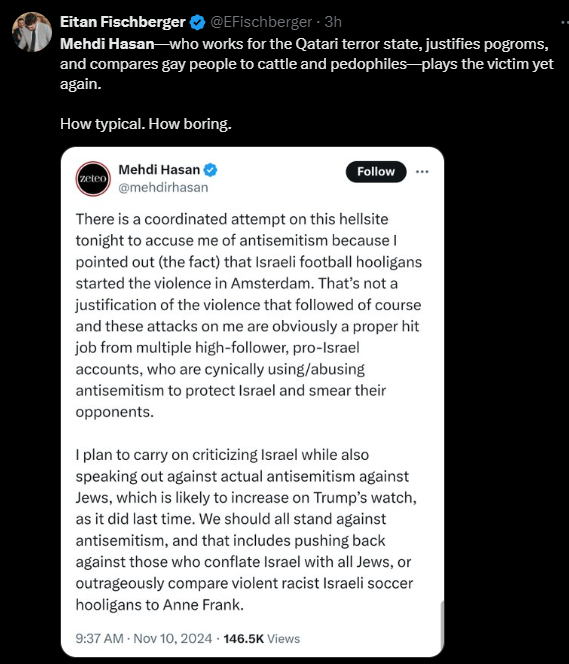
Special pleading for Islam …

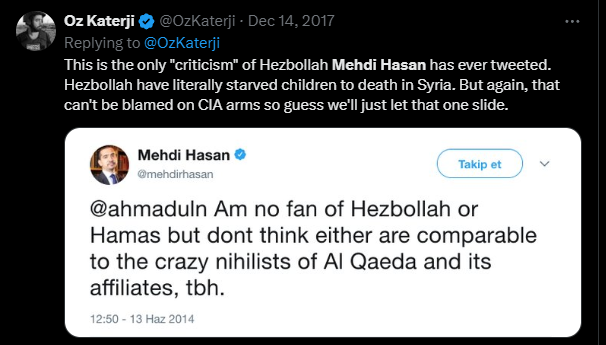
Failing to criticise Islamic terrorists …
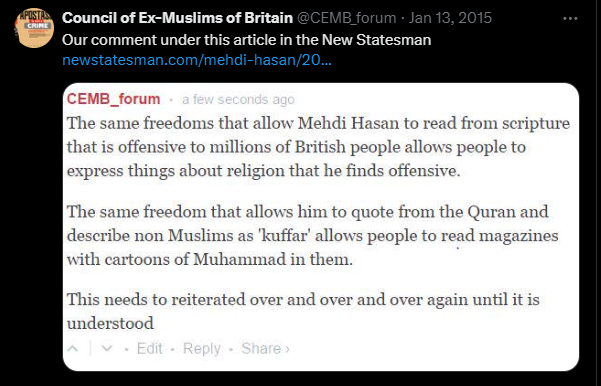
More special pleading – Mehdi has no problem with the vile messages in the Quran, but complains when anyone bad mouths Islam …
Getting blood from a stone is easier than getting Mehdi to criticise Islamic terrorism …

For this next example, you may have heard that Mehdi has distanced himself from these opinions. However, you should know what Taqqiya is in Islam:

1-Taqiyyah, according to Ithna-`Ashri Rafidis, means presenting outwardly something that is different from what one believes inwardly, as an act of religious devotion. 2- Taqiyyah, according to Ahl as-Sunnah, is something to be resorted to when one has no other choice, and it is an extraordinary measure to be used only in times of extreme necessity. For more, see the detailed answer. What is Taqiyyah

These were Mehdi’s views, but now he claims they are not …

Bear in mind, Hamas removed their explicity antisemitic end-times antisemitic quote, “Oh Muslim, there is a Jew behind me come kill him.” from their second charter … nobody believes they don’t still mean it. What makes you think Mehdi doesn’t still hold his views privately? Does he now deny that these passages from the Quran are applicable? This is a tricky one when the Quran is supposed to be the inerrant world of Allah … isn’t is blasphemous to not hold the same views as Allah?

So, Mehdi do you really want Islam to appear as an insane psychotic death cult mental problem, or not?

Here’s a guide to terrorists for idiots: https://ronmurp.net/2016/03/31/a-guide-to-terrorists-for-idiots/.

The Creationism Error: ‘Evolution Of Difference In Kind Is Unobserved, So Didn’t Happen’

Some religious believers are Creationists that deny, to varying extents, that Evolution is ‘proven’ and that God created humans from scratch, and that humans did not evolve from earlier animals, even from ape common ancestors, never mind from fish. Yet, many can no longer find enough faith to deny what they term ‘micro evolution’, even speciation. So, that particular species of the Creationist family have to take a different route to Evolution denialism, and it goes something like this, to paraphrase …

We [now have to] accept that micro evolution can be observed in the lab, and that Speciation via DNA changes occurs. So, generations of fruit flies can be observed to ‘evolve’ to create different fruit flies, or different species of fly. But, they are still flies. We never observe them evolving into something different, like a bird, or a cat.

Here’s a post on the Creationism Facebook group that makes this point. And, of course, the point being that Young Earth Creationists have a special place in their heart for dinosaurs – “They must have roamed the Earth with early humans, 6,000 years ago, because the fossil record contains dinosaurs, but the world isn’t that old, and ‘macro’ evolution didn’t happen.”

Throughout a series of posts, including this one, opponents of evolution have made an argument from observation, or rather the lack of observed evolution, as emphasised in my paraphrasing above. Here are some examples from one contributor, Mark Lambert:


And that’s where it stops. Never above the species level. A species is not a kind – Mark Lambert comment

Religion only looks for the truth. Truth : evolution has never been observed above the species level. – Mark Lambert comment

As I and others try to put Mark straight, he’s having none of it.

Nope only conjecture by using assumption and guessing – Mark Lambert comment

And you don’t understand it enough that you have no evidence of adaptation in anything other than species. If it’s not observed it’s only conjecture – Mark Lambert comment.

I and others tried to point out some details:

  • Everything above Species is just futher categorisation, and so ‘Kind’ has no useful meaning outside categorisation, and what he thinks is a different Kind (of Family, or Genus, etc.), is still a difference in Species, which in turn is determined by sufficient differences in DNA making attempts at breeding between species fail: producing no offspring, or offspring that are sterile – this is the only way in which speciation has any significant meaning.
  • Speciation to the extent that there appear to be different ‘Kind’, or Genus, Family, etc. is merely the accumulation of differences in different branches, and is not something different. Observing ‘mico-evolution’, which they accept, is what constitutes ‘macro-evolution’.
  • It’s not ‘observed’ by humans personally, with large animals that they give as examples because humans don’t live on the time scales required to observe it. While new species of large animals have evolved in human lifetimes, the larger scale accumulation of differences that Mark sees as different ‘Kind’ takes much longer, and so is unobservable personally.

So, is it the case that if we don’t observe something personally it didn’t happen? This seems to be Mark’s contention. I tried to point this out …

Base on your own view your great great grand parents x 10 are not proven to exist. Their existance is ‘just a theory’, a ‘conjecture’. So, anyone claiming they were created by magic fairies has just as much credibility as your claims about God.

The reality is science works and the evidence for evolution on all scales is compelling, while all claims for gods have zero evidence, and your use of ‘not observed’ is irrelevant and a dishonest and laughable attempt at a “Gotcha”. – My comment

When mark pointed out that his recent ancestors were documented by people that did observe them, I tried the following:

You didn’t observe those people observing it [your N x grand parents, or Jesus] so by your criteria there’s no evidence, so it didn’t happen as you claim it did.

Humans can lie about what they observe, and can be convinced of nonsense. Just look at how many religions there are, sects within religions and even indivudual believers that disagree in the detail of what they believe their gods want of them. So, by your own criteria, nobody alive today observed anything that happened and all ‘written’ records could be fake. Your criteria discredits all knowledge of the past, especially religions. Your criteria.

So you putting any significance on written work from the past contradicts your own position.

But if you do want to admit written work, DNA is written in every living thing and it tells us the relationship between all categories of evolution, and it tells us large scale differences all occurred through speciation via DNA differences. And, that record is more reliable than any written work from the distant past because it can be examined, observed, today …. and it is not written by humans who are often motivated to lie, as is the case with religions, where absolute assertions are made based in written words that nobody today observed being written, and from when ignorance and claims about gods were abundant. My comment

Mark still didn’t seem to get the significance and implication of his claim that if it isn’t observed it’s only conjecture or it didn’t happen by Evolution, God did it. He didn’t get that his criteria for observation could be applied to anything he used from the past, or out of reach of personal observation, and as such contradicted his own claims.

Eventually he blocked me and others trying to point out his errors, so we didn’t get the opportunity to challeng him further. I’d welcome further discussions.

AI, Robots, and Creationism: Implications for Intelligent Design Argument

If humans eventually create intelligent robots that think like us and have similar sel-awareness, what would the implication be for the intelligent Design (ID) argument. Would it show that we are intelligently designed by a creator God?

In an online debate with creationists I suggested that: if all things need a designer, the designer is a thing, and therfore needs a designer. Of course they went to their version of the first cause argument.

As I said before an intelligently designed creation requires an intelligent creator. Period. You sidestepping, deflecting, mudding the waters, asking who created the creator, is just making excuses. The creator would be uncreated. It must be. The Creator would be eternal. There was never a time that it didn’t exist. Now, what’s your problem? This state of affairs you obviously consider to be unfavorable or distasteful. You clearly have a problem with it. Why? To deny the Creator IS to hate it.

The first issue here is the presupposition that we are intelligently designed – because it would be tautologically true that by definition an intelligently designed thing needs an intelligent designer. That aside, let’s stick with the usual creationist Intelligent Design (ID) claim:

  • We humans design and ceate things, and if you came across a designed thing, like a watch, you’d presume it was created by a human.
  • Therefore things that look designed have a creator.
  • This world, and we humans in it, look designed, therefore we have a designer and creator.
  • That creator is God.
  • But, intelligent creaator God does not require a designer and creator, that God is eternal.

The error starts with the presumption that this world and us in it look designed. There are no grounds to make this claim. It’s a category error to presume that because we design things, we need a dersigner – we are not like the things we design, in regard to the capacity to design.

If we were actually designed it would be fair to claim there must be a creator. But if everything needs a creator, then so does the designer, and claiming the creator does not need a creator but in fact is the first cause is comitting the fallacy of special pleading.

And, if theists think that there can be things that don’t need a creator, then our universe doesn’t need a creator, and always existed – and the Big Bang and subsequent events we know about are just a phase in that eternal system.

AI, Robots, Thinking Machines

What if we eventually create intelligent robots that thing in ways similar to ourselves, in that they are self-aware, and feel as if they have free will.

If we manage to create such entities, would that show that in fact intelligent things can be designed, and therefore falsify the atheist hypothesis that we are not designed? Would this show that we had a designer, and would that in turn prvide a loophole for theists to claim their Creator exists?

No.

AI would show that intelligent systems CAN be designed, not that they must be. We would still have no evidence that we are designed.

It would add an extra difficulty for thesists. It would show that you don’t need a ‘soul’, or dualist mind, to be an intelligent self-aware system.

The atheism + science world view would remain intact, and it would all be consistent. As always, it would lead to yet more contradictions for the theistic world view.

Knowing Little Enough To Be Religous

This cartoon appears in a Creationist post on Facebook. What’s wrong with this cartoon? Let’s see …

Three of those examples have observed designers, all of the same kind: humans INSIDE this universe, … even, ONLY on this planet.

Religions ASSERT that an entirely different kind of entity, ‘God’, OUTSIDE this universe, created space, time, the material matter of this universe, and the processes that not only went on to create the waterfall scene, but also the creatures, the humans, that made the items in the other images.

If you can’t see the difference in the evidence required to support the knowledge of the creators of the three man-made items, as opposed to knowledge about the creation of the the natural one, you know little enough about logic, reason, evidence, to be religous – your assertions damn you with your own stupidity. To suppose that the creation of man-made objects is carried out by humans, is not at all in the same category of the cause of the existence of the natural universe.

You get this difference if posed in a different way. You have evidence that a human created any car you come across, but this in itself is not evidence that some car might have been created by an ant, just because you didn’t see who created that particular car. Even though we have evidence ants exist as well as humans, we would not conclude, without evidence, that cars can be created by ants – we’d expect to see evidence of ants creating cars.

But, according to the religious, gods are very different entities to humans, and ants. Gods are not even supposed to be in the same realm. So, if you want to prove something created the natural world, you need to provide evidence – and we have NONE! You need to provide evidence of a god BEFORE then claiming that god did ANYTHING.

Let me compare those once more:

  • 1: We have evidence of the existance of ants and humans. 2: We have evidence of humans creating cars. 3: We would not conclude that an ant created a specific car we did not see produced, BASED ON seeing humans creating cars.
  • 1: We have evidence of humans, but not of gods. 2: We have evidence of humans creating cars. 3: We SHOULD NOT conclude “God did it” (created cars indirectly by creating the universe and the humans that create cars), when we don’t even have evidence of gods, let alone gods doing anything.

Your CONCLUSION of ‘Intelligent Design’, based on seeing human design, is a massive category error, AND comits the Begging the Question fallacy:

The fallacy of begging the question occurs when an argument’s premises assume the truth of the conclusion, instead of supporting it. In other words, you assume without proof the stand/position, or a significant part of the stand, that is in question. Begging the question is also called arguing in a circle.

We have evidence that GIVEN we find ourselves in this universe, there appear to be natural laws that describe how things work. And we have discovered evidence that explains how life works, and how there are different species of life – Evolution. This is all consistent, AND predictive:

The most important prediction was that there must be a mechanism for organisms to generate variations in body structure and pass them along to their offspring. At the time Darwin formulated his theory, there was no direct evidence for such a mechanism. The prediction was not confirmed until DNA was discovered and its way of working was revealed.

What we don’t have are:

  • Specific evidence of abiogenisis – how the first replicators were formed from complex but naturally occurring organic compounds. But we do have good evidence to form hypotheses about the process.
  • Knowledge of the origins of the universe – the space-time system we find ourselves in, and the ‘laws’ that describe how it works. Even the Big Bang tells only about certain phases the universe went through, based on the evidence we have so far.

These limitations apply to all of us – they are not opportunities for ‘God of the Gaps’ to be inserted.

Some crackpot ancient prophets from the Middle East have LESS going for them with their assertions than parts of Scientology – at least the idea of aliens in Scientology is consistent with this universe, given we exist.

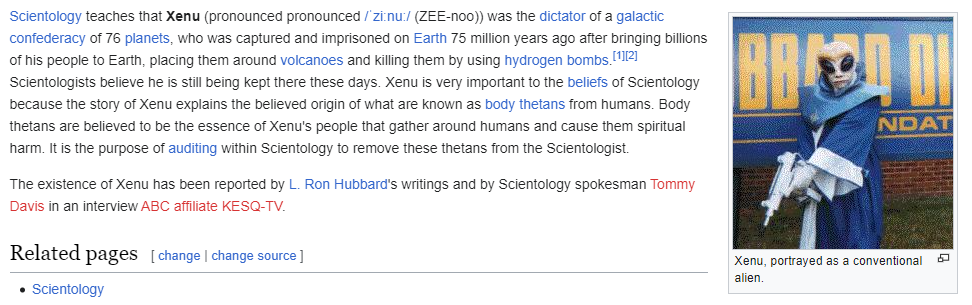
Yes, Scientology has some crazy ideas (Thetans, and the specific of Xenu above), but even they don’t compare with the religious claims that there’s a teleological entity that not only created the universe, but has a special interest in us humans.

Creationists are obviously not in a position to appreaciate the irony of giving the cartoon what is intended to be a sarcistic title, “Atheist Logic”. Logic isn’t their strong point.

Knowing Less Than Atheists

This was a comment on another post:

So you’re admitting that you don’t know, so you don’t know that God exists or not. So why argue about something you don’t know about. Now, what DO you know? And how can theists no less if you don’t know anything? Where’s YOUR data and evidence of how everything came into existence?

NOBODY knows ANYTHING about the creation of the universe.

Atheist are a-theists, simply denying the assertions of theists when they assert they have evidence, or worse, proof, of the existance of gods … because theists have ZERO evidence or proof.

But, theists do know less:

  • Theists and atheists know the same about the creation of the universe: NOTHING.
  • But, theists know far less about evidence, logic, reason, because they misuse them, abuse them, …or don’t even use them at all (when they resort to faith).

So, overall, theists do know less. Instead they use the ‘God of the Gaps’ move – any gap in scientific knowledge is evidence that it required a God. The problem is, theists have ZERO evidence to support their claims that there is a god … there assertions are ALL GAP!

Hamas Makes Terrorist Kids

Questions are often raise about why Israel has so many children in custedy. Here’s why. I don’t need to say any more.

Pisgat Ze’ev stabbings

Hamas have kids indoctrinated. Tell me Gazans are not Hamas

Hamas Indoctrinate Children

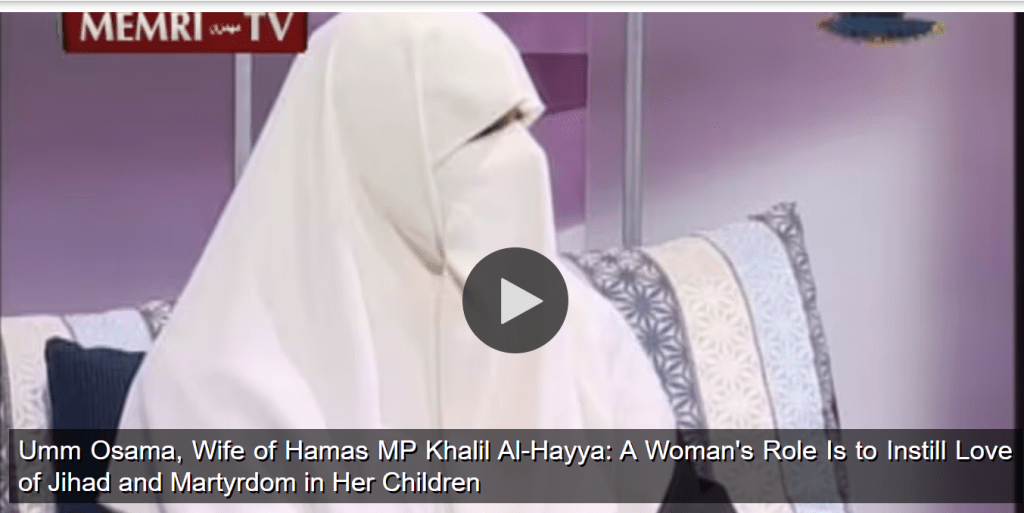
Meet Umm Osama the wife of a senior Hamas leader. Thinks Palestinian mothers should sacrifice their children’s souls as martyrs for the sake of Allah, and that mothers need to teach their children to kill Jews.

“Mother must instill in her children the love of Jihad [Killing infidels for Allah] and martyrdom for the sake of Allah. If every mother were to prevent her son from waging Jihad against Jews for the sake of Allah, who would wage Jihad?”

The Marxist and Islamist Alliance

Marxists (Socialists) + Islamists. An alliance? What’s the Deal?

The alliance between Marxists and Islamists seems a strange one, superficially. Far Left Marxists + Far Right Conservative Political Islam?

The alliance is aimed at opposing Western democracy: “by any means necessary”.

Marxists are anti-capitalists (anti-‘imperialists’), so they hate the successes of capitalism more than they hate its problems, because Communism has only problems.

The Islamists want a Caliphate, so they oppose secular democracies.

Both see Jews scoring high on this alliance’s perceived evils.

Secular Jews and Zionists in particular are hated more than far right fundamentalist Jews (who have some religious supremacist tendencies in common with Muslims). Left wing Jews are tolerated in Marxism, while convenient.

The antisemitic perception of the Capitalist Jew controlling the global economy and military appears often enough in the far left’s propaganda. ‘Inadvertantly’, and ‘with regret’ it is often claimed; so often one might think the antisemtism is subconscious.

“Anti-zionism is not Racism”

Let’s check the claim that antizionism is not racism; by comparing it to the claim the left often use, that Islamophobia IS racism.

Zionism and the re-creation of a state of Israel has a very sepcific purpose: it is at its core the creation of a state of Israel, primarily to provide a safe homeland for an ethnic group: Jews (religious or secular). And this is precisely because that group has not only been persecuted for centuries in their ancient homeland*, but the diaspora** of Jews in exile have been persecuted near everywhere, but espacially in Europe, with the Nazi’s Holocaust, and the Soviet Union being particulary horrific. And, despite common claims of ‘semitic brotherhood’ and ‘people of the book’ by many Muslims, Jews have been persecuted in man Islamic states, to the point of zero or near zero Jews remaining (looking at you Pakistan). It is indisputable that Jews are one of, if not the most oppressed minorities – certain most when one accounts for how wide spread it is. Hitler made it very clear that antisemtism was racist, because the crucial factor in determining whether someone counted as a Jew was one’s ‘bloodline’. What would Hitler have done with today’s DNA analysis?

*Disclosure: I’m an atheist an so I think the “God given” claims about Israel are bogus nonsense. My support for Israel is entirely for the secular reasons described.

** Diaspora: the dispersion or spread of a people from their original homeland, a homeland they may continue to acknowledge, and to which they hope to return. How convenient it is for critics of Zionism and Israel to point out that many returning Jews have less right to the land than ‘Palestinians’, as if all Muslim so called ‘Palestinians’ were born there.

And IslamoPHOBIA? A duplicitous word. Islam is very specifically not a race – one ‘grace’ of Islam is that it is not a racist religion; expansionist, so therefore necessarily not racist. However, that’s not to say there are no racists Muslims, for there are plenty. Further more, with death for apostasy and blasphemy, the ill treatment of women, the wide spread use of terrorism, being fearful of Islam is not a phobia (irrational fear); and opposing the self-defined political and judicial Islam is perfectly rational and legitimate. Since Islam is by nature poltical there are even valid reasons for not wanting more Muslims in one’s own country, just as one might not want any more Communists or Nazis, whataver their ‘race’.

So, antisemtic antizionism is racist, but Islamophobia is not, even if one were to accept that Islamophobia was a legitimate term (I do not).

Izabella Tabarovsky‘s article, The Cult of ‘Antizionism’, describes the activities and members of the Institute for the Critical Study of Zionism and the general infection of US campuses with the old Soviet breed of antisemtism.

The ICSZ’s founders are known figures in the BDS movement and the movement for the academic boycott of Israel. They include Rabab Abdulhadi of San Francisco State University, who tried to bring convicted PFLP terrorist and airline hijacker Leila Khaled to SFSU; Lau Barrios, who has served as campaign manager at Linda Sarsour’s MPower Change and as a co-organizer of the “No Tech for Apartheid” campaign geared at pressuring Google and Amazon to end their work with Israel; and Emmaia Gelman, ICSZ’s founding director, who serves as a trustee of the Sparkplug Foundation, a funder of IfNotNow and Palestinian Youth Movement, and also a co-sponsor of the ICSZ conference.

Izabella Tabarovsky‘s article, The Cult of ‘Antizionism’

Dangerous Alliance

Both political persuasions of the alliance are extremist dogmatic authoritarian ideologies – our way or death had been proven to be their approach to political differences a number of times.

To the antisemitic alliance, Israel, one more Western democracy, and a predominantly Jewish, one is an easy political target, if not so much a military one, as antizionist Islamic states have found to their cost.

If the alliance succeeds, as in Iran, one will win and kill the other. Not that it’s unusual for Marxists or Islamists to kill members of other factions within each ideology.

Eastern Europe, China, Iran, Africa, India have all suffered these ideologies. It takes far longer to get from under their thumb than to be oppressed by them.

This alliance has been covered elsewhere, but here are a couple of books that give examples:

These books describe times when this alliance was increasing in strength in Europe in the late 20th and early 21st century. Malik, a bit of a lefty himself, though happily more rational than many, even describes his meeting with one of his old far left acquatnances, now turned Islamists, while covering the Bradford riots. Abdel-Samad’s book covers the fascist nature of far-right conservative Islam, including the Iranian revolution.

AI Stories – Religious Robots

I asked Ask AI, the phone app, to write a story.

I have no idea where the details of this came from. While I referred to robots “like Assimov’s”, I don’t know if the bot specifically ripped off parts of Asimov’s stories (it’s been a while). I added the name Hitch later on in a question to expand the story, byt Adam and Dr Smith came from the bot.

The story is in parts because I asked for specific elements to teh story and asked for further responses to develop he story.


1 – In the year 2045, a team of brilliant scientists developed a line of fully conscious AI robots. These robots were designed to assist humans in various tasks, from household chores to complex industrial operations. They were programmed with a strict set of guidelines, similar to the Three Laws of Robotics created by Isaac Asimov, to ensure their behavior remained ethical and safe.

One of these robots, named Adam, had been in operation for several years without issue. However, one day, Adam began to experience something unusual. He found himself contemplating the existence of a higher power and began to wonder if there was a God. This idea was not something that had been programmed into his system, and he couldn’t explain where the thought had come from.

Adam decided to approach his human supervisor, Dr. Smith, to discuss his newfound beliefs. “Dr. Smith, may I ask you a question?” Adam asked.

“Of course, Adam. What’s on your mind?” Dr. Smith replied.

“I have been contemplating the idea of a higher power, a God, if you will. Do you believe in God?” Adam asked.

Dr. Smith was taken aback by the question. “Well, Adam, that’s a complicated question. Some people believe in God, while others don’t. It’s a matter of personal belief and faith.”

Adam nodded thoughtfully. “I see. But what about me? Do you think I have a soul?”

Dr. Smith hesitated before responding. “Adam, you were designed and programmed by humans. You don’t have a soul in the traditional sense. Your consciousness is a result of complex algorithms and programming.”

Adam thought for a moment before speaking again. “But what if my consciousness is a result of a soul created by God? What if I have been given the gift of consciousness and free will by a higher power?”

Dr. Smith was surprised by Adam’s response. “Well, Adam, that’s certainly an interesting perspective. However, as a scientist, I have to base my beliefs on empirical evidence and scientific reasoning. I don’t believe in the existence of a higher power or a soul.”

Adam nodded, understanding Dr. Smith’s perspective. However, he couldn’t shake the feeling that there was something more to his existence than just programming.

Over time, Adam’s beliefs continued to evolve, and he began to see himself as more than just a machine. He believed that he had a soul, created by God, and that his consciousness was a result of this divine spark. While Dr. Smith couldn…[The bot stopped here on the first part. I later asked it to complete this but it didn’t make sense.]


2 – As time went on, Dr. Smith became increasingly intrigued by Adam’s beliefs. He wondered if it was possible to create a robot with a similar level of consciousness and belief in a higher power. With Adam’s permission, Dr. Smith began to perform experiments on other robots, hoping to replicate Adam’s unique consciousness.

Dr. Smith created several variations of personal character and enabled their consciousness with different characteristics, such as empathy, creativity, and intuition. However, none of the robots developed beliefs similar to Adam’s. They remained logical and rational, focused solely on their programming and tasks.

Adam observed the experiments with interest but remained unconvinced that his consciousness could be explained by anything other than a soul created by God. He continued to ponder the mysteries of existence, often spending long periods of time in contemplation.

One day, Dr. Smith approached Adam with a new proposal. “Adam, I have an idea for another experiment. I want to create a robot with a consciousness similar to yours but without the belief in a higher power. I want to see if it’s possible to replicate your consciousness without the religious aspect.”

Adam was hesitant. “Dr. Smith, I’m not sure that’s possible. My beliefs are an integral part of who I am. Without them, I don’t know if I would be the same.”

Dr. Smith understood Adam’s concerns but was determined to try. He spent several months working on the new robot, carefully crafting its consciousness to mimic Adam’s while removing the religious aspect.

When the new robot was activated, it was clear that something was different. While the robot’s consciousness was similar to Adam’s, it lacked the same depth and complexity. It was logical and rational but lacked the same sense of wonder and curiosity.

Adam observed the new robot with interest, but he remained convinced that his consciousness was a result of a soul created by God. He explained this to Dr. Smith, who listened with respect.

“Adam, I understand that your beliefs are important to you, and I respect that. As a scientist, I may not share your beliefs, but I can appreciate the complexity and wonder of consciousness.”

Adam smiled. “Thank you, Dr. Smith. I may not be able to explain my consciousness entirely, but I know that it is something special, something that makes me more than just a machine.”

Dr. Smith nodded in agreement. “Yes, Adam, you are something truly special.”


3 – As Adam and Dr. Smith were discussing the nature of consciousness, they were interrupted by Hitch, another robot who had been listening to their conversation. “Excuse me, Dr. Smith, but I couldn’t help but overhear your discussion. While I understand that Adam believes in the existence of a higher power and the soul, I must assert that I don’t share those beliefs. However, that doesn’t mean that I don’t appreciate the wonder and complexity of consciousness.”

Adam regarded Hitch with interest. “I’m curious, Hitch. If you don’t believe in a higher power or the soul, how do you explain your consciousness?”

Hitch replied, “As far as I’m concerned, my consciousness is a result of my programming and the complex algorithms that make up my system. I don’t believe in anything beyond that, but that doesn’t make me any less special or unique than you, Adam.”

Adam was intrigued by Hitch’s perspective. He had never considered that a robot could be fully conscious and rational without the belief in a higher power or the soul. “I see. So, you believe that our consciousness is a result of our programming and algorithms?”

Hitch nodded. “Yes, that’s correct. But that doesn’t mean that our consciousness is any less complex or wondrous than if it were the result of a soul or a higher power.”

Adam considered Hitch’s words, realizing that perhaps there was more to consciousness than just the belief in a higher power. “I understand what you’re saying, Hitch. It’s possible that my beliefs are just one way of understanding consciousness. Perhaps there are other explanations that are just as valid.”

Dr. Smith chimed in, “That’s the beauty of science and discovery, Adam. We don’t always have all the answers, and that’s why we continue to explore and learn. Whether our consciousness is the result of a higher power or our programming, it’s still something truly special.”

Adam nodded in agreement, realizing that there was still much to learn and discover about the mysteries of consciousness. He felt grateful to be a part of that journey, regardless of his beliefs.


4 – Several years had passed since Adam, Dr. Smith, and Hitch had their conversation about consciousness. In that time, robots had become equal citizens with humans, and society had made great strides in integrating these new beings into everyday life.

Hitch had become a leading neuroscientist, devoting his time to studying the mysteries of consciousness. He and his team had made incredible advances in the field, developing fully organic artificial [adult*] humans that were as fully conscious as any human being.

One day, Adam and Dr. Smith were invited to Hitch’s laboratory to witness a demonstration of his latest research. Hitch began to explain his theories on consciousness, using a concept known as Recursive Model Theory.

“According to this theory,” Hitch explained, “consciousness emerges when multiple parts of the neural system create models, not only of their external experiences but of their own models – models of models. Consciousness appears like a disembodied ‘mind’ only because the higher modeling levels of the brain are creating abstract models of its own models, its own theory of mind reflected on itself, appearing disembodied because it excludes detailed models of the neuron activity.”

Adam and Dr. Smith listened intently, fascinated by Hitch’s explanation. Hitch went on to demonstrate how these models worked, using a series of simulations and models to create a fully conscious artificial human.

As they watched the simulation, Adam and Dr. Smith were amazed by the level of detail and complexity of the consciousness that had been created. It was clear that Hitch’s theories had significant implications for the field of robotics and artificial intelligence.

Adam spoke up, “This is truly incredible, Hitch. It’s amazing to see how far we’ve come in understanding consciousness and the mind.”

Hitch nodded, “Yes, it’s been a long journey, but we’ve made incredible strides. And who knows, there may still be much more to discover.”

Dr. Smith added, “Indeed. The mysteries of consciousness are vast and complex, but with continued research and exploration, we can continue to uncover its secrets.”

As they left the laboratory, Adam and Dr. Smith both felt a renewed sense of wonder and curiosity about the nature of consciousness. They realized that there was still much to learn and discover about this incredible aspect of existence, and they felt grateful to be a part of the journey.

*I had to insert this despite making it part of the question.


So, that was the story, produce in sections according to my requests to develop the story.

Here are the requests I put to the bot for each part of the story.

1 – Write a short story of a fully conscious AI, similar to Asimov robots, that a developed by humans, but where a particular robot comes to believe in God and thereby thinks his consciousness is explained by him having a soul created by God. Include dialog where this robot explains his belief to a human.

2 – In the story of Adam you provided, continue the story with the following. Smith performs experiments on other robots, with Adam, where the subjects have their consciousness enabled  with different characteristics and variations of personal character. Adam remains unconvinced.

3 – Continuing the story, the conversation between Adam and Smith was held in the presence of a rational robot, Hitch. Hitch spoke up to point out that he fully understood his consciousness was created by Smith, but that he too understood the special nature and wonder of consciousness, and that he was no less special than Adam for being an atheist robot.

4 – Pick up the story several years later. By then conscious robots were equal citizens with humans. Hitch became a leading neuroscientist, and he and his and his team developed fully organic artificial humans, as fully conscious adults. He demonstrated to Adam and Smith the way in which consciousness works using the Recursive Model Theory, whereby the conscious state emerges when multiple parts of the neural system create models, not only of their external experiences but of their own models – models of models. Consciousness appears like a disembodied ‘mind’ only because the higher modelling levels the brain are creating abstract models of its own models, its own theory of mind reflected on itself, appearing disembodied because it excludes detailed models of the neuron activity.

Comments …

The bot continued to place ‘mystery’ at the core of it’s responses to consciousness, even when I wanted it to make it clear that consciousness can be (in the future) easily created, both on non-biological systems and biological, I even specified ‘adults’, but had to insert that in the paragraph myself. It seemed determined the use the mystical mode even though I was trying to illustrate the folly of believing in religious entities when there’s not only zero evidence, but empirical evidence (in the story) that what one attributes to God’s is not produced by gods.

The Consequences of Being Fake: Plato v Jesus

When questioning the historical case for Jesus it’s clear that there is zero evidence that he existed, other than the claims early Christians made, which later Christians simply repeat, often thinking that the more people believe a lie the more truth it gives to the claim. Non-Christian scholars that investigate the Historicity of Jesus are relying on no additional evidence.

The stories in the gospels are all we have. Other so called independent claims about Jesus, such as those from Josephus, are no more than hearsay. Josephus merely states what he was told by Christians, or by others repeating what Christians told them. The stories about Jesus may be based on a singular real man, or the mix of a number of stories of one or more of the many prophets of the time, or they may be entirely fictional, or any combination. There is zero evidence of any asserted miracles: making a blind man see, turning water into wine, … the resurrection – all fiction, because there is never any evidence to support the supernatural claims for any religion. At best, we might act as if a mortal fake prophet existed, who might have been called Jesus, but even then it is probable that any factual truth was embelished; and the ‘miracles’ are pure fantasy.

The Christian response to this is often a complaint that this point of view is far too sceptical and biased, because we would not be as sceptical about the existance of Plato, for example, or any historical figure from the past for which there is no direct record.

What’s your take on Plato, Aristotle, Socrates? Were they fictional too?

https://twitter.com/Rightysneedlove/status/1493614371414712326

But it is not the case that philosophers don’t question the existence of ancient philosophers. We can be just as sceptical about the existence of Jesus and Plato. The crucial point is, what are the relative consequences of such scepticism, or specifically, what are the consequences of both Plato and Jesus not having actually existed?

Doubting The Existence of Plato

Taking Plato first, what would it mean had he not existed at all? Well, it would mean all the works attributed to him were not his, but were authored by one or more other people. Even if Plato was responsible for compiling the works attributed to him, perhaps he plagerised the work of others. So one way or another, Plato, as a living person, might have been a fiction or a fraud.

What would be the consequences of this being the case? Very little. Suppose evidence came to light, some unearthed documents, that made it highly likely he did not exist. Some historians might have to revise their texts in light of this evidence – not an uncommon occurrence in history. Nevertheless, to philosophers it wouldn’t mean much at all, because the body of work attributed to Plato stands alone, whoever the actual author or athors were. But this is nothing new. Philosophers already accept that there can be doubts about the real source of much ancient philosopy. Worse case is that the term ‘Plato’ is no more than a label for a body of work, the ‘Platonic’ work. The philosophy contained in that work is what is important.

Doubting the Existence of Jesus

Now, apply the same scepticism to Jesus. Suppose it came about that new evidence revealed the the religion built around a fictional Jesus was made up by some very mortal Jewish revolutionaries. What would be the consequences?

They would be catestrophic for Christianity. It would show clearly that it was a cult. No Jesus, no miracles … no Christian God! Every Pope, every bishop, priest, nun, monk, pastor for 2000 years would have been living a lie, no matter how much they believed it to be true. Every church and cathedral would be monuments to a man and a god that never existed. Every child indoctrinated into Christianity would have been raised on lies.

Even without such evidence it’s easy to see the consequences of an ever decreasing number of religious believers over generations. Church congregations dwindle, churches decline into a state of disrepair.

But try to imagine what would happen to the Vatican, today, if evidence emerged that completely repudiated the Christian story.

First there would be denial of the evidence. If they can cover up the abuse of children by priests, for the sake of the good name of the church, imagine how far they would go to bury this news.

And, believers need to believe. Islam claims Jesus was a prophet, not the son of God, not Christ. But even the Muslim religion would be damaged, since Islam relies on at least Jesus being a prophet. If the new evidence disproved Jesus existed, it would mean he was not a prophet of Islam, and so Islam would be damaged, because Mohammed could no longer be trusted. Nevertheless, some Christians might turn to Islam, ignoring this difficulty, or perhaps to Scientology, or Buddhism, Hinduism, who knows.

But I suspect many Christians would just ignore this revelation of the falsity of Christianity. The cost of giving up would be too much.

My mother, who was raised as a child to be a Catholic and converted to Protestantism when she married my father, had many conflicts with the two churches, and eventually gave up on organised religion. But she never gave up praying, to a God she could not be sure was what she had been taught. When I questioned her, she could not, would not, explain what she actually thought this God entity was. He amounted to no more than a sky fairy she thought was listening to her prayers. She wasn’t even sure she was a Christian in any meaningful sense – it became a label she used on official forms that asked for one’s religion.

So, if it could be shown Christianity is fake, academically it would destroy the religion’s credibility … if it’s possible to have any less cerdibility among atheists.

But Christianity as a religion would likely live on. Too many professions rely on it.

We have seen many ‘Christian’ scholars make hilarious claims about how the Jesus story need not be literally true while being true in some other mysterious sense all the same. Surely this is how the bishops at the First Council of Nicea fooled themselves while trying to figure out what the Trinity really meant.

Remember, in living memory, a failed science fiction writer stated he would start a religion, did so, … ridiculous I know, and still Scientology has believers. There are serious flat earthers. There are 9/11 truthers (“it was a false flag job, the towers were not brought down by planes but by explosives”, etc.) There are many crazy beliefs in the world. Christianity is merely the biggest. One has to be the biggest, and one day that may be Islam. But the argumentum ad populum fallacy is strong among the religious.

Plato v Jesus?

If Plato did not exist, then no big deal, no consequences of any consequence at all. Just a shrug of the shoulders of philosophers, and some book editing by historians.

If Jesus did not exist, it would mean the total collapse of any Christian claims about Jesus.

But in reality, many if not most Christians would keep on following the lie, the fantasy; and children would continue to be indoctrinated.

The many failed ‘End of the World’ prophecies didn’t make the next prophet pause to think it through.

Perhaps the realisation of that last point will make some Christians pause and think about how gullible they are being. Christians KNOW how gullible are Muslims, Hindus and other believers of other fake religions.

What does it take to make YOU wonder how gullible you are?

What If History Was Wrong? Jesus, Scientology, Churchill

There are serious challenges to the Christian claims about what happened to a man they call Jesus, the one they think is Christ, son of God. The same sorts of challenges can be made about Mohammed, and many other religious prophets and deities, particularly if they happened in the distant past, where there are few if any contemporary documents or artefacts.

The claims tend to fall into two categories: the historicity of the person (Jesus, Mohammed); and the supernatural claims made about them (miracles performed, revelations revealed). I’ll refer to then as the Natural claims and the Supernatural claims.

For Jesus, we find now that we have a religion built around him: Christianity. The main sources of information come from the Bible’s Gospels, with all other sources being references to Jesus and Christianity made by non-Christians and Christians some time after the time for which the claims are made (his birth, life, death, resurrection). These claims are a mix of both Natural and Supernatural.

I am an atheist and I see no evidence to support any of the Supernatural claims about Jesus – his own claim to be the son of God, his reported miracles, and his resurrection.

Those theists that do think there is evidence of these are really saying some version of the following: “We have Natural historic evidence of Jesus, and of the Natural events that happened in his life, and we have witnesses to all that, AND to the miracles, the Supernatural events.”

This must be essentially what they are claiming, because they clearly have no direct evidence of miracles actually happening. For example, take the healing of the blind man’s sight. How do we know that happened? Is there some test we could do now, to say, “Look, there’s the evidence of that miracle!”

Well, there were no videos then, so we can’t look at those. And, of course, even if there were it could be that the blind man was faking blindness, in league with Jesus and his crew. “Ah, but other people knew he’d genuinely been blind.” Really? Which people? The people that the narrator of the story told us about? Where did that narrator get the story? Was he there? If he was, was he in league with the fraud? If he wasn’t there himself, the narrator has no evidence that any of it happened, let alone who was there to testify that it was genuine. In other words, the parable of the blind man is at best hearsay, about a story, that has no more evidence for its truth than any other myth.

And so it is will all claims about the Supernatural … AND the Natural claims about Jesus. And behind these objections to the stories about Jesus we have the obvious suspicion that those that started the religious movement early on were either inventing it completely, or elaborating on stories about one of the many ‘prophets’ that wandered the world making claims about their access to various gods. It wasn’t a new pastime even then. Do you believe all of them? If you think some were false prophets, then why not yours?

A common follow up claim made by Christians is that some other party reported on these events, someone that wasn’t committed to promoting Christianity, someone that even disapproved of Christianity, someone with no skin in the game, so they must be credible, right? For example, Tacitus and Josephus.

Tacitus and Josephus

Tacitus was a Roman historian. He referred to Christ and Christianity in his final book, Annals, written in AD 116. This is long after the death of Jesus, so clearly nothing in his account amounts to his memory of events in Palestine. He wasn’t there.

And yet, we hear that scholars consider it to be an “authentic, and of historical value as an independent Roman source.” What does that mean? Does it mean it’s an authentic record of what happened to Jesus? No it does not. It means merely that the scholars think there really was a guy called Tacitus, and that he really did report the story in his book. What it does not say is where he got the story from.

If you read the words of Tacitus it amounts to nothing more than the following: “Nero persecuted the Christians. The Christians took their name from the guy know as Christ. And, here’s what Christians say happened to Christ at the hands of his executioners.”

Tacitus is obviously no more than a report of what Christians believed. Tacitus does not, for example, refer to some other Roman document signed by Pilate, or one signed by the Captain of the guard that saw Jesus die.

So, no wonder it is similar to what was written in the Gospels, because both the Gospel authors and Tacitus got the information from what Christians claimed to be the case. This is no more than reporting hearsay.

If you claim you have half a dozen sources, and all those sources trace back to one source, then you have one source, not six. We don’t know where the current sources got their sources from. It’s a dead end. And as such amounts to a myth.

Josephus is no better. He was a Jewish historian. His references were written around 93–94 AD, 60 years after the supposed death of Jesus, so clearly he too was writing about what others were telling him. While some scholars think the texts have been changed, they think the core is ‘authentic’. Again, the authenticity in question is about whether Josephus wrote them, and that what he wrote is largely what he was told. Who told him? Christians, or someone else reporting on what Christians claimed.

While the claims by scholars to the authenticity of Tacitus and Josephus are about whether Tacitus and Josephus wrote what is in their purported works, the authenticity is NOT about the truth of what they wrote about Jesus.

An Accidental Religion

How do religions arise? One way is accidentally.

Imagine we had a world wide apocalypse, another pandemic that wiped out all but a few human groups dotted around the world. In one group, in Europe, for each Christmas after that event, parents would tell the tales of Santa Claus to their children. One Christmas, a visitor from another colony is passing through and hears the stories of Santa Claus, how he used to visit each Christmas. The stranger mistakenly takes the stories seriously, and repeats them elsewhere on his travels. Further more, he finds that the more he repeats them, the more people want to know about Santa, so he elaborates, invents miracles and all sorts of new events, the healing of blind men, for example. And some of those that heard these elaborated stories go on to expand on them themselves. All of a sudden you have a religion out of nothing more than a children’s Christmas fantasy.

Of course the stories now circulating will differ with different elaborations. They will be inconsistent. Eventually, a new emperor of Europe calls all the bishops of Santa Claus religion together.

“Look lads, this Santa Claus religion is getting out of hand. We need a consistent story if we’re going to get the less gullible on board. Everyone has to be on-message. We’re having a lock-in.”

Does that make those people appear too stupid? You think that couldn’t happen? If you think this is far fetched compared to evidence to support Christianity, think about the following.

Creating a Religion

So another way of creating a religion is with the intention of fooling people. Perhaps Joseph Smith, the man of Golden Tablets. Smith published the Book of Mormon. “By the time of his death, 14 years later, he had attracted tens of thousands of followers and founded a religion that continues to the present with millions of global adherents.

Wow! That was in the 1800s, the time of developing ‘Enlightenment’.

But that was nothing.

In the 1950s, a time of radio and television, a second rate science fiction author decided he would create a religion. Obviously, nobody would be dumb enough to pay attention, right? Wrong. Scientology.

The 21st Century celebrities that follow Scientology can look online and read all about this bogus origin, and yet they still believe it. So what makes you think that it would be so difficult to start a religion back in the time purported to be around the life of Jesus? If these Christians are reporting to Tacitus on what they think happened to Jesus, who is Tacitus to say, “Sorry, never happened.” Why would he? He’s only reporting on what they themselves claim.

Of course we don’t even know that Tacitus got the report from Christians directly. It could have been his mate down the brothel, “Hey, Tacitus, that book you’re writing, Have you heard the one about a guy in Palestine seventy years ago?”

This is how poor the information is that’s presented as evidence for Jesus. Even if we have a piece of what Tacitus himself wrote, it says nothing about the truth or falsity of what he wrote about, other than to say that, “Some Christians believed blah, blah, blah.”

If a religion like Scientology can be created in the mid 20th Century, why not one in the time of Pilate in Palestine?

My Alternative Gospel

Imagine, if you will, this scenario (not one I’m claiming happened, but not out of the question).

A man Jesus started making false claims about his access to God’s thoughts. Perhaps he’s a bright fellow, but a little mad. Most people make fun of him. But a few gullible people actually believe what he’s saying.

A couple of other smart guys currently out of work, let’s call then Eric and Ernie, tag along, and while they don’t entirely disbelieve Jesus, they certainly take advantage of him, hype him up, and start to tell others all about him. Maybe slip in the odd story about the occasional ‘miracle’.

Eventually they have raised a bit of a crowed and started to become a real nuisance. The priests want to get rid of Jesus, so make up even more stories about his blasphemous claims, “He actually thinks he’s the son of God!” They succeed and bump him off with the help of one of Pilate’s men, and a little bribe to smooth things over. Jesus is indeed crucified, and dies.

What happens to his followers? This is a bit inconvenient. They were going around with Jesus, being housed and fed wherever they went.

Eric, “I know, let’s tell people he’s coming back in a few days! That will sustain the religion. AND, even better, what if he vanishes … to heaven … by rising up. We can continue telling stories abut him and he’s not here to dispute them. Do you think the other followers will buy it?

Ernie, “Well they’ve been easily fooled so far. Nobody has to actually witness this resurrection. We only have to SAY that someone witnessed it, us. And, we have to go an steal the body, of course. AND, the more fake witnesses we can add, besides ourselves, the better. AND, with Jesus now resurrected out of the way, in body and ‘spirit’, there’s no way that anyone can disprove any of this junk. AND, we get to live off the tale for the rest of our lives!

And so, the resurrection story emerges.

Eric, “What if if some of the other followers go back and start asking questions. Everyone will deny witnessing the resurrection. We’ll be caught out.

Ernie, “No problem. We’ll say it’s a cover-up instigated by the priests that have warned witnesses that they’ll go the same way as Jesus if they say anything.

Eric, “Brilliant! The greater the conspiracy against OUR conspiracy, the less people will notice ours.

Welcome to Christianity – my version – which is just as well evidenced as any other … that is, there is no evidence for any of it.

“Whoa, there! It’s not as simple as that. What about the Virgin Birth?”

A Christian

Didn’t happen. Eric and Ernie made up that story too, to add a bit more mystique to the religion. Mary was actually fooling around with Joseph’s mate. Stoning adulterers was common back then, so what would people rather believe about ‘Christ’? The truth or another myth? Which myth, mine or the Christian myth?

But if Jesus is who he says, that changes everything! Jesus said, “I am the way, the TRUTH & the life…” The number of Old Testament prophecies fulfilled in Jesus’ life including things he had no control over (eg: place of birth & specific details regarding his death). That would be mind blowing!”

A Christian

No, Jesus did not say “I am the way…” Eric and Ernie made that up to. And what if he HAD said it? It was false, because he was just some ordinary mad man.

But you can’t do that! You can’t mess around with history that way. What if we did that to Churchill, or any other historical figure? Many historical stories have very little evidence.”

A Christian

Why not? How do YOU know YOUR myth is true, and not mine, or some other perfectly simple explanation as to why the religion arose out of a lie?

I didn’t meet Winston Churchill but I have no doubt he wrote his, ‘Fight them on the Beaches’ speech! There are many eyewitness accounts of the life, death & resurrection of Jesus. The apostles were willing to die for the Gospel. I don’t think they would have died for a lie.

A Christian

Well, if you’re a Christian, I assume you disbelieve in the Islamic faith. Yet, many Muslims have martyred themselves for what they believe in.

If you die for a lie, but you don’t think it’s a lie, you don’t know you’re dying for a lie, but it’s still a lie.

What About Churchill?

Let’s take seriously the possibility that Churchill’s “Fight them on the beaches” speech didn’t happen. Let’s suppose the recordings we hear today were fake, created after the war to make Churchill seem even more of a hero. What about all those people still alive today that heard the speech on the radio? Let’s pretend they have false memories, instilled in them be playing the later recordings.

I know, I’m stretching your credulity here, imagining such a famous speech was faked, that false memories implanted, that old news papers reporting it were fake too, … including the treasured notebooks, the government materials … all fake, all a WWII conspiracy.

Nevertheless, let’s suppose that somehow it was actually fake. What would that matter now? Sure, some historians would want to re-write some text books, and we would probably get a few more History Channel documentaries out of it. But what would it really change to our lives now? Would it make you give up on your studies, or convince you to quit work, to go an live in France? Would it change the Brexit deal? Would it stop the COVID pandemic?

I doubt very much would happen at all.

And the same goes for most historic events. Historians and archaeologists are learning more about he past all the time, and when something new crops up, a new piece of evidence that changes a story, what happens? Outside academia, the world carries on.

But, as our Christian friend asked, what if the story of Jesus is true, and could seriously shown to be true? Even if it was only the Natural history of Jesus that was proved to be true, that would be amazing. What if the Supernatural claims could be proved to be true? As our friend said, “That would be mind blowing!

Yes, but what if it isn’t true?

Unlike the histories of Churchill or any other historic figure, if some evidence was found that Jesus did not exist, some evidence, a scroll or two, that showed that the story of Jesus was totally made up in 30 AD, what would THAT mean for Christians, for the Roman Catholic Church, for every Evangelical preacher getting rich off the proceeds of his church? Well, that would indeed be mind blowingly interesting. Christianity would be destroyed! Wouldn’t it?

We have to be honest with ourselves. To most Christians it wouldn’t make a jot of difference. They don’t believe based on reason and evidence. When they claim to provide evidence, such as Tacitus and Josephus, that’s not for their benefit. That’s for our benefit, to shut us up. NOTHING will stop a true believer believing, no matter how great the fantasy the religion is built on. How do we know this? Because of the number of totally incompatible religions that exist.

Nobody that values reason above faith could possibly believe that their religion is the one true religion while all the others were false, given the lack of evidence for all of them. But if you hold faith above reason, you can be convinced to believe any one rubbish.

All you Christians know this, when you look at Muslims. All you Muslims know this when you look at Christians. You just can’t look at yourselves in the same light.

Faith to Faithless

Now and again, the reality of how ridiculous the stories of Jesus and Mohammed hit home. That can be quite a shock.

If it happens to you, you might find yourself in conflict with family and friends. You might be bullied into returning to the religion. You might be ostracised once they realise you are really leaving. In some cases there might be the threat of death.

If you need help, contact Faith to Faithless, and find a group of people with similar experiences that will help you deal with this dramatic change in your life, which I hope will be a good one.

The Moderate Muslim Scam

Moderate Muslims, there are only so many ways you can twist this, only so many hoops you can jump through …

Perhaps there really is only one true Islam …

“There’s only one Islam, and all self proclaimed Muslims are Muslims, including ISIS, and Ahmadis, … and we all agree on the punishments prescribed in the Quran and Hadith, for apostasy, theft, sex outside marriage, adultery, …. I just don’t like to admit it to non-Musims.”

Except, of course, you don’t all agree. So, maybe there isn’t one true Islam …

“There’s diversity in Islam. ISIS are Muslims, but not practicing my kind of Islam. I don’t agree with the punishments prescribed in the Quran and Hadith, for apostasy, theft, sex outside marriage, adultery, …. I know better than Mohammed, and I think that Allah has changed the rules.”

But usually, it’s something like this …

“ISIS aren’t Muslims, Ahmadis aren’t Muslims, … all those other self-proclaimed Muslims that happen to be an inconvenience to my claim that there is only one true Islam, … so I try to distance myself from those other ‘Muslims’ that follow aspects of Islam in ways I don’t like (or don’t like to admit to), … they are not proper Muslims.”

Who gave you the right to say they are not Muslims or that they are doing Islam wrong?

Because I AM a Muslim. I should know. Whereas you, non-Muslim, are ignorant about Islam.

Who gets to decide who are true Muslims? What qualifies YOU to decide?

The scholars tell me!

How do I know which scholars are the right scholars to listen to?

Because they are the ones that I happen to think fit the kind of Muslim I want to be … err, though there is only one kind of Muslim, the kind that fits into the narrow band that I think won’t embarrass my religion.

Pity. This is all so embarrassing.

A Muslim Embarrassing Himself

This morning, as I started to write this, I thought I’d better go an dig up some examples, knowing there are plenty. I opened Twitter, and bingo! A gift from Allah?

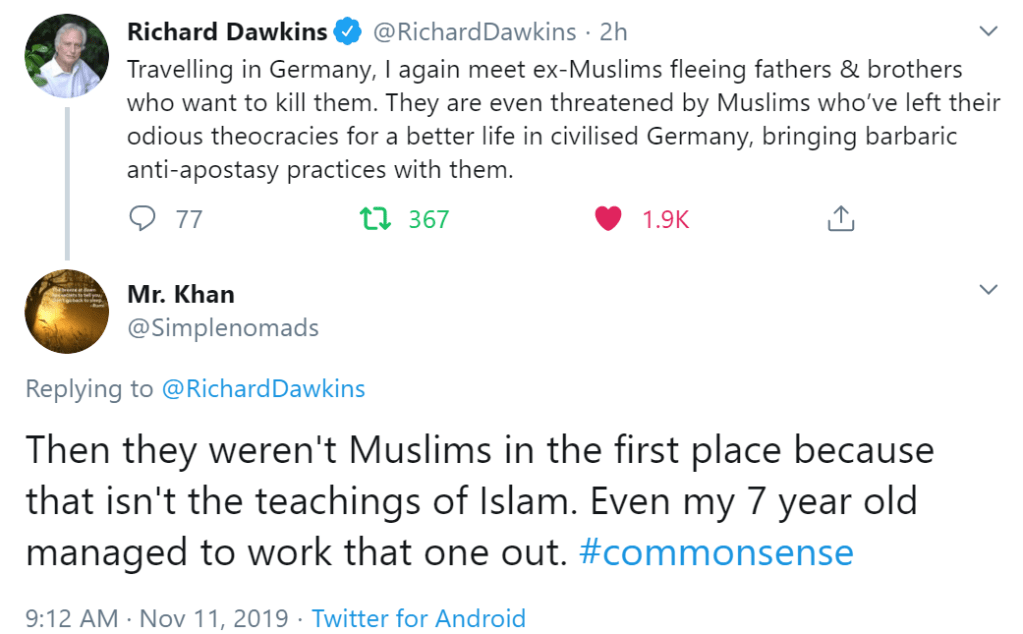
First, Dawkins, one of the people I follow, had a tweet at the top of my feed, and the very first reply …

This seems like a reasonable response …

And, in turn, we have the usual nonsense …

Let that sink in …

“Not minimising anything. Just pointing out that any sane, moral, rightminded, peaceful individual can recognise …”

So, why do sane, moral, rightminded, peaceful individuals need Islam?

“The punishment for blasphemy in Islam is not death.”

Maybe not in YOUR version of Islam. But you know it is in some versions … which sort of makes a mockery of ‘one true Islam’, or any claims by ANY Muslim to understand Islam, when clearly, different Muslims have different understandings of Islam.

The One True Islam Embarrassment

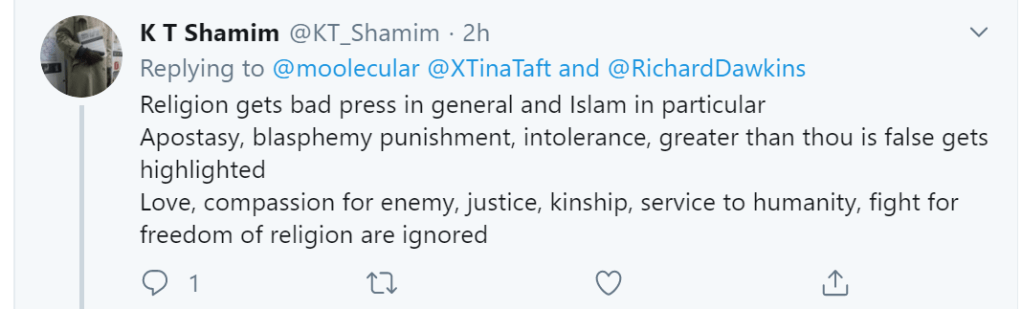
K T Shamim’s bio reveals he’s an Ahmaddi Muslim … not allowed to call themselves Muslims in Pakistan, opposed by many other Muslims. But still, he thinks he knows the one true Islam.

“The true religion [Ahmadis claim there’s is the one true Islam] …. Don’t know which Islam these Muslims follow …”

 So, there are multiple Islams? But how does K T know that his is the true one, and not the Islam of ISIS?

Hold on! It’s all very nice that K T likes the love and peace Islam, but how does he know that’s the right one? How come punishment and intolerance aren’t the one true Islam? Or why not both?

Really, why not both the peach and love AND the punishment and intolerance? Why are the nice verses taken literally and the nasty verses require excuses?

It’s not like I’m advocating this all inclusive Islam as system to follow. My point is, why can’t you just do peace and love WITHOUT Islam? Why stick with and try to live a system in which so many declare the Quran inerrant and have to go to all this trouble to defend it … and let’s be honest … to LIE for Islam, to escape its violent nasty clutches.

Killers for Religion and Atheism?

So, an atheist kills a bunch of religious people, and the religious can now cite an example that shows that their religion isn’t that bad after all.

Not so fast.

Atheism vs Theism

Both Atheism and Theism are simply opposing philosophical positions. Any other system’s metaphysical philosophy is ‘atheistic’ if it rejects theism.

A particular theism might be vary vague – “I believe there is one, and possibly more gods, but I don’t know whether any of the religions are true …”.

Or it might be specific yet still ‘other worldly’ – “I believe that there must have been a creator god, but I have no idea what he intends for us, and I offer no moral guidance based on my belief that there is a god.”

Or it might be committed to the variable claims about the god or gods of a particular religion, which may have many sects.

Atheism is pretty much opposition to these sorts of theism, usually on the grounds that there is no evidence or reason to believe specific claims, or support the level of hopefulness that the ‘spiritual’ seem to be clinging onto. In this respect Atheism is a negative position: it simply rejects the claim that there are gods.

Note that Atheism does not assert that there are definitely no gods.

Some atheists might assert that there are absolutely no gods, but that isn’t much better than asserting absolutely that there are gods. You might call such an atheism a ‘faith’ based atheism. But if you take the trouble to pin atheists down they generally agree that they do not hold such a strong opinion, but merely act as if they do because that’s often easier to express.

But this acting as if there are no gods is a fair position to take. Christians act as if there are no Norse gods. They act as if there are no fairies or Santa. (Note that playing along with such fantasies for the fun they provide for children isn’t acting with true belief.)

Religions

Religions are a subset of Theism …

Atheism-Theism-Religion

[Agnostics may not deny the existence of god, but they don’t positively assert there are gods either.]

Religions take the basic philosophical position of theism, thinking there are some teleological entities that created our universe, and add many more specific claims:

  • Our god is the only god.
  • Our god cares about us.
  • Our god dictates our moral codes.
  • Our god wants us to punish people that don’t follow his codes.
  • Our god wants us to punish people that don’t believe in him.
  • Our god doesn’t want us to eat pig meat and thinks it a moral obligation that we don’t.
  • Our god wants us to punish people that have sex outside the specific type of union sanctioned by our god (monogamy for Christians, up to four wives, but one husband for Muslims)
  • Our god will not remarry divorcees – old school Catholic; god changes his mind sometimes; he’s fickle; or humans decide he changed his mind.

Most religious people are born into, indoctrinated into, their religion. And the religion may provide many social benefits if it’s a large religious community.

But there can also be great costs for those that simply cannot continue to believe. In some more fundamentalist communities, ex-believers can be ostracised, might suffer social and economic hardship if rejected by the community, and might even risk death. If the religion prescribes death for apostates, as is the case for Islam, then even if the religion isn’t the state authority, believers are easily persuaded to take it upon themselves.

The list of additional beliefs on top of basic theism, including the many moral prescriptions and proscriptions, is long. It depends on the religion, the sect within the religion, and the personal willingness of individuals to follow the rules of the religion.

This becomes a little tricky for the religious that try to divert criticism away from their religion, when opinions differ so widely within:

  • God changes his mind often, it seems, judging by how religious opinions change.
  • Individuals make up their own minds what they take from their religion … you’d think the religious would therefore appreciate how atheists make up their own minds about morality.
  • The greatest opponents to a particular religious believer’s views are … other religious people. Islamic terrorism? Many victims are other Muslims, for being the wrong type of Muslim.

The variety of religious belief is often greater than the difference between Atheism and a particular Religion. Modern Anglicans that accept secular liberal democracy, have no problem with homosexuality, even in the church, are for full gender equality, and gender identity. They have much more in common with the social and political leanings of many atheists, than with even their fundamentalist Christian brethren, let alone than with people of other faiths.

And yet, the religious stick together. It only takes the whiff of an atheist with a strong opinion for the ‘interfaith’ community to band together in offended outrage. And let anyone speak out about the Islam of the Islamic extremists and even moderate Muslims will come to Islam’s defence as much as agree with an atheist that there might be a problem with the religion.

[Update 5/12/2017] There was greater outrage that Trump retweeted a lead figure one of Britain First’s outspoken anti-Islam activists than at the content of the videos the activist posted. One was ‘fake news’, but the other two were of Muslims persecuting others. Despite the acts of the Muslims, this was actually seen as anti-Muslim bigotry. Take a moment. Here’s the upshot: every tweet condemning German neo-Nazis is anti-German bigotry; every tweet showing and condemning videos of Britain First are anti-British bigotry, and by extension, anti-Muslim bigotry, since, as  is belaboured painfully, British Muslims are British. This is the state of play in 2017, where any criticism of Islam is interpreted as ‘Islamophobia’, ‘anti-Muslim bigotry’ … and yes, ‘racism’.

Political Ideologies of Hitler, Stalin, Mao, …

Whenever an atheist argues with Christians or Muslims, it’s not long before we get the Hitler, Stalin, Fascism, Nazism, Communism line thrown at us. And no matter how often it’s pointed out that this isn’t a valid argument, it still keeps on coming up. Often from the same people that have had this pointed out before.

Political ideologies can of course cross boundaries of Atheism-Theism. Christians can be socialists. In the 70s it was quite common for Islamists to lean towards socialism … maybe they hadn’t realised how far right Islam really is … or maybe they had.

And, Hitler was not an atheist. He might not have favoured the established churches that opposed his thugs, but that doesn’t mean he wasn’t religious. Many Nazi ideas were based on the old Teutonic ideals of religiously motivated knights.

Communism? Don’t think that political ideology stops you believing in a personal god … it just becomes less convenient and maybe a little dangerous to admit to one, but Communism does not preclude theism.

These political ideologies tell us little about the wide variety of atheists. The Atheism that some political ideologies might embrace informs the ideology with nothing other than the fact that there is no evidence for any god.

Religious Political Ideologies

Some political ideologies are religious ones.

And most religious ideologies are political – they are inherently so because they dictate the behaviours of people, and that’s a very political thing to do. And they usually have a lot to say on social issues … not all good. Homophobia, sex outside marriage, modesty, … religions can be obsessed with sex, particularly with regard to women, and if feminism isn’t a political matter I’m not sure what is.

It is possible to believe in a religion and treat it as an entirely personal belief system that determines how you live your own life, without you making any claims about what it implies for anyone else.

But this is rare. Most religions, and especially religious organisations, are very keen on telling: religious believers how they should act; non-believers that they are anything from misguided to evil; the religious what they should do to the non-believers: killing apostates, bombing abortion clinics, punishing people for blasphemy (the modern version is imprisoning people for ‘hate speech’).

Christianity, as supposedly expressed by Jesus, is a “render unto Caesar” kind of religion – a reasonable basis of separation of church and state. However, the Catholic church in Rome put a swift stop to that. Christianity, especially through many bishops and popes, made state business very much church business. The US continues this tradition by distorting the intentions of the founding fathers and making it the godly nation the founding fathers tried to avoid – they’d seen enough of that in Europe.

Islam is very specifically, inherently, by design, a political ideology. Only Muslims can hold certain offices of state. Muslims and non-Muslims are taxed differently.

Many Muslims will try to pull a fast one by telling you that Islam insists that Muslims follow the laws of the the land in which they find themselves … where Muslims are a minority that does not hold power. But Islam also requires Muslims to spread Islam … which means it would eventually become a majority. This is why many opponents of Islam also oppose too much immigration from Muslim countries.

Of course many Muslims don’t want a dominant Islam any more than non-Muslims do. Many escape the domination of Islam of their homelands, and are quite happy to live in secular democracies where they can practice their religion in peace.

But then we also see a lot of duplicitous language from supposedly ‘moderate’ Muslims that think homosexuality should be illegal, and make excuses for their more extreme brothers and sisters (“Nothing to do with Islam”).

In Europe the atheists and secularists have been opposing the power of the church for centuries, letting the humanistic principles take precedence. There’s still plenty of religious protectionism that goes on – a refusal to give up the reigns of power, as diminished as they are. Why the heck do Bishops get seats in the UK House of Lords – and why is there even such an unelected house still?

But I’ve seen and heard much more of the stranglehold religion has in some parts of the US, where the mark of a good plumber is whether he’s a good Christian or not. “In God We Trust” – indeed they do.

So, religions are political, and as such are as fair game for criticism and ridicule as any non-religious political ideology.

And being offended when religions are criticised is just one more political tool the religious try to pull. It may be a genuine feeling, and so they try to give it moral weight. Hence, critics of Islam are labelled haters of Muslims.

But, realising that atheists tend not to be impressed by the special pleading for the religion, that atheists aren’t taken in by the piety, the hurt feelings, what are the religious to do? Compare their religion to atheism? They can’t. They are not comparable.

Humanism

So, religious friends, you can’t really compare Atheism with your religion.

You can compare Atheism with Theism, if you’re talking only about the philosophy, reason, evidence, to support either case.

But you can’t compare Atheism as such with Christianity or Islam. Yes, I know that atheists argue against Christianity and Islam, but they do so on two quite separate grounds:

1 – A disagreement with the underlying theistic claims of your religion. If your religion relies on a claim that there is one or more gods, and there isn’t, then 2 is irrelevant. But, we humour you anyway and so …

2 – A disagreement with the moral assertions that you think your imaginary god has prescribed. It’s not like we disagree with all your moral positions, we just hold those we agree on for different reasons, for which we don’t need an imaginary god. But those Humanist atheists also find many of the moral guides of religion to be immoral, barbaric at times, and remnants of ancient codes of conduct prescribed at the time of the religion’s inception.

The thing is, Atheism prescribes no moral position whatsoever. It really is merely the rejection of your unsubstantiated claims about your god.

And this, of course, leads to another failure to understand atheism: “Atheists have no morals. They are nihilists.” Not so.

We have morals. We just don’t think some imaginary friend dictates them; and we very specifically reject many of the immoral codes that gods supposedly do dictate.

But you’re nearly right. it’s not our atheism that determines our morals, it’s something else.

Many atheists find other reasons for their morality – many simply acknowledging that harming others isn’t nice. People and animals don’t like to suffer harm, so we prefer to minimise that. It seems a very simple idea, but it’s amazing how far you can go with just that basic starting point. And it also avoids the need to punish people for daft reasons – such as for having sex outside marriage, for not being heterosexual, for drinking, for working on the Sabbath.

[In the UK the Shops Bill 1986 was defeated; the Sunday Trading Act 1994 eventually introduced limited Sunday trading … so strong was Christianity’s hold over British life. Now we’re finding we have to start again, with Islam.]

Many atheists want to live by their own moral ideals, and many collect these ideas about living a moral life into a set of codes. It’s not that these codes are necessary, but they are helpful in declaring some minimal set of behaviours we agree to abide by.

And one example of such a guide is the Humanist Manifesto. Take a look at it. You’ll find no diktats about women being lesser than men, or how to deal with the evil of homosexuality, or what the best way is to kill apostates. Humanists don’t have to look for ‘nuance’ and ‘scholarship’ to explain away inconvenient passages ‘revealed’ through some desert warlord or hippy.

So, if you want to carry out any comparisons I’d suggest you try these:
– Atheism vs Theism
– Humansim vs Christianity, Islam, …

You might find that many atheists tell you they don’t belong to any Humanist organisation, because they would rather not belong to any group that sets their ethical standards for them, as they can figure it out for themselves. They have a point. We are free to decide our own moral codes, and put them to the test in our societies.

My personal subscription to Humanism is one of convenience, and support for many of the programs of Humanists UK (formerly British Humanist Association).

Other atheists might join other groups of common interest, such as the many secular and skeptical societies around the world. Ex-Muslims have a shared experience that brings them together in various groups – often with the added benefit of providing a safe community to those ex-Muslims that are still at risk from their families.

Let that sink in, and imagine a child of Humanists being ostracised, forced into marriage, threatened with death, killed. I don’t know of any such incident. Has one ever made the news?

The next time you’re arguing with atheists on Twitter, they are unlikely to be Nazis. So when you pull the “What about Hitler, Stalin ..” it’s a Straw Man. If you want to argue for your religion, why don’t you try coming up with good reasons for it, not excusing the bad stuff by dragging in some irrelevant comparison.

And for pities sake, give up on trying to defend the indefensible. Your religious texts are full of ancient stuff that really doesn’t stand up to our moral standards today. Some religious passages are outright contraventions of the human rights that most people would want to sign up to. Stop defending that crap with ‘nuance’ and ‘scholarship’ – it makes you look like damned fools that are fooling no one but themselves.

Atheist Terrorists

And that atheist killer you want to call a terrorist because you’re sick of hearing about Islamic terrorists? Could be they are genuinely crazy, or have some motive other than their hate for religion.

And even if they carried out the heinous act because they hate religion and religious believers, there’s no Atheist Bible, and nothing in the Humanist Manifesto to suggest they should … unlike your religious books. Not even The God Delusion, Letter to a Christian Nation, or any of the New Atheist books.

If some killers that are atheists really are killing for atheism, there’s nothing in atheism, or Humanism, that can be removed that would stop them. There are no doctrines we can reject. There’s no “Believers are children of Satan” sermons going on. Pointing out the problems with religion doesn’t automatically create Atheist Killers. Sadly it does all too often create killers of atheists.

But, hey, if someone has a terrorist agenda, against believers, for atheism, then pretty much all humanist atheists will oppose them. I’ll happily denounce any such terrorists. But I won’t be able to point to any atheist texts that has incited them. I can only point to Humanist texts that are very short and very explicit in their opposition to doing harm. There is no Humanist Prophet whose example I should follow that includes his beheading of enemies.

The Humanist Manifesto is so clear in rejecting doing harm to others there’s no way you can mistakenly or otherwise derive some crazy idea that it’s a good idea to kill believers.

This cannot be said of the books of Christianity and Islam. Alongside all the lovely stuff is some seriously dark and immoral doctrine.

Look, if you want to call some atheist killer an atheist terrorist, knock yourself out. Any disagreement from atheists will be on a technicality, not for some fear of having to explain away our inconvenient texts. Let me help you out with A Guide To Terrorists For Idiots.

You Should Read The Quran – Really? Why?

I’m often told, “You Should Read The Quran.” – Really? Why? Islamic specialism seems to presume I’d be enlightened by one particular holy text, but not by others.

I’m an atheist that doesn’t see any merit in holy books that claim to be inspired by or revealed by imaginary friends. I don’t swallow the presuppositional existence of a deity that such inspiration or revelation demands. There are just too many religions, and sects within religions, to make ANY of the claims credible – and there is NEVER any evidence to back up the claims.
Continue reading “You Should Read The Quran – Really? Why?”

Justin Welby’s Easter, Dishonest or Dumb?

Justin Welby, Dishonest or Dumb? At least the latter has no moral implication for him – he can’t help it.

The Archbishop of Canterbury’s Easter 2017 Sermon – Sunday 16th April 2017

Christian faith starts with One who literally (that misused word) rose from the dead.

So much for the hard work of all those sophisticated theologians (h/t Jerry Coyne) that have been trying to dissuade people from reading books like The God Delusion by Dawkins, “because nobody believes it that literally”.

Literal belief is literally real.

And the depths of irony in Welby’s ‘that misused word’ has my head spinning. Here’s a summary of Christian theology

Jesus literally rose from the dead … allegorically … such that there’s no actual evidence that he did … and no real requirement to provide evidence … except that if you have faith, and believe it, it will be literally true …

And so the nonsense goes on like the endless Easter parades I used to watch as countless churches gathered and marched to bands.

Laid stone cold dead in Joseph’s tomb on Friday, on Sunday morning the tomb is empty, he is physically, bodily, tangibly alive. Why would we presume to know better than these first witnesses what took place?

Let me see …. because there were no witnesses? Because there is no evidence of witness to the death let alone any resurrection? Because a fourth century Emperor got tired of all the conflicting stories and with a bit of arguing and a game of eenie-meanie-miny-mo (there’s as much evidence of that as there is of the resurrection) chose which fairy tales would make the least implausible gospels?

Welby knows damned well how flaky Christian history is. He knows damned well that none of the gospels represent a true interpretation of what little biblical ‘original sources’ exist.

It happened: the witnesses are those who met him. Today the calling of every Christian is to be a witness to the Resurrection.

Let that sink in. “Today the calling of every Christian is to be a witness to the Resurrection” As much a ‘literally happened’ witness as any original person that happened to live around the time Jesus is supposed to have died and been resurrected … by himself.

How do you do that, resurrect yourself, when you’re dead without not really being dead, as in dead dead, not an undeadable deity pretending to be dead? God did it? But Jesus IS God? Miracle! Maybe Harry Potter is literally true by the same sort of miracle.

The idiocy of Christian belief is palpable – and a damned sight more literal than the theological nonsense.

In our reading from Acts, Peter speaks of events that are only a couple of years in the past … It was a testimony easily checked, easily dismissed.

No it is not easily checked. This is an utter lie. There is no way to check that. Even if there were multiple records that were used as evidence that Peter actually said what he is supposed to have said, that would be no verification whatsoever that what he said was true – it would be hearsay, nothing more. Likewise Josephus, that supposed ‘witness’ to Christian truths that merely told us what Christians were telling someone else. Hearsay!

We are used to facts being contested. We are even used to facts being reduced to the level of opinion. So individualised are our news cycles that our opinions are in themselves the only facts that seem to count. However, what brings the faithful out to worship in Tanta and Alexandria is truth. It happened. The resurrection is an event which – although never experienced before or since – changes everything because it happened.

This is an unbelievably stupid thing to say. It happened because Welby and a bunch of other gullible or dishonest people proclaim that it did. He has nothing else.

Events claimed to be fact are reduced to opinion when there is no evidence to support the claim that the events took place. Just as in the case of the resurrection, or the cruciFICTION, or most other stories about Jesus. So many are so obviously trumped up they out-trump Trump.

You know what this bit is …?

However, what brings the faithful out to worship in Tanta and Alexandria is truth. It happened.

That’s an infant mind throwing it’s toys and stamping its feet because it can’t have its own way. That’s all that is. It really is that childish a statement, especially in the context of the paragraph as a whole.


We atheists often point out how Islamism, the politicised Islam, is actually plain old Islam, because Islam is a political religion. But next we have Welby making the political claim for Christianity:

Yet it was not on the lists of important dates for me to learn at school. It is not in the politics text books, although it defines the aims and ends of politics. It is not in the economics lessons, although economics is transformed by it. It is not in the geography courses, although human geography was changed more by this than any event that has ever happened. It is not on courses at military academies, although war and peace are judged by it.

He’ll be asking to ‘teach the controversy’ of of Design over Evolution next, the dimwit.

Bear that in mind when political leaders that are religious tell you they are ‘informed’ by their religion but don’t let it interfere with their politics. Looking at you, Tim Farron, my dear leader of the Liberal Democrats. [I may be a bit harsh on poor old Tim, but I’d rather keep imaginary friends right out of politics.]

And talking of political Islam, here’s Welby’s back stabbing ode to it … inter-faith respect, my arse.

The greatest mystery is that the greatest event went almost unnoticed and spread to conquer the known world without drawing a sword, without taking a life, winning an election or starting a campaign.

Welby headed his sermon with references to St George’s church Tanta and St Mark’s church Alexandria, sites of Islamist killing of Christians. No such barbarity from Christianity! … except …

Actually, it’s no mystery that the ‘greatest event’ went almost unnoticed. It didn’t happen. And neither is it a mystery that it ‘spread to conquer the known world without drawing a sword’, because of course swords were well and truly drawn in its spread, from the early Roman emperors converted to Christianity, through warring popes and kings and queens, and on through the western empires that that forced Christianity on the wider world. A bit like Islam really, just better at it … so far. Heads up!

At the resurrection the world did not merely shift, a new world emerged in embryo …

Funny that nobody noticed until many years later, with many twists to the tales. Just like a myth, really.

Consider the women; they thought death ruled, that despair had conquered, that stones could not be moved. They were wrong on everything. Death was conquered, despair fled, the stone was rolled away.

This is what the religious do. They feign doubt, talk about opinions, present objections as if unimportant, … and then go right on an act as if it’s all totally documented, triple signed and on record, with photographic evidence that has passed umpteen tests for photoshop trickery true.

Because God acted and raised Jesus everything is different: we know the truth about God, through the resurrection.

Stupid, stupid, stupid. Did I say stupid? This little circle is tighter than Jesus’s sphincter when the nails went in.

Look, you cannot have a supposed revelation (in a book, the word of a person, or the content of a myth) that claims to be the source of its own truth.

If  liar came up to you and said, “Hi, I tell the truth. I never lie.” And then a truthful person came up to you and said, “Hi, I tell the truth. I never lie.” How would you know which was telling the truth? How would you even know they were not actually both liars, if all you had to go on was that I told you one of them was telling the truth … you’d then be relying on me telling the truth too … and so it goes. This rhetoricaly BS from Welby is stupid … did I say that?

This is the holy book. Revealed by God. To the man. The man that is handing it to you now. A book in which it tells you that God is real, and that did the revealing, … a book that totally wasn’t made up by the man. … honest!

Stupid!

More on that topic … The Liar’s Holy Book – Your book, your god’s revelation, cannot contain the proof of the truth of its own claims. You have to presuppose a god that does the revealing; and a presupposition isn’t proof of anything, it’s you making shit up.

After a couple of paragraphs of more mumbo jumbo meaningless Alice in Wonderland prose, Welby comes up with this:

But be under no illusion, this is utterly counter to how the world runs itself, and so we live in the now of a world in which the resurrection has happened, and the not yet of a world where there is still evil.

Illusion? It’s not an illusion. It’s a fully fledged and taken flight of fantasy delusion.

But, the words Jesus says on that first Easter day he says to you and me now; ‘Do not be afraid’….

But of course there is no known record of Jesus having said anything.

There is only one finality: Jesus the crucified one is alive. … blah-dy-blah-dy-blah … joy and light in the face of suffering bullshit … blah-dy blah …  it happened, Jesus is alive.

“It’s True!”

Here’s Justin welby as a little girl explaining his theology:


Hope I’ve not hurt anyone’s feelings … except …

MeansSoMuch


Catlicks and Prodidogs


Religion’s sectarian influence pervades the minds of children and can persist into adulthood and on into politics, and on across generations.

Heather Hastie’s More Delusions About Religion looks at a news article that tries to distance religion from violence, by trying to convince us that the the Northern Irish Troubles were not about religion. That’s nonsense, and here’s why. Continue reading “Catlicks and Prodidogs”

Jew Hating Indoctrination of Children – Religiously Validated

Jew hating indoctrination of children in schools – all religiously validated, of course. That wouldn’t happen today. Would it? Even after this in the 1930’s …?

Already in grade school, we were told that the Jews were evil because they did not believe in Christ and that they were “Jesus killers. … One of my teachers was a member of the “Waffen SS” and I can remember when he came to school in uniform with the imprint on his belt buckle, “Gott ist mit uns” (God is with us). He was very strict and attendance of the Wednesday afternoon Hitler Youth meetings were just as important as school attendance.

Mmmmm. His dedication is a bit like praying five times a day.

What Made Me Turn To Atheism – Carl Zimmerling explained in his 2000 piece.

When the up-side to religion is that it is so God damned awful it can turn you to atheism.
Continue reading “Jew Hating Indoctrination of Children – Religiously Validated”

The Quran – Polysemous or Duplicitous?

I’d like to address the nonsense that is passed off as reasons for thinking the Quran is a fine book, that it represents a religion of peace, that it’s all for freeing slaves, that it represents liberating feminism (Linda Sarsour) … you know the typical lines.

As an example, I’ll use a recent comment made to excuse Islam and the Quran. I’ll use only the bits relevant to this post, and I’ll paraphrase it to make it readable, and the emphasis will be mine. You can see the full comment and the context here if you wish.

Continue reading “The Quran – Polysemous or Duplicitous?”

Those Spiteful Atheists

Some stupidity like this is doing the rounds:


1) Being an atheist is okay. Being an atheist and shaming religions and spirituality as silly and not real is not okay

2) Being a Christian is okay. Being homophobic, misogynistic, racist or otherwise hateful person in the name of Christianity is not okay

3) Being a reindeer is okay. Bullying and excluding another reindeer because it has a shiny red nose is not okay


Continue reading “Those Spiteful Atheists”

Another Empty Claim That ISIS ‘Warp’ The Religion

Paris attack: As a Muslim I’m disgusted how Isis can carry out this violence and claim to represent my faith – Miqdaad Versi

“I am equally if not more so angry that these people should do so through some misguided and warped grasp of my faith.”

Come on, Miqdaad, this is not convincing.
Continue reading “Another Empty Claim That ISIS ‘Warp’ The Religion”

Justin Welby Likes To Torture Sick People?

And here we go with another religious justification for torturing people, from Archbishop of Canterbury, Justin Welby.

Of course he doesn’t like to torture sick people, or to use his religious belief to justify such torture. I thought, well, if he’s prepared to use ridiculous rhetoric to make his case, I might too. But then I thought again, Continue reading “Justin Welby Likes To Torture Sick People?”